Risk Assessment, Safeguarding & Hazardous Energy
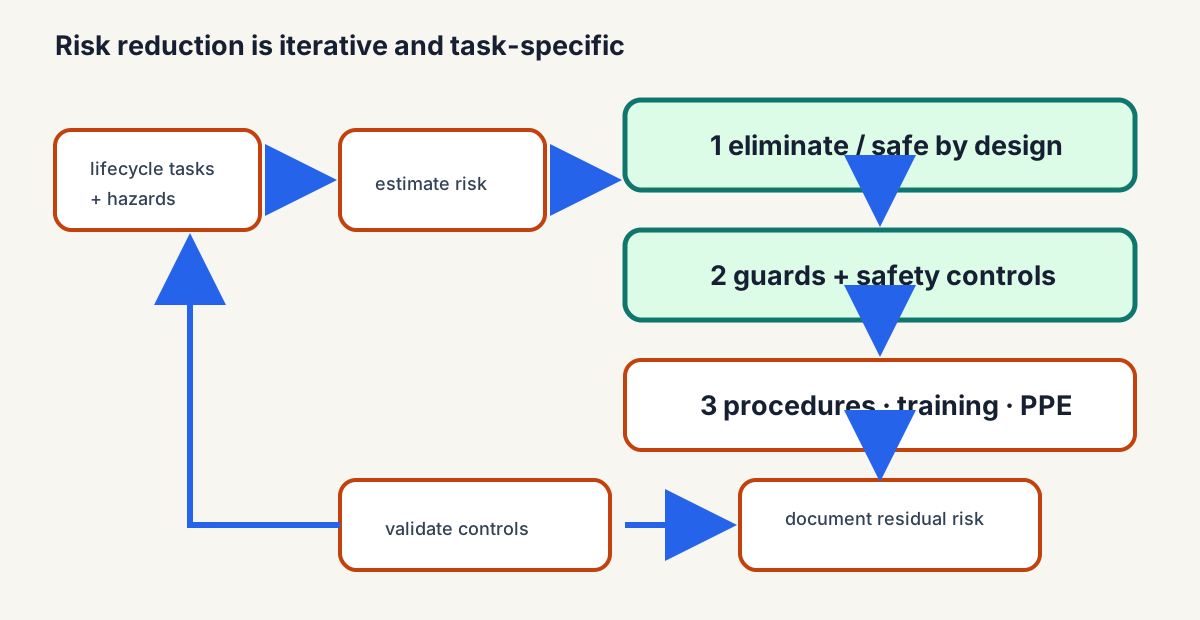
Making the palletizer cell safe for every task, not just production: listing tasks (running, pallet change, jam clearing, pattern teaching, maintenance), applying the hierarchy (design out the hazard, then guards and safety devices, then procedures), OSHA's robot safeguards and the four collaborative modes, and the lockout/tagout sequence for the cell's electrical, pneumatic, and gravity energy.
- 4 min
- 4 steps
- 3 questions
- Lesson 70 of 78
In this lesson
- List every task
- The hierarchy
- Collaborative cells
- Lockout/tagout
Picking up where you left off.
List every task
A robot cell isn’t dangerous only while it’s stacking. OSHA notes that studies in Sweden and Japan found many robot accidents happen during assembly, installation, programming, testing, and maintenance, when people are inside or near the robot’s space 1. So the risk assessment starts with a list of every task anyone will do, for the palletizer:
| Task | Who | Hazard |
|---|---|---|
| Normal running | nobody inside | none, if guarding works |
| Full pallet out, empty in | operator, forklift driver | robot moving into the pallet station |
| Clearing an infeed jam | operator | conveyor nip points, robot reaching for the case |
| Teaching a new pattern | technician | robot motion at close range |
| Replacing the gripper | mechanic | unexpected startup, stored air, a gripper falling |
| Cleaning | sanitation crew | water and chemicals near electrical parts; unexpected motion |
For each task, ask what could hurt someone, how badly, how often they’re exposed, and whether they could get out of the way.
Quick check
That’s why risk assessment covers every task.
The hierarchy
Reduce each risk in this order:
- Design it out. Put the infeed jam point outside the fence so nobody enters to clear it. Use two pallet stations, so the robot builds on one while the other is swapped, and it never needs to move into a station a person is in.
- Guards and safety devices. Fixed fencing, interlocked gates, light curtains at the pallet openings, area scanners.
- Procedures, training, PPE. Lockout, signs, training, gloves. Necessary, but each relies on people doing the right thing every time.
OSHA’s guidance describes the standard safeguards: fixed barriers that keep people out of the robot’s space, interlocked gates that stop the robot when opened, presence-sensing devices (light curtains, safety mats, scanners), and, in teach mode, a reduced speed of 250 mm/s (10 in/s) or less with a three-position enabling switch 1. ISO 10218-2 sets the requirements for the robot application and cell as a whole 2.
Quick check
Each step down the list relies more on people doing the right thing every time.
Collaborative cells
A cobot palletizer often uses area scanners instead of a full fence. OSHA describes four collaborative methods: a safety-rated monitored stop, hand guiding, speed and separation monitoring (slow as a person approaches, stop if they get close), and power and force limiting 1; ISO/TS 15066 gives the detailed requirements 3. For the palletizer, the case is the problem: a 20 kg box swung at speed is dangerous no matter how gentle the robot arm is, so speed and separation monitoring is the usual choice.
Lockout/tagout
OSHA’s lockout/tagout rule, 29 CFR 1910.147, covers servicing and maintenance where unexpected startup or released energy could hurt someone 4. The palletizer has several energy sources: electrical power to the robot and conveyors, compressed air to the vacuum gripper and pallet clamps, and gravity, since a gripper or a raised pallet lift can fall.
The sequence for the gripper change:
- Prepare: know every energy source (the cell’s written procedure lists them).
- Notify the operators.
- Shut down the cell normally.
- Isolate: open the main disconnect and close the air supply valve.
- Lock and tag each isolation point with the mechanic’s own lock.
- Release stored energy: bleed the air, block or lower anything that could fall.
- Verify: try to start the cell and check air gauges read zero before touching anything.
An emergency stop or a gate interlock isn’t a lockout; it can be reset by someone else.
Try it
Write the task-and-hazard table for the job you studied, and for the worst three hazards, write how you’d design it out, guard it, and then what procedure covers the rest.
Quick check
OSHA 1910.147 covers stored and residual energy, not just electricity.
Lesson complete
Nice work.
Sources for this lesson
- 1OSHA Technical Manual, Section IV, Chapter 4 - Industrial Robot Systems and Industrial Robot System Safety. Occupational Safety and Health Administration. 2021. verifiedRobot-system components, lifecycle hazards, risk assessment, safeguards, collaborative modes, training, evaluation, and applicable U.S. requirements.
- 2ISO 10218-2:2025 - Safety Requirements for Industrial Robot Applications and Robot Cells. International Organization for Standardization. 2025. verifiedCurrent requirements for integration, commissioning, operation, maintenance, decommissioning, and disposal of robot applications and cells. Cited at: scope.
- 3ISO/TS 15066:2016 - Collaborative Robots. International Organization for Standardization. 2016. verifiedCurrent technical specification supplementing industrial-robot safety requirements for collaborative applications and work environments.
- 429 CFR 1910.147 - The Control of Hazardous Energy (Lockout/Tagout). Occupational Safety and Health Administration. verifiedU.S. general-industry minimum performance requirements for controlling unexpected energization, startup, and release of stored energy during service and maintenance. Cited at: hazardous energy scope.