Requirements, Concept Selection & Early Economics
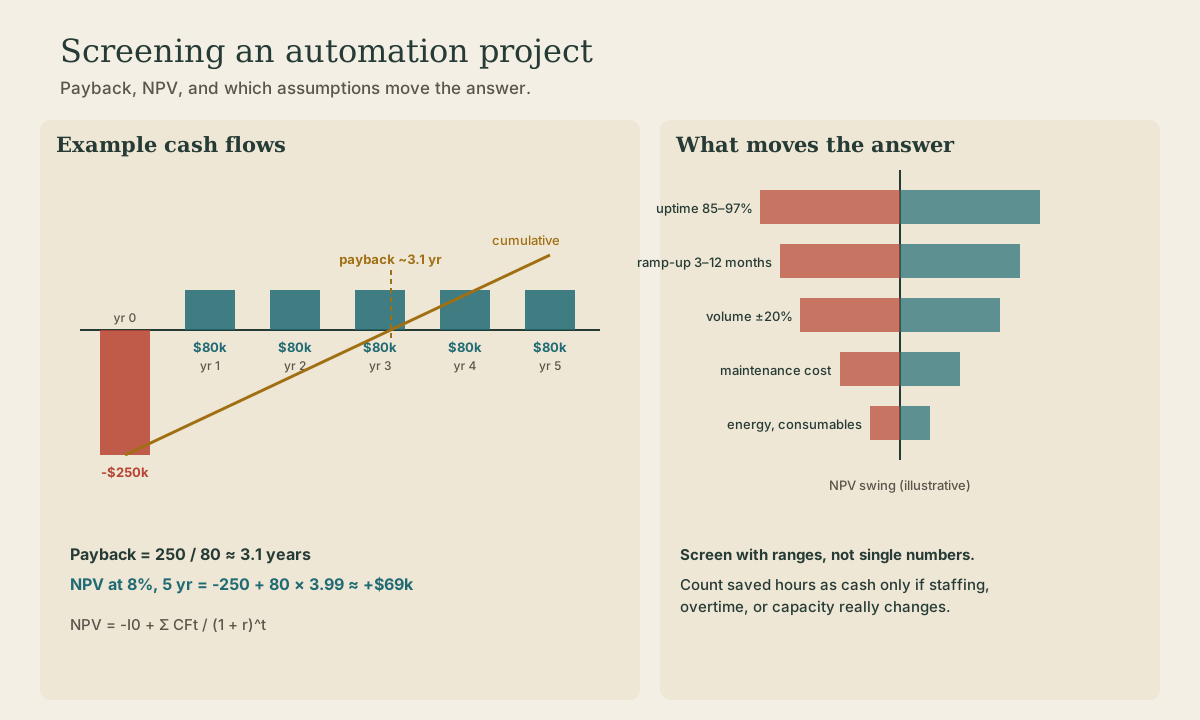
Turning the palletizing study into requirements a supplier can bid on (6 cases a minute, 44-pound cases, three pallet patterns, 15-minute changeover, works with the cardboard you actually buy), comparing four concepts from a lift table to a robot palletizer, and an early money screen: simple payback and five-year net present value worked for a $250,000 cell.
- 4 min
- 4 steps
- 3 questions
- Lesson 68 of 78
In this lesson
- Requirements with numbers
- Four concepts
- A first money screen
- Stage the uncertainty
Picking up where you left off.
Requirements with numbers
The study from the last lesson becomes a requirements list: what the system must do, written so a supplier can bid on it and you can test it.
| Requirement | Value | How it’s checked |
|---|---|---|
| Rate | 6 cases/min sustained, 8/min peak | 4-hour run at the end of the line |
| Case | 20 kg, three sizes, corrugated from two suppliers | run all six combinations |
| Patterns | A, B, C; 8 layers max; 2 m max height | build a full pallet of each |
| Changeover | ≤ 15 min between patterns, by an operator | timed by a trained operator |
| Mis-picks | ≤ 1 per 2,000 cases | count over the acceptance run |
| Ergonomics | no manual lift over waist height or below knee | observation |
| Space | fits the existing 6 × 8 m area; forklift access on one side | layout check |
| Recovery | a jam cleared in ≤ 5 min without entering the robot’s space while it’s powered | timed test |
Write what you need, not how to do it (“6 cases a minute,” not “a six-axis robot”), so suppliers can propose different solutions. And write the bad cases in: the crushed case, the late forklift, the second cardboard supplier.
Quick check
Every requirement needs a number and a way to check it.
Four concepts
| Concept | What it is | Fits | Weak spots |
|---|---|---|---|
| Lift table and turntable | pallet rises and turns so every lift is at waist height | removes the worst lifts | person still lifts 44 lb 6 times a minute |
| Vacuum lift assist | an overhead hoist with a suction pad | removes the weight | slower; operator still walks and turns |
| Collaborative-robot palletizer | a small robot, often with area scanners instead of a fence | moderate rates, small footprint | payload and speed limits near the 20 kg case |
| Industrial robot palletizer | fenced cell with infeed conveyor and pallet stations | full rate with margin | cost, floor space, guarding |
Score each against the requirements, not against how impressive it looks. Sometimes the lift table plus fixing the jams buys most of the benefit for a few percent of the cost, and the robot waits for the next capacity increase.
A first money screen
Before detailed quotes, a rough screen tells you whether to keep going. Suppose the industrial robot cell costs $250,000 installed and saves $80,000 a year in net cash (labor redeployed to other open jobs, overtime avoided, fewer injury claims, minus maintenance and power).
- Simple payback: 250,000 ÷ 80,000 = 3.1 years.
- Net present value at an 8 percent discount rate over 5 years: each year’s $80,000 is worth less the further out it is. The 5-year factor at 8 percent is 3.993, so NPV = 80,000 × 3.993 − 250,000 ≈ $69,000.
Positive NPV means the savings, valued in today’s dollars, beat the cost at that rate. Now vary the inputs: if the line runs fewer hours, if the ramp-up takes six months, if maintenance doubles. If one plausible bad case turns NPV negative, that’s what needs pinning down before you buy.
Quick check
250,000 ÷ 80,000 = 3.125 years.
Quick check
5-year annuity factor at 8% ≈ 3.993; 80,000 × 3.993 − 250,000 ≈ 69,400.
Stage the uncertainty
Big unknowns get tested cheaply first. Will the robot’s gripper handle the soft cardboard? Send the supplier 50 real cases for a gripper test. Will operators accept it? Put a lift table in now and learn how the pallets actually get built. NIST’s robotics work exists partly so buyers and integrators can agree on measurable performance before money changes hands 1.
Try it
Write eight requirements, with numbers and test methods, for automating the job you studied. Then do the payback and 5-year NPV at 8 percent for a concept that costs $120,000 and saves $35,000 a year.
Lesson complete
Nice work.
Sources for this lesson
- 1Robotic Systems for Smart Manufacturing Program. National Institute of Standards and Technology. verifiedMeasurement science, performance metrics, test methods, interoperability, planning, agility, and collaborative workcell integration. Cited at: requirements and validation.
Further reading
- Design and Manufacturing II. MIT OpenCourseWare. verifiedModern manufacturing organized around process physics, equipment and control, manufacturing systems, and design for manufacture.
- The Work of the Future - Building Better Jobs in an Age of Intelligent Machines. MIT Task Force on the Work of the Future. 2020. verifiedTask-level account of automation, new work creation, skills, technology diffusion, job quality, institutions, and shared prosperity.