Commissioning, Change, Maintenance & Governance
Bringing the palletizer into service and keeping it there: factory and site acceptance tests with real cases, a ramp plan with a daily review of stoppages, a preventive maintenance list (vacuum cups, filters, belts, safety device checks), management of change so nobody quietly edits a pattern or bypasses a light curtain, and who owns the cell after the integrator leaves.
- 4 min
- 5 steps
- 3 questions
- Lesson 72 of 78
In this lesson
- Acceptance tests
- Ramp-up
- Keeping it running
- Management of change
- Who owns it
Picking up where you left off.
Acceptance tests
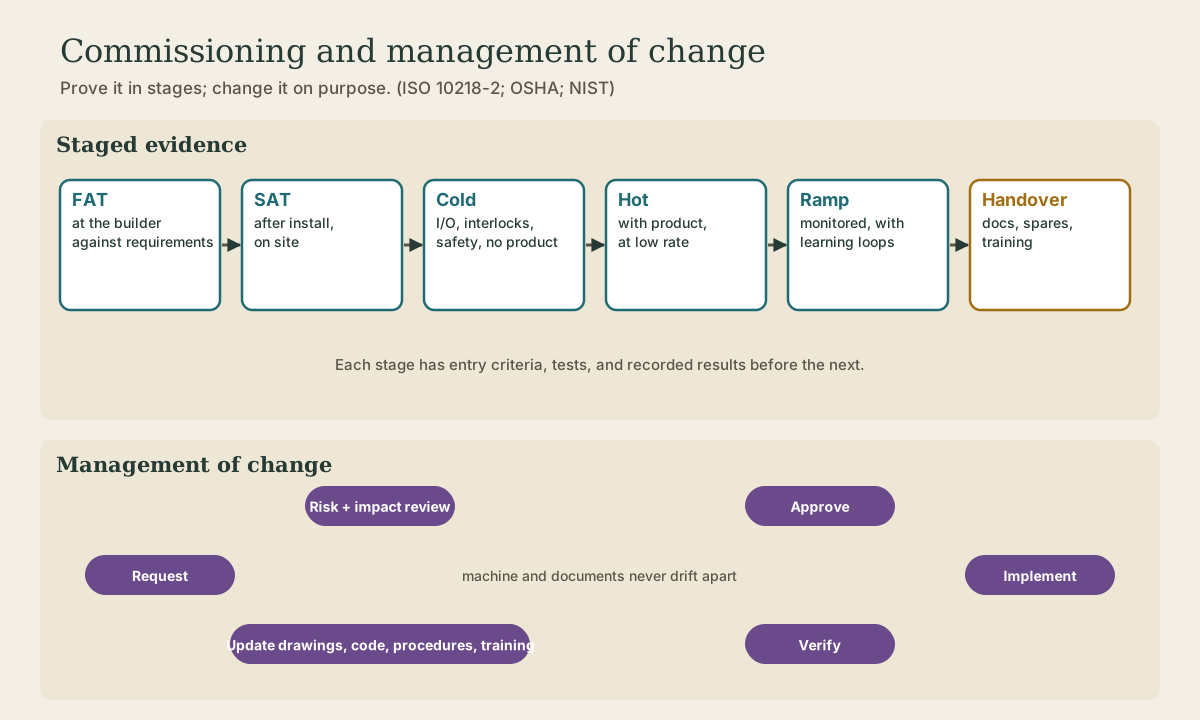
Factory acceptance (FAT) happens at the integrator’s shop before shipping. Bring real cases from both cardboard suppliers, every pallet pattern, and two operators. Run the requirements list: rate, mis-picks over a few thousand cases, a changeover timed by your operator, a jam cleared from outside the fence. Try the abnormal cases: a crushed case, an empty pallet station, power off mid-pallet. Write a punch list of everything that fails.
Site acceptance (SAT) happens after installation, in production: a multi-shift run at real rate with the plant’s people running it. The robot cell’s safety functions get validated in place, every gate, light curtain, and stop tested and recorded, as the standards for robot applications require 1 2.
Ramp-up
The first weeks find the problems the tests didn’t. Plan for it:
- A daily 15-minute review at the cell: every stoppage in the last 24 hours, its cause, and who owns the fix.
- A simple log by cause (mis-picks, infeed jams, pallet station faults), so the biggest category gets fixed first.
- The integrator on call, with a response time in the contract.
- Production targets that ramp up over a few weeks rather than full rate on day one.
Quick check
Ramp-up is where most of the remaining problems surface.
Keeping it running
A preventive maintenance list, built from the suppliers’ manuals and what ramp-up taught:
| Interval | Task |
|---|---|
| Daily | check vacuum cups for tears; wipe the camera lens; walk the fence |
| Weekly | drain air filters; check conveyor belt tracking |
| Monthly | functional test of light curtains, gate interlocks, and e-stops, recorded |
| Yearly | robot manufacturer’s service (grease, batteries for encoder memory); review the risk assessment |
Keep spare vacuum cups, a spare gripper, fuses, and a backup of every program on hand. Back up the robot and PLC programs after every approved change.
Quick check
Safety devices need periodic functional tests, not just production parts.
Management of change
Over time, someone will want to change something: a new case size, a faster speed to catch up on orders, a sensor that “keeps nuisance-tripping.” Every change goes through management of change: a written request, a review of what it affects (cycle, quality, and especially safety: faster motion means longer stopping distance), approval, testing, and updated programs, drawings, and procedures. NIST’s OT security guide treats change control on control systems as basic practice 3.
A bypassed light curtain or a jumpered gate switch is the classic failure. If a safety device trips too often, the fix is to find out why, not to defeat it.
Quick check
Speed changes can affect stopping distance and the safety assessment.
Who owns it
When the integrator leaves, name an owner for each piece: the robot programs and patterns, the PLC, the safety validation records, backups and passwords, spare parts, the maintenance schedule, and the monthly performance review. Without names, the cell slowly becomes a machine nobody understands. And keep the operators in the loop: the people who run it every day are the first to see what’s starting to go wrong, which is the point MIT’s task force makes about involving workers in how technology is used 4.
Try it
Write the FAT test list (at least ten tests, including five abnormal cases) and the monthly maintenance list for the concept you developed in this course.
Lesson complete
Nice work.
Sources for this lesson
- 1ISO 10218-2:2025 - Safety Requirements for Industrial Robot Applications and Robot Cells. International Organization for Standardization. 2025. verifiedCurrent requirements for integration, commissioning, operation, maintenance, decommissioning, and disposal of robot applications and cells. Cited at: scope.
- 2OSHA Technical Manual, Section IV, Chapter 4 - Industrial Robot Systems and Industrial Robot System Safety. Occupational Safety and Health Administration. 2021. verifiedRobot-system components, lifecycle hazards, risk assessment, safeguards, collaborative modes, training, evaluation, and applicable U.S. requirements.
- 3NIST SP 800-82 Rev. 3 - Guide to Operational Technology Security. National Institute of Standards and Technology. 2023. verifiedSecurity guidance for OT systems, including PLC, DCS, SCADA, physical-process interactions, reliability, performance, and safety constraints. Cited at: guidance.
- 4The Work of the Future - Building Better Jobs in an Age of Intelligent Machines. MIT Task Force on the Work of the Future. 2020. verifiedTask-level account of automation, new work creation, skills, technology diffusion, job quality, institutions, and shared prosperity. Cited at: task automation and new work.