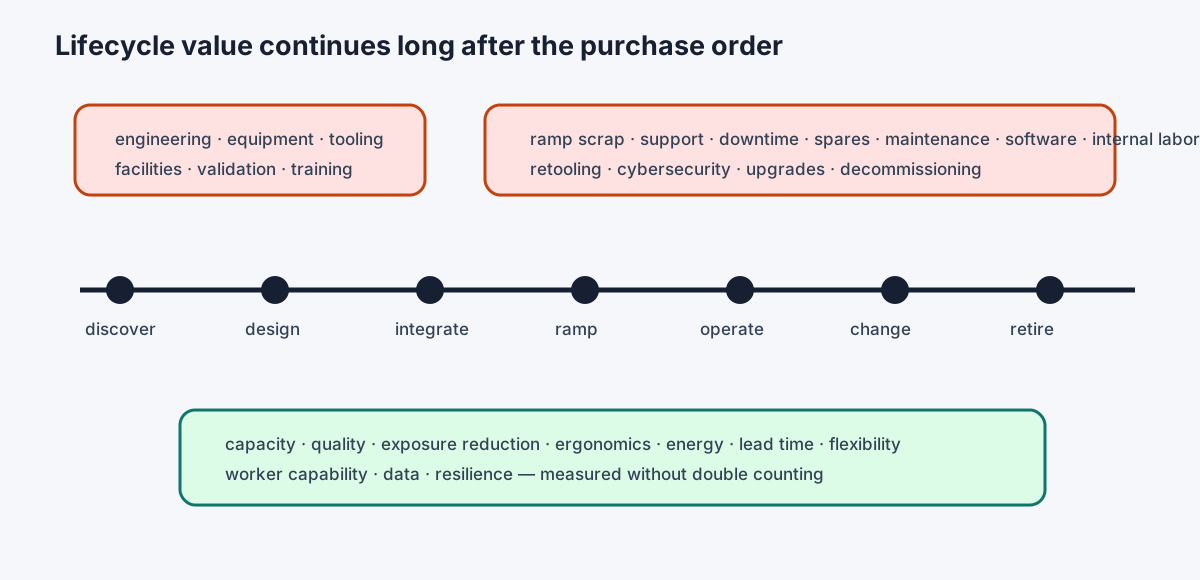
Lifecycle Business Case & Integration Contract
The palletizer's full five-year business case: every cost from engineering to spare parts, only the benefits the plant can actually collect, base and bad-case scenarios (the same $250,000 cell drops from about +$69,000 to negative NPV if savings fall to $55,000 and startup slips), and a contract that pays for a tested result: acceptance on the plant's real cases, ownership of programs and backups, and spares and support.
- 4 min
- 4 steps
- 3 questions
- Lesson 71 of 78
In this lesson
- Every cost
- Benefits you can collect
- Scenarios
- A contract for results
Picking up where you left off.
Every cost
A robot palletizer’s purchase price is only part of what it costs. For the $250,000 cell:
| Item | Cost |
|---|---|
| Robot, controller, gripper | $95,000 |
| Infeed conveyor, pallet stations | $45,000 |
| Fencing, gates, light curtains, safety controls | $28,000 |
| Engineering, programming, integration | $50,000 |
| Installation, electrical, air | $17,000 |
| Training, documentation | $5,000 |
| Lost production during the changeover week | $10,000 |
| Installed total | $250,000 |
Then yearly: maintenance and spare vacuum cups (about $5,000), power and air, software support, and a gripper rebuild every few years. At the end, decommissioning or redeploying the robot.
Quick check
The robot is often well under half the installed cost.
Benefits you can collect
List only benefits that turn into cash or something the plant actually values:
- Labor: the stacking position on two shifts. It only counts as savings if the people move to open jobs the plant would otherwise hire for, or overtime goes away.
- Injuries: back injury claims and lost time on that job, from the plant’s own records.
- Capacity: if the line can run faster because palletizing no longer limits it, and there’s demand for the extra product.
- Quality: fewer crushed cases from rough handling.
Don’t count the same benefit twice (“faster” and “more capacity” may be one thing), and keep risk reduction and strategic value as separate notes rather than padding the cash numbers. In the base case these come to $80,000 a year net.
Scenarios
The lesson-2 screen gave an NPV of about +$69,000 at 8 percent over 5 years. Now a bad case: savings are only $55,000 a year (one shift’s position wasn’t really freed), and startup problems mean year 1 delivers only half.
- Year 1: 27,500 × 0.926 = 25,500
- Years 2–5: 55,000 × (3.993 − 0.926) = 168,700
- NPV = 25,500 + 168,700 − 250,000 ≈ −$56,000
So the project lives or dies on two things: whether the labor savings are real, and how fast it ramps up. Those are what to nail down before signing, perhaps by phasing (lift table now, robot when the second shift is fully staffed).
Quick check
Year 1: 27,500 × 0.926; years 2–5: 55,000 × (3.993 − 0.926); minus 250,000.
A contract for results
The purchase contract with the integrator should buy a tested outcome, not a pile of equipment:
- Scope: exactly what’s included, down to who supplies the air drop and the network cable.
- Performance: the requirements table from lesson 2, with the test method for each.
- Factory acceptance (FAT) at the integrator’s shop with the plant’s own cases from both cardboard suppliers, and site acceptance (SAT) after installation: a multi-shift run with real production.
- Ownership: the plant gets the robot and PLC programs, passwords, backups, drawings, and the safety validation report. NIST’s OT security guidance stresses knowing and controlling the software and remote access on plant systems 1.
- Spares, training, warranty, response time for support calls.
- Payment tied to milestones, with a final share held until SAT passes.
Try it
Build the cost table and base and bad-case NPVs for a concept from the job you studied. Find the one input that, if it went wrong, would flip the decision.
Quick check
Pay for evidence, not a curated demonstration.
Lesson complete
Nice work.
Sources for this lesson
- 1NIST SP 800-82 Rev. 3 - Guide to Operational Technology Security. National Institute of Standards and Technology. 2023. verifiedSecurity guidance for OT systems, including PLC, DCS, SCADA, physical-process interactions, reliability, performance, and safety constraints. Cited at: guidance.
Further reading
- The Work of the Future - Building Better Jobs in an Age of Intelligent Machines. MIT Task Force on the Work of the Future. 2020. verifiedTask-level account of automation, new work creation, skills, technology diffusion, job quality, institutions, and shared prosperity.
- Robotic Systems for Smart Manufacturing Program. National Institute of Standards and Technology. verifiedMeasurement science, performance metrics, test methods, interoperability, planning, agility, and collaborative workcell integration.