Knives and Sharpening for Butchering
The few tools butchering needs and how to keep them working: sticking, skinning, and boning knives and a meat saw, grinding a bevel, honing without cutting yourself, steeling at 20 to 25 degrees, the thumbnail test, and safe habits at the block.
- 4 min
- 6 steps
- 3 questions
- Lesson 34 of 55
In this lesson
- The kit
- Three steps to an edge
- Testing the edge
- Safe habits at the block
- Try it
- What to take from this
Picking up where you left off.
The kit
The USDA farm bulletins keep the list short 1 2:
.jpg)
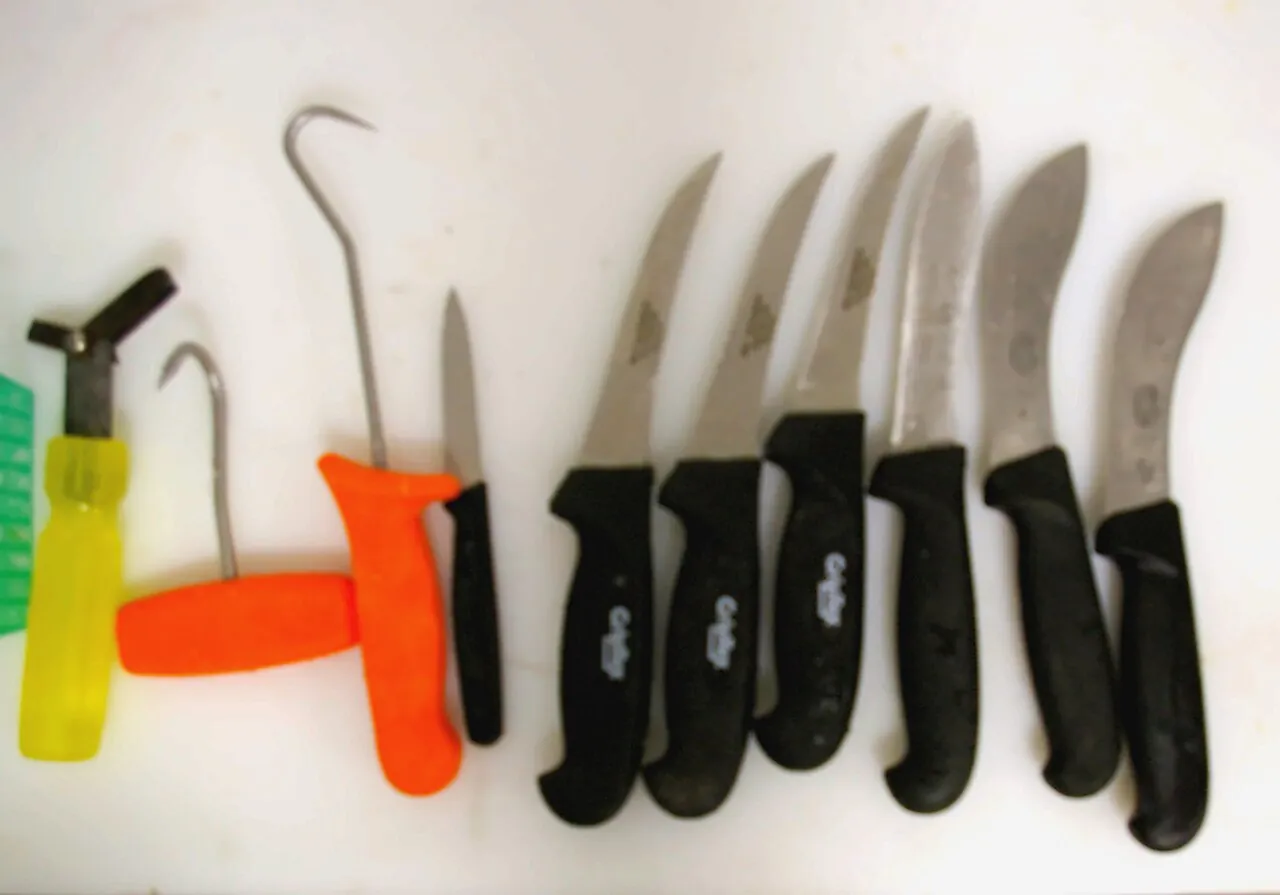
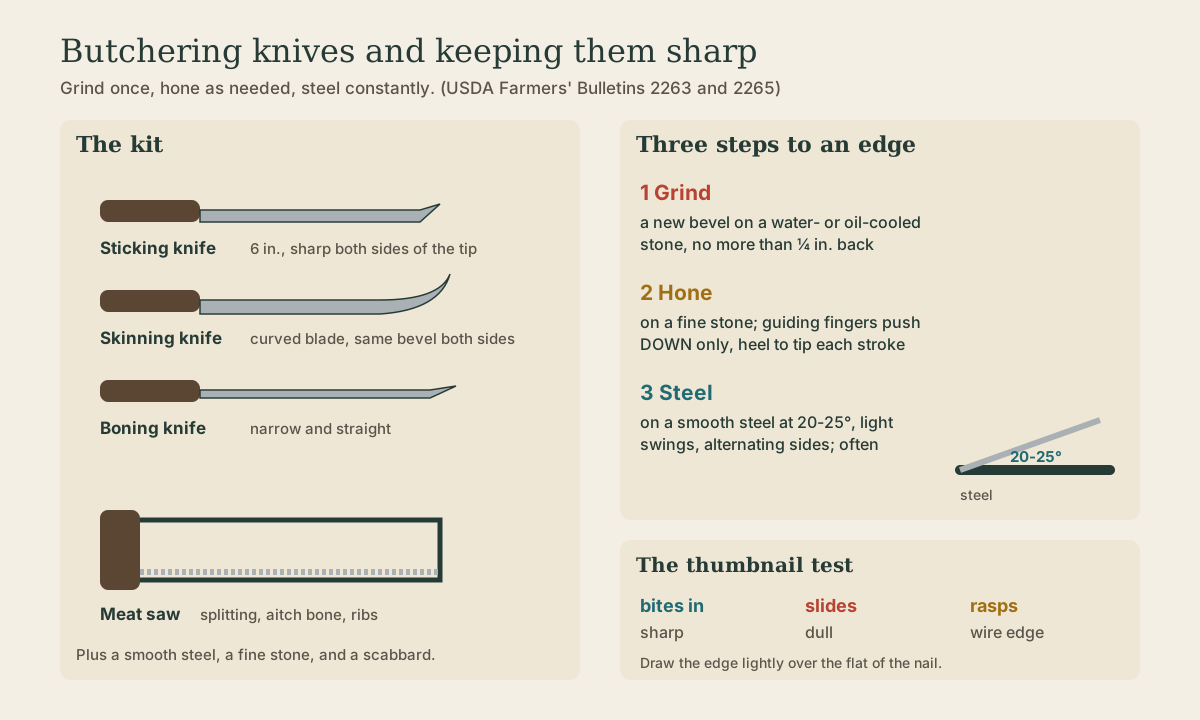
- Sticking knife: a 6-inch blade sharpened on both sides of the tip, for bleeding 1. A boning or skinning knife works in a pinch.
- Skinning knife: a curved blade, with the bevel the same on both sides so it can be used in either hand while siding a beef 2.
- Boning knife: narrow and straight, for breaking down cuts.
- Steak knife for slicing steaks and chops, and a meat saw for splitting carcasses, the aitch bone, and ribs 2.
- A smooth steel and a fine stone 2.
Keep the knives in a scabbard or rack, not loose in a bucket.
Three steps to an edge
The beef bulletin breaks sharpening into three operations 2:
- Grinding shapes the bevel. New knives often aren’t sharp enough to use. Grind on a water- or oil-cooled stone so the steel doesn’t overheat, holding the edge against the stone, and don’t grind back more than 1/4 inch from the edge.
- Honing sharpens the bevel on a fine carborundum stone set in a wooden block or on a damp cloth so it can’t slide. Tilt the blade so the bevel lies flat on the stone, rest the fingertips of the other hand on the flat of the blade, and sweep the whole edge across the stone from heel to tip. The guiding fingers push down only: if they push sideways and the knife catches, they slip off onto the edge 2. Repeat on the other side.
- Steeling keeps the edge between honings. For butchering, use a mirror-smooth steel; ribbed and carborundum steels are kitchen tools that actually hone. Hold the steel angled away from your body, put the heel of the blade against the tip of the steel at 20 to 25 degrees, and swing the whole blade down lightly toward your hand; then do the other side 2.
How often: a knife in heavy use needs steeling throughout the day and honing daily or at least weekly 2.
Playback is optional. If the player is unavailable, open the video at its source.
Quick check
USDA calls this very important for safety.
Quick check
Light, quick strokes, alternating sides, from heel to tip.
Testing the edge
Draw the edge lightly across the flat of your thumbnail 2:
- It bites in: sharp.
- It slides: dull; hone it.
- It rasps: there’s a rough wire edge (a burr); a few light strokes on the steel or fine stone take it off.
Quick check
Draw the edge lightly across the flat of the nail.
Safe habits at the block
- A sharp knife is safer than a dull one: it goes where you aim with less force.
- Cut away from yourself and from helpers, and keep the free hand behind the edge.
- When sticking or skinning, open the hide from the inside out with the blade turned up, which also keeps hair off the meat 1.
- Never try to catch a falling knife. Set knives down blade-in, and keep the work area clear of loose tools.
- Wash knives, steel, and saw with hot soapy water before and after, and rinse well 1.
Try it
Take your boning knife to a fine stone: hone until a slight burr forms along the whole edge on one side, flip and do the other, then finish with ten light alternating strokes on a smooth steel. Test on your thumbnail, then on a piece of paper held up by one corner. Note how many strokes it took, and steel it again halfway through your next butchering job.
What to take from this
Butchering needs a sticking knife, a skinning knife beveled the same on both sides, a boning knife, a meat saw, a smooth steel, and a fine stone. Grind a bevel on a cooled stone no more than 1/4 inch back, hone heel to tip with the guiding fingers pushing down only, and steel often at 20 to 25 degrees. A sharp edge bites into a thumbnail; a dull one slides; a wire edge rasps.
Lesson complete
Nice work.
Sources for this lesson
- 1H. Russell Cross. Pork Slaughtering, Cutting, Preserving, and Cooking on the Farm (Farmers' Bulletin 2265). U.S. Department of Agriculture (Project Gutenberg edition). 1978. verifiedIssued June 1978, revised 1981. Sausage from trimmings, more than 50 percent lean, 20-30 percent fat, ground through 1/2-in. then 1/8-in. plates, 2 lb salt, 6 oz pepper, 1-2 oz sage per 100 lb, seasoned sausage frozen no more than 2-3 months; dry cure 8-2-2 in three rubs, 36-42 F, bellies about 7 days per inch; sweet pickle cure 3-1/2 to 4 days per pound, ropy brine; soak 2 minutes per day in cure; smokehouse from a barrel and buried stovepipe; hardwoods only; ham and bacon smoking schedules; trichinae destroyed at 137 F or by specified freezing; lard rendering near 212 F and never above 255 F, leaf fat best, organ fat separately, no copper or brass, cool fast and stir to creamy.
- 2H. Russell Cross. Beef Slaughtering, Cutting, Preserving, and Cooking on the Farm (Farmers' Bulletin 2263). U.S. Department of Agriculture (Project Gutenberg edition). 1977. verifiedPen clean and dry, no feed 24 hours, water always; 1,000-1,200 lb steer or 900-1,000 lb heifer on full feed 150 days for Choice-like meat, under 17-18 months for tenderness; dressing about 60 percent, cutting loss 20-30 percent, rule of thumb one-quarter each waste, ground and stew, steaks, roasts; knife sharpening by grinding, honing, and steeling at 20-25 degrees, thumbnail test; stun with a .22 at the crossing of lines from poll to opposite eyes; bleed within 2 minutes; quarter between the last two ribs leaving one on the hindquarter; chill at 28-35 F, below 40 F, don't freeze the first day; age at least 2-3 days, no benefit beyond 7-9; forequarter separated between the sixth and seventh ribs for novices.