Off-Grid Power Basics
Sizing solar and batteries for a cabin, shop, or homestead off the grid: start with a load list (watts × hours ÷ 1,000 = kWh a day), then size the array from Wisconsin's real output (Madison arrays make about 1,300 kWh per kW per year, about 3.6 kWh per kW per day on average, far less in December), the battery for 1–3 days of autonomy, and the inverter for peak load and motor surges, with a generator for the dark weeks; and why a grid-tied system shuts off in an outage.
- 4 min
- 7 steps
- 3 questions
- Lesson 18 of 55
In this lesson
- Start with the load
- Array
- Battery
- Inverter
- Grid-tied versus off-grid
- Try it
Picking up where you left off.
Off-grid power means you are the utility: whatever you use, you have to make or store. The design is simple arithmetic, but it has to be done in the right order, starting with the load. The common mistake is buying panels first.
Start with the load
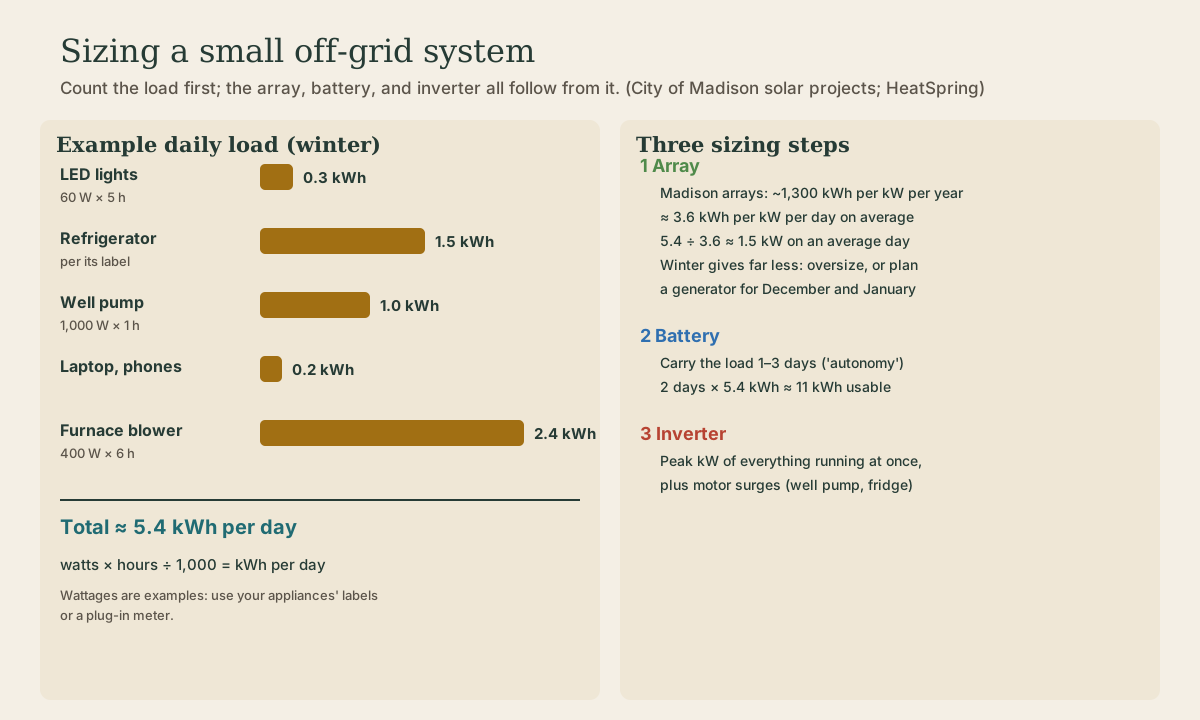
List everything that will run and how long. The arithmetic 1:

watts × hours per day ÷ 1,000 = kWh per day
Read the watts from each appliance’s label or measure it with a plug-in meter 1. An example for a small Wisconsin homestead in winter (your numbers will differ):
| Load | Use | kWh/day |
|---|---|---|
| LED lights | 60 W × 5 h | 0.3 |
| Refrigerator | from its EnergyGuide label | ~1.5 |
| Well pump | 1,000 W × 1 h | 1.0 |
| Laptop, phones | 0.2 | |
| Furnace blower | 400 W × 6 h | 2.4 |
| Total | ≈ 5.4 |
Two things jump out. Heat-related loads (blower motors, heat tape, a block heater) dominate the winter, and any resistance heater, whether a space heater, an electric water heater, or an electric range, would dwarf everything else. Off-grid homes heat and cook with wood, propane, or both. And the peak load, everything running at once, matters as much as the daily total 2.
Quick check
400 W × 6 h ÷ 1,000 = 2.4 kWh.
Array
How much a kW of panels makes in Wisconsin comes from real systems. The City of Madison’s 46 kW array at Fire Station 7 is estimated at 60,000 kWh a year, and its 24 kW array at the Streets Waste Transfer Station at 31,000 kWh 3. Both work out to about 1,300 kWh per kW per year, or about 3.6 kWh per kW per day on average.
So on an average day, 5.4 kWh ÷ 3.6 ≈ 1.5 kW of panels. But Wisconsin’s average hides the problem: December days are short, the sun is low, and snow sits on the panels. Off-grid designers either oversize the array so winter production still covers the load, or size for the average and pair it with a generator for the dark weeks 2. Account for losses too, such as wiring, dirty or snow-covered panels, and inverter efficiency, and design conservatively 2.
Battery
The battery bank has to carry the load through days without sun, typically 1 to 3 days, called days of autonomy 2. You can’t size it from the array; it has to cover the load 2. For the example, 2 days × 5.4 kWh ≈ 11 kWh of usable storage. Usable is the key word: depending on the battery chemistry, you may not be able to drain it all the way without shortening its life, so the nameplate capacity needs to be larger.
Quick check
You can’t size the battery from the array; it has to cover the load.
Inverter
The inverter turns battery DC into household AC. Size it for the peak load, the most kW running at the same moment 2, plus the starting surge of motors. A well pump or refrigerator compressor draws several times its running power for a moment as it starts, so the inverter has to ride through that without tripping.
Grid-tied versus off-grid
Most home solar is grid-tied: no batteries, and the inverter needs the grid’s signal to run. When the grid goes down, a grid-tied inverter shuts down too, so the panels can’t power the house in an outage 2. Getting backup power from solar means adding batteries and a battery-based inverter, which is the same design problem as off-grid, just smaller.
Quick check
Backup requires batteries and a battery-based inverter.
Try it
Write your own load list from appliance labels, or a week of readings from a plug-in meter on the big users. Total the winter kWh per day, then work out the array at 3.6 kWh per kW per day, the battery for two days, and the biggest load that could start while everything else is running.
Lesson complete
Nice work.
Sources for this lesson
- 1Estimating Appliance and Home Electronic Energy Use. U.S. Department of Energy, Energy Saver. verifiedDaily kWh = wattage x hours used per day / 1,000; annual kWh = daily kWh x days used; annual cost = annual kWh x rate. Wattage can be read from the appliance label or measured with a plug-in usage meter.
- 2Design Considerations When Sizing Grid-Tied Solar versus Off-Grid Solar. HeatSpring (Brit Heller, NABCEP PVIP). 2022. verifiedGrid-tied systems have no batteries and their inverters shut down when the grid is down; size is set by annual use, space, and budget. Off-grid sizing starts with a load analysis including peak demand in kW; PV production must exceed daily load; the battery bank carries the load typically 1 to 3 days ('days of autonomy'); the battery inverter is sized for peak load; seasonal sun-hour swings mean either oversizing or pairing with a generator; account for voltage drop, soiling, snow, and inverter losses and design conservatively.
- 3Solar Electric – Fire Station 07 & MPD West District; Solar PV – Streets Waste Transfer Station. City of Madison Engineering. verifiedA roughly 46 kW ground-mounted array at Madison Fire Station 7 is estimated to produce 60,000 kWh a year; a roughly 24 kW roof array at the Streets Waste Transfer Station about 31,000 kWh a year (https://www.cityofmadison.com/engineering/projects/solar-pv-streets-waste-transfer-station). Both work out to about 1,300 kWh per kW of panels per year in Madison.