Root Cellars and Cold Storage
Keeping the harvest alive through a Wisconsin winter: temperature, humidity, and ventilation; the four storage groups; curing potatoes, onions, and squash; packing roots in damp sand; a storage table by crop; and building a small cellar in a basement corner.
- 5 min
- 7 steps
- 3 questions
- Lesson 32 of 55
In this lesson
- Temperature, humidity, air
- Four groups
- Curing
- How long things keep
- A cellar in the basement
- Try it
- What to take from this
Picking up where you left off.
Temperature, humidity, air
Stored vegetables are still alive: they respire, slowly using up their stored food, and warmth speeds that up and costs quality. A root cellar slows it with three controls 1:

- Temperature: most vegetables keep best at 32 to 40 °F. Warm air rises, so the top of a cellar is warmest; put thermometers at a few heights.
- Humidity: most want 80 to 95 percent relative humidity so they don’t dry out. A dirt floor keeps it steady; on concrete or wood, set out pans of water. A small, full cellar stays more humid than a big, half-empty one, since vegetables are about 90 percent water.
- Ventilation: vents let out excess moisture and stale air, and they need screens against rodents.
Quick check
A dirt floor holds humidity naturally.
Four groups
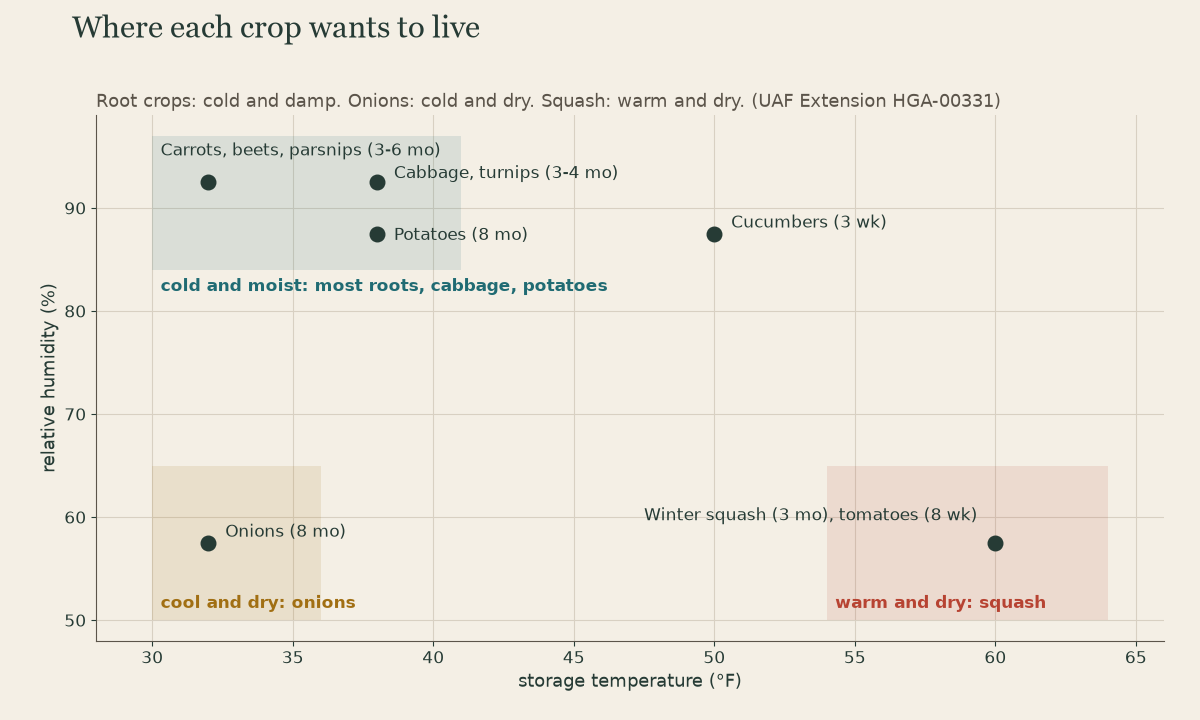
Alaska Extension sorts produce into four storage groups 1:
- Cold and very moist: thin-skinned roots and leafy crops: beets, carrots, parsnips, turnips, kohlrabi, radishes. Trim tops to a short stem and pack them in moist sand, sawdust, or peat, or perforated bags, to hold moisture.
- Cold and moist: potatoes.
- Cool and dry: onions (and garlic): papery skins, low humidity, good air.
- Warm and dry: winter squash and pumpkins, which mold in damp storage; a dry corner of a heated room suits them.
Strong-smelling crops like cabbage and turnips keep better wrapped individually in newspaper, which also limits odors 1.
Quick check
In moist storage, squash molds quickly.
Curing
- Potatoes: dig late, then hold them warm and dark for 7 to 10 days to dry and toughen their skins; then move them cold and dark. Stored together in crates, they share moisture and don’t shrivel. Keep them at or below 40 °F or they start to sprout 1.
- Onions: cure several weeks until the skins are papery and the roots shrivel; store braided or in mesh bags in cool, dry, moving air 1.
- Winter squash: cut before frost, leaving a 2-inch stem; the more mature, the thicker the skin and the better it keeps 1.
Harvest storage crops late, in the morning after the dew dries, and cool them right away 1.
Quick check
Then keep them cold and dark, at or below 40 °F, or they start sprouting.
How long things keep
From Alaska Extension’s table 1:
| Crop | °F | Humidity | Keeps |
|---|---|---|---|
| Carrots | 32 | 90-95% | 5 months |
| Parsnips | 32 | 90-95% | 6 months |
| Beets | 32 | 90-95% | 3 months |
| Cabbage | 38 | 90-95% | 4 months |
| Turnips | 38 | 90-95% | 3 months |
| Potatoes | 38 | 85-90% | 8 months |
| Onions | 32 | 55-60% | 8 months |
| Winter squash | 60 | 55-60% | 3 months |
Playback is optional. If the player is unavailable, open the video at its source.
A cellar in the basement
Alaska Extension’s guidance applies well to a Wisconsin house 1:
- Small is better: about 4 by 6 feet is enough for most families, and easier to keep cold and humid.
- Where: a walled-off corner of the basement with a window or vent to the outside for cold air and ventilation.
- Insulate the interior walls and ceiling that face the warm house, and put a vapor barrier on the cellar side of those walls to keep moisture out of the house framing. Leave the outside foundation walls uninsulated so the cold ground keeps the room cool.
- Watch it: thermometers high and low, a hygrometer, and in deep cold a little heat (Alaska suggests even a 100-watt bulb near the floor) to keep it above freezing.
In Wisconsin an unheated basement corner, an insulated bin in an attached garage, or a buried barrel or cooler in the garden (for roots only) are all workable small-scale versions.
Try it
Before harvest, put a thermometer and a cheap hygrometer in the coldest corner of the basement for a week in October. If it’s in the 35-45 °F range with high humidity, it’s a candidate: start with a bin of carrots in damp sand and a crate of cured potatoes.
What to take from this
Most roots keep at 32-40 °F and 80-95 percent humidity, with screened ventilation; a dirt floor or pans of water and a small, full room keep humidity up. Group crops: roots cold and very moist in damp sand; potatoes cold and moist after a 7-10 day warm cure, never above 40 °F; onions cool and dry after curing; squash warm and dry with 2-inch stems. A 4-by-6-foot insulated basement corner with an outside vent is enough for most households.
Lesson complete
Nice work.
Sources for this lesson
- 1Phillip Kaspari, Ray Morgan. Vegetable Storage in Root Cellars (HGA-00331). University of Alaska Fairbanks Cooperative Extension Service. 2020. verifiedMost vegetables keep best at 32-40 °F and 80-95% humidity; squash and onions want dry storage; a dirt floor or pans of water add humidity, and a full small cellar stays more humid; screened ventilation; four groups: cold and very moist, cold and moist, cool and dry, warm and dry; cure potatoes 7-10 days warm and dark, never store them above 40 °F; cure onions several weeks; squash warm and dry with 2-in. stems; 4 x 6 ft is enough for most families; storage table: carrots 32 °F, 90-95%, 5 months; potatoes 38 °F, 85-90%, 8 months; onions 32 °F, 55-60%, 8 months; squash 60 °F, 55-60%, 3 months; cabbage 38 °F, 90-95%, 4 months.