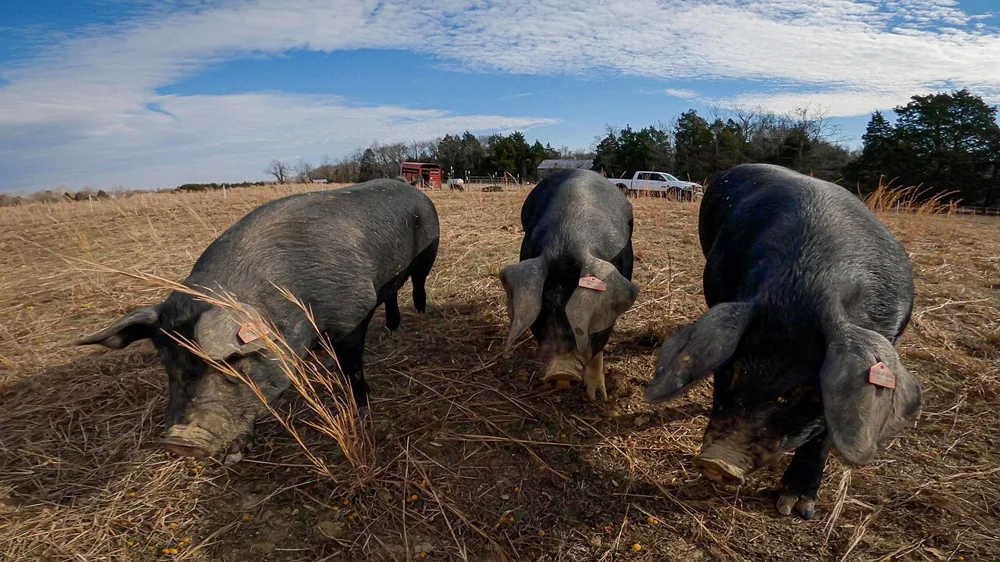
Pigs
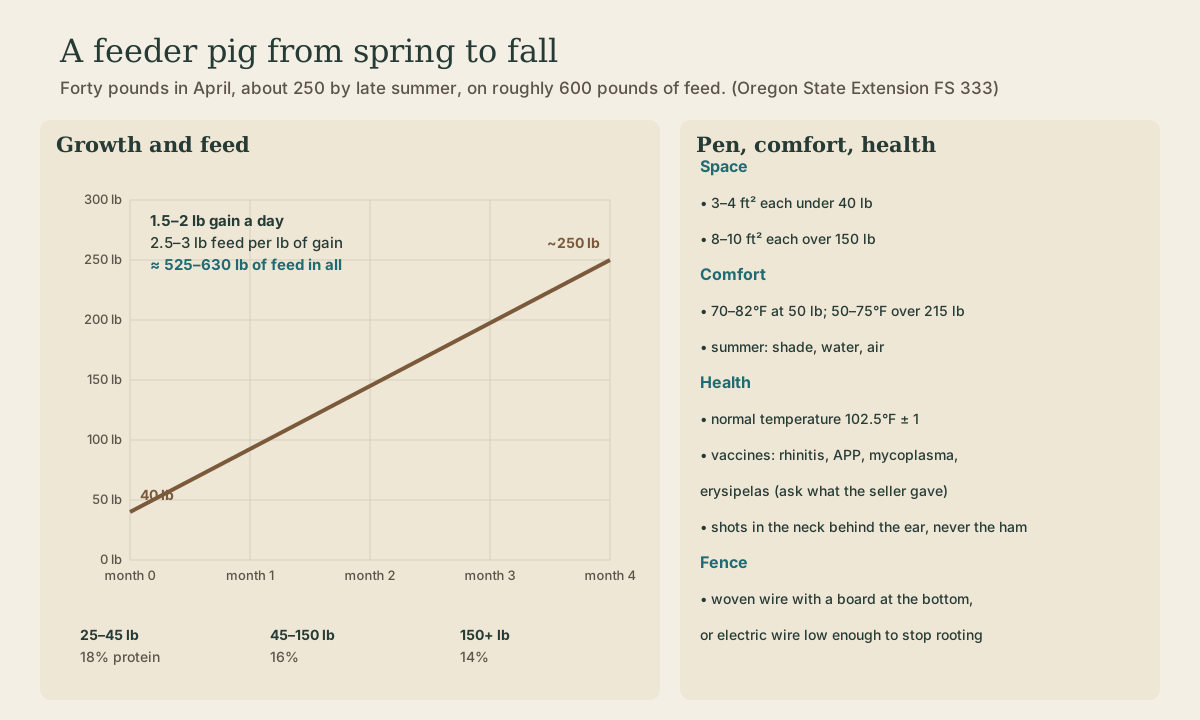
Raising feeder pigs for the freezer: buy 40-pound pigs in spring and raise them to about 250 pounds in roughly four months at 1.5–2 pounds of gain a day, on about 2.5–3 pounds of feed per pound of gain (525–630 pounds of feed each); step protein from 18% to 14% as they grow, keep fiber under 5%, give 3–4 square feet each when small and 8–10 when big, keep them warm in spring and cool in summer, vaccinate, and give shots in the neck, never the ham.
- 4 min
- 6 steps
- 3 questions
- Lesson 13 of 55
In this lesson
- The numbers
- Feed
- Pen and comfort
- Health
- Try it
Picking up where you left off.
Two feeder pigs bought in April will fill a freezer with pork by fall, and they’ll eat garden surplus, turn over a patch of ground, and generally be good company. The work is daily but simple: feed, water, a dry bed, a fence they respect. The biggest cost is feed, so it’s worth knowing the numbers before you start.
The numbers
Feeder pigs are usually bought weaned, at about 40 pounds, and raised to a market weight around 250 pounds. On good feed they gain 1.5 to 2 pounds a day and need about 2.5 to 3 pounds of feed for every pound of gain 1. So:
- 250 − 40 = 210 pounds to put on.
- At about 1.75 pounds a day, that’s around 120 days, four months.
- At 2.5–3 pounds of feed per pound of gain, about 525–630 pounds of feed per pig.
Price that much feed locally before you buy pigs. Raise at least two; pigs do better with company.
Quick check
210 lb of gain ÷ 1.75 lb/day ≈ 120 days.
Quick check
2.5–3 lb of feed per lb of gain × 210 lb of gain.
Feed
Pigs have a simple stomach like ours, not a rumen, so they need concentrates (grain and protein), not hay 1. Read the feed tag 1:
- Crude fiber 5% or less.
- Protein stepped down as they grow: at least 18% for 25–45 pounds, 16% for 45–150 pounds, 14% over 150 pounds.
- A good protein source such as soybean meal, or added amino acids like lysine.
- Energy from corn (the most energy), wheat, barley, or oats.
- Any medications, and their withdrawal times before slaughter.
Ask the seller what the pigs were eating and match it at first, then change gradually. Sudden switches cause scours (diarrhea) 1. Garden and kitchen produce make a good treat, but the bulk of the diet should be a balanced ration.
Pen and comfort
Have the pen ready and clean before the pigs arrive: dry, draft-free, and sheltered from rain and snow 1.
- Space: 3–4 square feet each under 40 pounds, at least 8–10 square feet each over 150 pounds 1, and far more on pasture.
- Temperature: a 50-pound pig is comfortable at 70–82 °F, a pig over 215 pounds at 50–75 °F 1. In a Wisconsin April, young pigs need deep bedding or a hover against cold nights. If you use a heat lamp, secure it carefully; they start barn fires 1.
- Summer: plenty of water, shade, and air. Pigs can’t sweat, so heat stresses them as much as cold 1. A wallow helps.
Fencing: pigs root, and they’ll go under a fence before they go through it. Woven wire with a board or a strand of barbed wire along the bottom, or electric wire set low (about snout height), keeps them in. Train them to electric in a small pen with a solid backup fence first.
_USDA_images.jpg)
Health
Check the pigs every day: watch for coughing, labored breathing, loss of appetite, or scours. A pig’s normal temperature is 102.5 °F, plus or minus 1, and knowing it helps your vet 1.
The basic vaccines for feeder pigs protect against atrophic rhinitis, APP (pleuropneumonia), mycoplasma pneumonia, and erysipelas. Ask the seller what’s been given, and follow label timing for boosters 1. Give intramuscular injections in the neck, just behind and below the ear, never in the ham, where the injection can damage the most valuable cut 1. Treat for internal and external parasites, and keep the pen clean 1.
Quick check
A shot in the ham can damage the most valuable cut.
Try it
Price 1,200 pounds of grower feed at your feed mill, enough for two pigs. If that still makes sense, line up the feeder pigs for spring, build a pen with 10 square feet per pig, a dry corner, and a low hot wire, and book a processing date about four months after you bring them home.
Lesson complete
Nice work.
Sources for this lesson
- 1Caring for New Feeder Pigs (FS 333). Oregon State University Extension Service (Gene Pirelli). 2003. verifiedPrepare a clean, draft-free pen with shelter; disinfect if pigs were housed before. Space: under 40 lb 3-4 sq ft each, over 150 lb at least 8-10 sq ft. Ideal temperature 70-82 F at 50 lb, 50-75 F over 215 lb; heat lamps carry fire risk. Pigs are monogastric and need concentrates, not roughage: feeds under 5% crude fiber; protein 18% at 25-45 lb, 16% at 45-150 lb, 14% over 150 lb; corn has the most energy, then wheat, barley, oats. Good feed: 2.5-3 lb feed per lb of gain, 1.5-2 lb gain per day. Match the seller's feed and change gradually. Normal temperature 102.5 F plus or minus 1. Vaccines: atrophic rhinitis, APP, mycoplasma pneumonia, erysipelas; intramuscular injections in the neck behind and below the ear, never the ham. Summer: water, shade, ventilation.