Sanitation, Cold, and the Rules
The habits that keep home-butchered meat safe and legal: a clean site and clean tools, keeping carcasses at 28 to 35°F without freezing the first day, wrapping and freezing at -10°F, freezer storage times, thawing and refreezing, and Wisconsin's rule on what can and can't be sold.
- 5 min
- 6 steps
- 3 questions
- Lesson 35 of 55
In this lesson
- A clean site
- Keep it cold
- Wrap and freeze
- What can be sold
- Try it
- What to take from this
Picking up where you left off.
A clean site
Spoilage and illness start with dirt and warmth. The USDA bulletins set up the day so neither gets a foothold 1:
- Rake the site so leaves and dirt don’t blow onto the carcass; outdoors, spread straw where it will hang 1.
- Wash floors and every piece of equipment with plenty of soap and water, then rinse thoroughly: sanitizer left on surfaces can discolor meat and cause off-flavors 1.
- Keep plenty of cold, clean water for hands, tools, carcass, and organs 1.
- Don’t let blood and dirt on outer clothes get onto the washed carcass 1.
- Open hides from the inside out and tie off the bung so hair and intestinal contents stay off the meat 1.
- Dispose of waste so blood doesn’t run into streams and animals can’t dig up viscera 1.
Avoid slaughtering in high wind, which blows dirt onto the carcass 1.
Quick check
Wash with plenty of soap and water, then rinse thoroughly.
Keep it cold
“The surfaces of freshly slaughtered … carcasses are contaminated with bacteria that can spoil the meat unless their growth is promptly checked,” as all three bulletins put it 1 2 3.
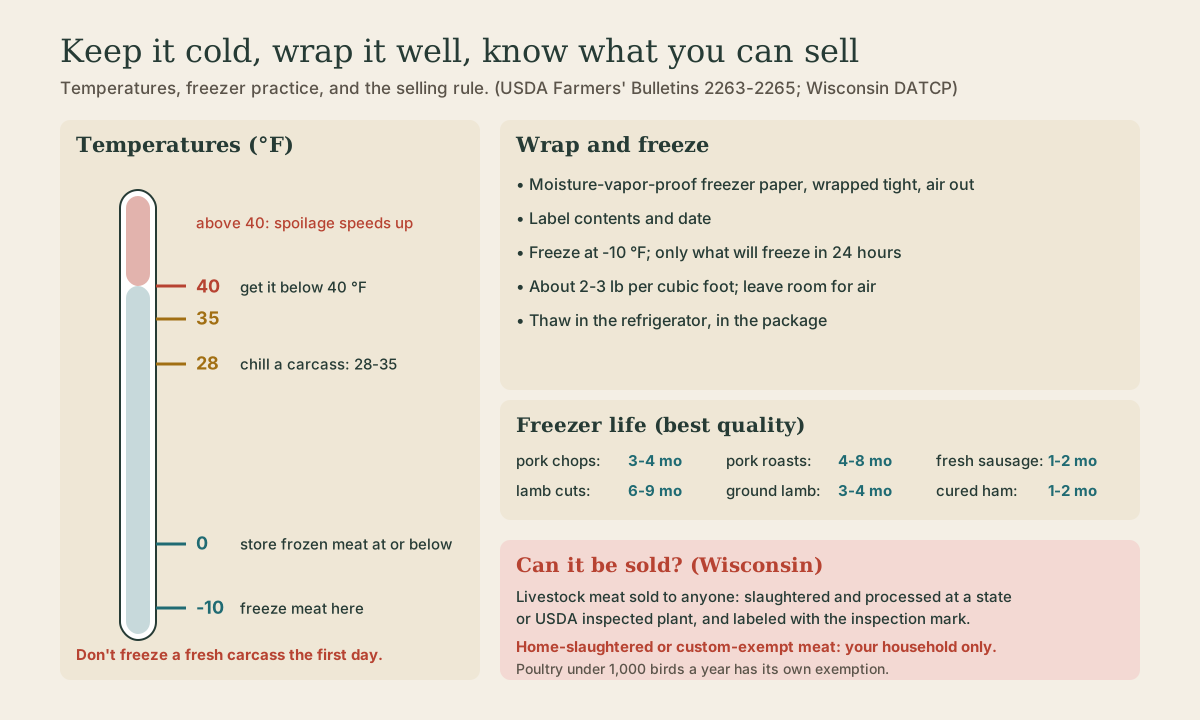
- Chill at 28 to 35°F, wrapped in a clean sheet in a ventilated shed if the weather allows 1.
- Get the carcass below 40°F; if you can’t on the farm, take it to a locker plant 1.
- Don’t let it freeze the first day: freezing within a day of death can toughen the meat 1.
- In hot weather, slaughter in the cool of early morning or evening; below 30°F, any time 1.
Wrap and freeze
Right after cutting, wrap, freeze fast, and store cold 2:
- Use moisture-vapor-proof wrap such as heavily waxed or laminated freezer paper.
- Wrap tightly, pressing out the air; air causes freezer burn and rancidity.
- Label every package with contents and date.
- Freeze at -10°F or below, and only as much as will freeze in 24 hours; pack about 2 to 3 pounds per cubic foot and leave room for air to circulate. Store at 0°F or below 2.
Wrapping and freezing “does not improve quality but maintains original quality” 3.
Freezer life for best quality: pork chops 3 to 4 months, pork roasts 4 to 8, fresh sausage 1 to 2, cured ham 1 to 2 1; lamb cuts 6 to 9 months, ground lamb 3 to 4 3. Salted and cured meats keep the shortest because salt speeds rancidity.
Thawing: in the refrigerator, in the package, about 3 hours per pound for small roasts and chops, never on the counter. Meat thawed below 40°F can be refrozen safely, with some loss of quality 1 3. Cooking from frozen takes up to a third longer 1.
Playback is optional. If the player is unavailable, open the video at its source.
Quick check
Freeze only what will freeze in 24 hours, about 2 to 3 pounds per cubic foot.
What can be sold
Federally, meat from an animal slaughtered outside an inspected plant can be used only by the owner, the household, nonpaying guests, and employees 1. Wisconsin’s DATCP spells out the same rule for selling 4:
- Livestock (cattle, hogs, sheep, goats, bison, rabbits, and others): all meat sold to consumers must be slaughtered and processed at a state or USDA inspected meat establishment and labeled there, with the inspection mark, safe handling instructions, and a net weight.
- Meat slaughtered by the producer, by a registered mobile slaughterer, or custom exempt (processed without inspection for the owner) cannot be sold 4.
- Selling inspected meat from the farm needs a retail food license and a freezer used only for that meat, kept separate from living quarters; farmers markets need a mobile or transient license 4.
- Poultry has its own small-producer exemption, covered in the Poultry module 4.
Quick check
Custom-exempt and home-slaughtered meat is for your own household.
Try it
Before your first butchering day, check your freezer with a thermometer (it should read 0°F or colder), estimate how much space the meat will need at 2 to 3 pounds per cubic foot, and buy freezer paper, tape, and a marker. Write a one-page plan: where the carcass will chill, how you’ll keep it between 28 and 40°F, and who will take the waste.
What to take from this
Clean the site and tools, rinse sanitizers off, and keep hair, dirt, and gut contents off the meat. Chill carcasses at 28 to 35°F, below 40°F, but don’t freeze them the first day. Wrap tightly in freezer paper, label, freeze at -10°F no more than will freeze in a day, and store at 0°F. Thaw in the refrigerator. In Wisconsin, livestock meat that’s sold must come from an inspected plant; home-slaughtered and custom-exempt meat is for your household only.
Lesson complete
Nice work.
Sources for this lesson
- 1H. Russell Cross. Pork Slaughtering, Cutting, Preserving, and Cooking on the Farm (Farmers' Bulletin 2265). U.S. Department of Agriculture (Project Gutenberg edition). 1978. verifiedIssued June 1978, revised 1981. Sausage from trimmings, more than 50 percent lean, 20-30 percent fat, ground through 1/2-in. then 1/8-in. plates, 2 lb salt, 6 oz pepper, 1-2 oz sage per 100 lb, seasoned sausage frozen no more than 2-3 months; dry cure 8-2-2 in three rubs, 36-42 F, bellies about 7 days per inch; sweet pickle cure 3-1/2 to 4 days per pound, ropy brine; soak 2 minutes per day in cure; smokehouse from a barrel and buried stovepipe; hardwoods only; ham and bacon smoking schedules; trichinae destroyed at 137 F or by specified freezing; lard rendering near 212 F and never above 255 F, leaf fat best, organ fat separately, no copper or brass, cool fast and stir to creamy.
- 2H. Russell Cross. Beef Slaughtering, Cutting, Preserving, and Cooking on the Farm (Farmers' Bulletin 2263). U.S. Department of Agriculture (Project Gutenberg edition). 1977. verifiedPen clean and dry, no feed 24 hours, water always; 1,000-1,200 lb steer or 900-1,000 lb heifer on full feed 150 days for Choice-like meat, under 17-18 months for tenderness; dressing about 60 percent, cutting loss 20-30 percent, rule of thumb one-quarter each waste, ground and stew, steaks, roasts; knife sharpening by grinding, honing, and steeling at 20-25 degrees, thumbnail test; stun with a .22 at the crossing of lines from poll to opposite eyes; bleed within 2 minutes; quarter between the last two ribs leaving one on the hindquarter; chill at 28-35 F, below 40 F, don't freeze the first day; age at least 2-3 days, no benefit beyond 7-9; forequarter separated between the sixth and seventh ribs for novices.
- 3H. Russell Cross. Lamb Slaughtering, Cutting, Preserving, and Cooking on the Farm (Farmers' Bulletin 2264). U.S. Department of Agriculture (Project Gutenberg edition). 1977. verifiedNo feed 24 hours (smaller gut, fewer bacteria entering the blood), water always (better bleeding, brighter lean, easier pelting); lamb 12-14 months or less, yearling mutton 14-24 months, mutton over 2 years; over 70 percent of carcass in major trimmed cuts; yield table for yield grade 2 and 4; stun with a .22 midway between and slightly above the eyes; bleed just behind the jaw; pelt (fist) with wet hands, cutting toward the skin to keep the fell intact; carcass not split for chilling; chill at 28-35 F, cut after 24-48 hours; thin cuts off first, shoulder between fifth and sixth ribs, rack to the 12th-13th rib, loin, and legs in front of the hipbones.
- 4Direct Marketing Meat and Poultry (P-DFRS0238). Wisconsin Department of Agriculture, Trade and Consumer Protection. 2026. verifiedUnder 1,000 birds a year, a producer may slaughter healthy birds raised on their premises and sell them from the premises without inspection or license, only directly to consumers within Wisconsin, labeled NOT INSPECTED with name and address; farmers market and wholesale sales need bird-by-bird inspection at a state or USDA establishment; over 1,000 birds all sales need inspection; livestock meat sold to consumers must be inspected; custom-exempt meat cannot be sold.