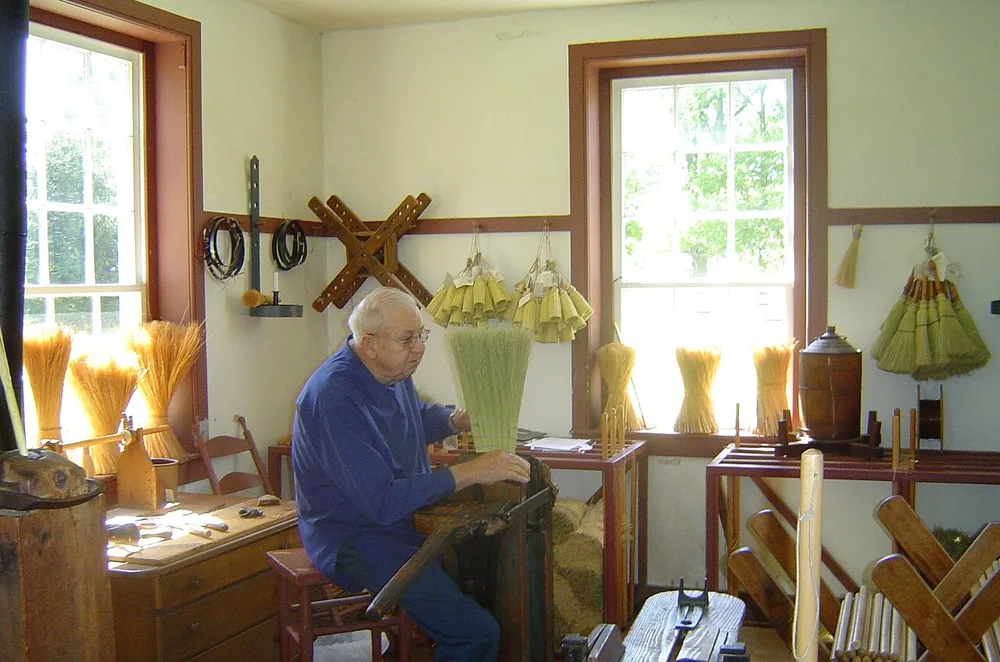
Making a Broom by Hand
Two farm methods for making a broom with nothing but cured broomcorn, twine, a needle, and a handle: the foot-cord method, where a cord hung from the ceiling squeezes the bundle tight before it's wound, pressed flat, sewn, and driven onto a handle; and the handle-first method, where stalks are wound onto the handle in three tiers. From directions in the American Agriculturist, reprinted in 1912.
- 5 min
- 5 steps
- 3 questions
- Lesson 55 of 55
In this lesson
- Materials
- The foot-cord method
- The handle-first method
- Try it
Picking up where you left off.
Before factories, the American Agriculturist printed directions for farm families who wanted to make their own brooms. A. G. McCall reprinted two of them in his 1912 book on broomcorn 1. “With a little practice,” either makes a neat broom.
Materials
- Cured broomcorn, enough for a broom, with the largest and best stalks set aside for the outside. The broom’s appearance depends on even brush and a neat outside layer 1.
- Strong small cord for pressing, and strong twine (or wire) for winding and sewing 1.
- A needle 6 to 8 inches long, of iron or steel or strong hardwood 1.
- Two narrow boards, or a vise, and a handle 1.
The foot-cord method
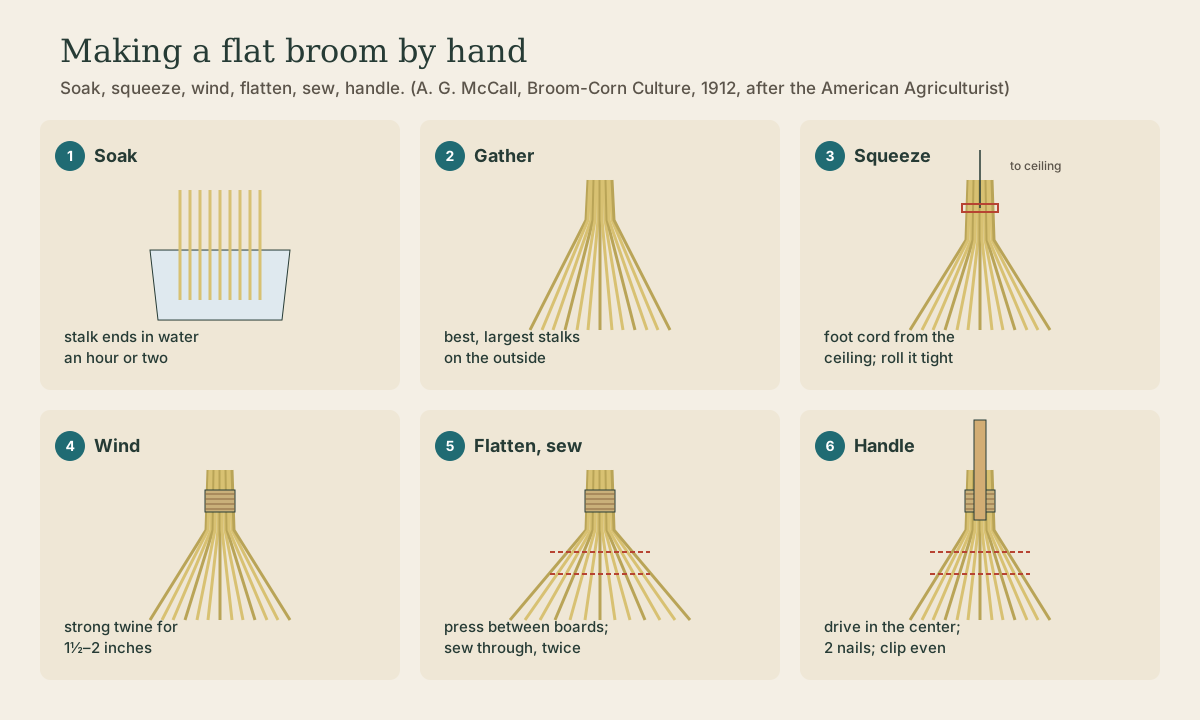
- Soak. Stand the stalk ends in water up to the brush for an hour or two to soften them 1.
- Gather. Take enough brush for a broom in your hands, with the largest and best stalks on the outside in regular order 1.
- Squeeze. Fasten a strong small cord to the ceiling with a loop for your foot at the bottom, or tie a stick to it as a treadle. Wind the cord two or three times around the brush, grip the bundle firmly in both hands, and roll it around several times while pressing harder with your foot. Some used a lever under the workbench instead, with a helper bearing down on it 1.
- Wind. Wind strong twine on for 1½ to 2 inches, rolling the pressing cord ahead toward the end and following it with the twine. To hide the end, lay a doubled end of twine along the stalks before winding; when the winding’s done, slip the free end through the loop and pull the loop under the coil, then cut both ends close. No knot shows 1.
- Flatten. For a flat broom, “usually the desirable form,” press the brush between two narrow boards fastened together at one end with a strong piece of leather and tied at the other, or between two short boards in a vise 1.
- Sew. Three or four inches below the winding, wind twine once or twice around and tie it firmly, leaving one long end to sew with. Sew through and through the brush, each stitch passing around the tied twine, pointing the needle forward so each stitch comes out a little farther along. Tie on a second twine lower down and sew a second row. Two sewings are usually enough; very long brush may need three 1.
- Handle. Sharpen the end of the handle and drive it exactly into the center of the neck, fasten it with two small nails on opposite sides, and clip the ends of the brush even 1.
Wire instead of twine, and stalks pared down at the neck, make a neater broom, though not a stronger one 1.

Quick check
An hour or two in water is enough.
Quick check
Some used a lever under the bench instead of a foot loop.
Quick check
Two sewings are usually enough; very long brush may need three.
The handle-first method
A second writer built the broom right onto the handle 1:
- Soak the butt ends in warm water.
- Tack one end of a strong twine to the handle about 3 inches from its lower end. Tie the other end, about 2 feet away, to a short round stick you stand on with both feet.
- Lay on the brush one stalk at a time, turning the handle enough with each to hold the new stalk, pulling upward to keep the twine tight. Build three layers.
- Start a second row nearer the end of the handle, then a third, finishing with the longest and finest brush outside.
- Wind the cord snugly a few more times and fasten it with a carpet tack.
- For a flat broom, put more brush on two opposite sides, then slip a loop of string over the handle and down to the right place, and sew.
“You now have as neat a broom as you can buy,” the writer claimed, “and stronger than most of those in the market” 1.
Playback is optional. If the player is unavailable, open the video at its source.
The Shakers’ flat broom press, mentioned in the last lesson, made the flattening and sewing step far easier for their broom shops 2.
Playback is optional. If the player is unavailable, open the video at its source.
Try it
Start small: make a hearth whisk first, from a handful of broomcorn with no handle. Soak it, squeeze it with the foot cord, wind 1½ inches of twine, flatten it between two boards clamped in a vise, and sew two rows. Once that holds together, make a full broom on an old handle.
Lesson complete
Nice work.
Sources for this lesson
- 1Arthur Gillett McCall. Broom-Corn Culture. Orange Judd Company, New York. 1912. verifiedBroom-corn is a sorghum whose seed is borne on long straight branches, the brush; sorghums cultivated in Italy for 1,800 years, and broom-corn thought to have originated there by selection; first record of brooms from an Italian source. Dwarf: 3-6 ft, brush 10-18 in., partly enclosed in the boot. Standard: 10-15 ft, brush 18-24 in. Needs dry weather at harvest; rain on ripening heads turns them red; rain after cutting bleaches them yellow; cured outdoors gives bleached poor brush. Harvest while in bloom as the anthers fall for good green color; quality deteriorates rapidly after bloom. Tabling: one man bends stalks of two rows into a self-supporting table; cut heads 6 to 8 inches below the attachment of the straws, not less than 6 or more than 8. Formerly brooms were made at home by the farmer and family. Hand directions from the American Agriculturist: soak stalk ends an hour or two; largest stalks outside; foot cord hung from the ceiling wound two or three times and rolled; wind twine 1 1/2 to 2 inches and hide the end under the coil with a loop; for a flat broom press between two narrow boards hinged with leather or in a vise; sew with a 6 to 8 inch needle three or four inches below the winding, stitches passing around a tied twine; two sewings generally enough; sharpen the handle and drive it into the center, fasten with two small nails, clip ends. Alternative: tack twine to the handle and wind stalks on in three tiers. Factory hand machines: seven or eight dozen brooms a day.
- 2Billy Rankin. Swept Away. Shaker Village of Pleasant Hill (Kentucky). 2020. verifiedThe Shaker broom industry began at Watervliet, New York, in 1798 and became one of the most important economic lifelines. The Shakers did not invent the flat broom, but they created a flat broom press that greatly facilitated the process. By the 1840s Pleasant Hill had planted nearly 60 acres of broomcorn and produced thousands of brooms a year; Brother Francis Monfort reportedly made 25,000 broom handles in 1859; brooms sold for $2 to $3 per dozen.