Curing: Salt, Nitrite, and Safety
How salt, sugar, and nitrite cure pork: what Cure #1 is and why it isn't Himalayan pink salt, dosing by weight (1 teaspoon per 5 pounds, about 156 ppm), dry curing at about 7 days per inch, brine curing hams, the 36 to 40°F window, and making bacon.
- 5 min
- 7 steps
- 3 questions
- Lesson 47 of 55
In this lesson
- What cure does
- Dose by weight
- Dry cure
- Brine cure
- Temperature and time
- Try it
- What to take from this
Picking up where you left off.
What cure does
Curing preserves meat with salt, sugar, and nitrite 1:
- Salt is the preserving agent. It draws water out of the meat and slows bacteria.
- Sugar softens the harshness of the salt.
- Nitrite fixes the pink color and cured flavor and is itself a preservative. It’s an effective inhibitor of Clostridium botulinum, the bacterium behind botulism 2.
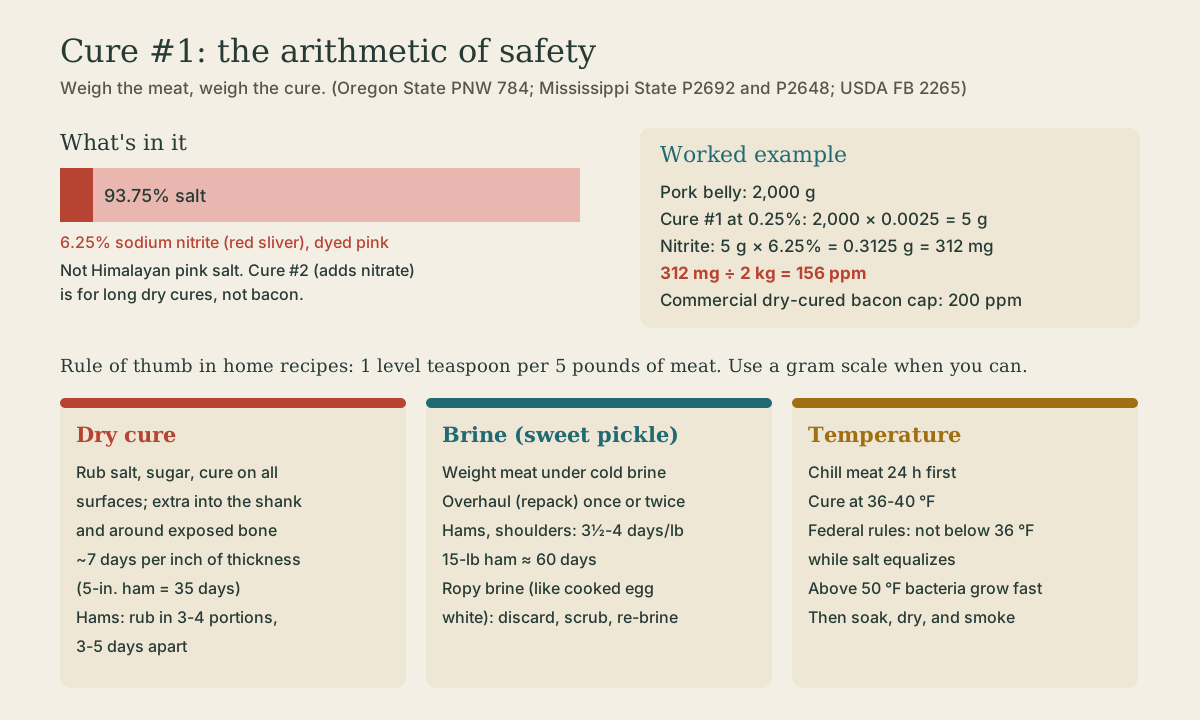
At home, nitrite comes as Cure #1 (Prague Powder #1, Insta Cure #1, or pink curing salt): 6.25 percent sodium nitrite and 93.75 percent salt, dyed pink so it can’t be mistaken for table salt 2. It is not the same as Himalayan pink salt, which is pink from trace minerals and doesn’t cure anything 2. Cure #2 adds sodium nitrate for long dry cures such as salami; Oregon State doesn’t recommend it for bacon because it can form nitrosamines at frying temperatures 2.
Quick check
Himalayan salt is pink from minerals and doesn’t cure anything.
Dose by weight
Nitrite is toxic in large amounts, so it’s always measured 1 2:
- Home recipes commonly use 1 teaspoon of Cure #1 per 5 pounds of meat 2.
- By weight, that’s about 0.25 percent of the meat. A 2,000-gram belly gets 5 grams of Cure #1, which holds 312 milligrams of nitrite: 156 parts per million. Mississippi State’s smoked sausage uses exactly that level 3.
- Commercial dry-cured bacon is capped at 200 ppm 2.
Use a gram scale and follow the cure maker’s directions 2. Weigh the meat first; everything else is a percentage of that number.
Dry cure
Rub the cure mixture over every surface, push extra into the shank end and around any exposed bone to prevent bone souring (spoilage deep at the bone), and lay the pieces skin side down where the drippings can drain 4.
- Time: about 7 days per inch of thickness. A ham 5 inches thick at its thickest takes about 35 days 4. USDA gives bellies the same 7 days per inch 1.
- Hams: divide the cure into three rubbings (four for hams over 20 pounds), applied 3 to 5 days apart 4.
- Bacon: many cooks now use an equilibrium cure: salt, sugar, and Cure #1 measured as percentages of the belly’s weight, sealed in a bag, and refrigerated, so the meat can’t get saltier than the recipe no matter how long it sits. Oregon State’s bacon cures 5 to 7 days at 40°F, flipped daily 2.
Afterward, soak or rinse the meat to remove surface salt and salt streaks before smoking 4. USDA suggests about 2 minutes of soaking per day in the cure, then about 3 hours of drying 1.
Quick check
Brined hams and shoulders take about 3-1/2 to 4 days per pound.
Brine cure
Hams and shoulders can also cure under a cold sweet pickle brine (salt, sugar, and nitrite dissolved in water), weighted down, and overhauled (taken out and repacked) once or twice so the brine reaches every surface 1. Brined hams and shoulders take 3-1/2 to 4 days per pound: about 60 days for a 15-pound ham 1. Commercial packers speed this by pumping brine into the ham.
If the brine turns ropy (like partly cooked egg white), bacteria have taken hold: discard it, scrub the meat with hot water, scald the crock, and start again with fresh cold brine 1.
Temperature and time
Chill meat at least 24 hours before it goes into cure, and keep it at 36 to 40°F throughout 1. Federal inspection rules keep dry-curing meat from dropping below 36°F while the salt equalizes, and above 50°F bacteria grow rapidly in unsalted meat, which is what the center is until the cure reaches it 1. A spare refrigerator with a thermometer in it is the home curing room.
Mississippi State notes that traditional country hams aged for about 6 months at 70 to 75°F come from a different climate, and it doesn’t recommend aging dry-cured hams at home in the humid Southeast 4. Short cures of 2 to 3 weeks, followed by refrigeration and freezing, are the safer home route 4.
Playback is optional. If the player is unavailable, open the video at its source.
Quick check
USDA notes bacteria grow rapidly in unsalted meat above 50°F.
Try it
Cure one pork belly as bacon. Weigh it in grams. Measure 2 percent salt, 1 to 2 percent sugar (brown sugar or maple sugar), and 0.25 percent Cure #1 on a gram scale; rub it on, seal it in a bag, and refrigerate at 40°F for 7 days, flipping daily. Rinse, pat dry, rest uncovered in the refrigerator overnight, and smoke it (next lesson). Write down the weights so the next batch is repeatable.
What to take from this
Curing preserves meat with salt, sugar, and nitrite. Cure #1 is 6.25 percent sodium nitrite in salt, dyed pink, not Himalayan salt. Dose it by weight: about 1 teaspoon per 5 pounds, or 0.25 percent, for about 156 ppm. Dry cure about 7 days per inch; brined hams take 3-1/2 to 4 days per pound. Keep everything at 36 to 40°F, rinse before smoking, and use Cure #2 only for long dry cures.
Lesson complete
Nice work.
Sources for this lesson
- 1H. Russell Cross. Pork Slaughtering, Cutting, Preserving, and Cooking on the Farm (Farmers' Bulletin 2265). U.S. Department of Agriculture (Project Gutenberg edition). 1978. verifiedIssued June 1978, revised 1981. Sausage from trimmings, more than 50 percent lean, 20-30 percent fat, ground through 1/2-in. then 1/8-in. plates, 2 lb salt, 6 oz pepper, 1-2 oz sage per 100 lb, seasoned sausage frozen no more than 2-3 months; dry cure 8-2-2 in three rubs, 36-42 F, bellies about 7 days per inch; sweet pickle cure 3-1/2 to 4 days per pound, ropy brine; soak 2 minutes per day in cure; smokehouse from a barrel and buried stovepipe; hardwoods only; ham and bacon smoking schedules; trichinae destroyed at 137 F or by specified freezing; lard rendering near 212 F and never above 255 F, leaf fat best, organ fat separately, no copper or brass, cool fast and stir to creamy.
- 2Joy Waite-Cusic, Jared Hibbard-Swanson. Making Cured Bacon at Home (PNW 784). Oregon State University Extension. 2025. verifiedDry cure or wet brine; Prague Powder #1 is 6.25 percent sodium nitrite and 93.75 percent salt, dyed pink and not the same as Himalayan pink salt; 1 teaspoon per 5 pounds of meat; dry-cured bacon is capped at 200 ppm nitrite commercially; Cure #2 not recommended for bacon (nitrosamines at high heat); cure 5-7 days at 40 F, flipping daily; smoke at 225-250 F to 160 F internal; refrigerate up to 7 days, freeze within 4 months.
- 3J. Byron Williams, Courtney A. Crist. Making Sausage at Home (Publication 2692). Mississippi State University Extension. 2023. verifiedTwo-thirds lean, one-third fat (10.7 lb lean, 5.3 lb fat per 16 lb); chill to about 32 F to minimize fat smearing; grind through a 1/2-3/4 in. plate then a 3/16 in. plate; seasoning for 16 lb (10 Tbsp salt, 10 Tbsp black pepper, 2 Tbsp red pepper, 4 Tbsp sage, 4 Tbsp sugar); natural casings soaked 30 minutes; nitrite at 156 ppm for smoked sausage, cured about 24 hours; smoke at no more than 90-95 F; cook to 160 F; fresh sausage refrigerated no more than 3 days, frozen 2-4 months.
- 4J. Byron Williams, Courtney A. Crist. Curing Pork Products at Home (Publication 2648). Mississippi State University Extension. 2022. verifiedClean, cold, covered; dry cure about 7 days per inch of thickness at 32-40 F, hams in three or four rubbings 3-5 days apart, extra cure at exposed bones to prevent bone souring; soak before smoking; hardwoods only; hot smoking in three stages (about 125 F drying, about 135 F with smoke for about 8 hours, about 180 F until 142 F inside); fully cooked hams reach at least 148 F; cold smoking below 100 F, ideally 70-80 F, for 1-5 days; spoilage bacteria grow rapidly from 80 to 110 F; aging dry-cured hams about 6 months at 70-75 F and 55-65 percent humidity.