Smoking Meat
Smoking cured pork: drying to a tacky surface, hardwood versus softwood smoke, a three-stage hot-smoke schedule for ham, smoking bacon, cold smoking below 100°F, a barrel-and-stovepipe smokehouse for one hog, trichinae, and storing smoked meat.
- 5 min
- 8 steps
- 3 questions
- Lesson 48 of 55
In this lesson
- Before the smoke
- Wood
- Hot smoking a ham
- Cold smoking
- A smokehouse for one hog
- Trichinae
- Try it
- What to take from this
Picking up where you left off.
Before the smoke
Smoke gives cured pork its color, aroma, and flavor 1. Two things come first:
- Soak or rinse off the surface salt 2 1.
- Dry until the surface is slightly moist and tacky. Too wet and the meat streaks; too dry and it smokes pale 2.
Hang cuts so they don’t touch each other or the walls. Hang hams and shoulders by the shank; skewer bellies at the ends with hardwood or galvanized wire to keep them square 1.
Quick check
The first stage of a hot smoke is drying with dampers open and no smoke.
Wood
Use hardwoods: hickory, oak, maple, ash, apple, or pecan. Hickory is the classic 1 2. In Wisconsin, sugar maple, apple, and cherry are easy to come by.
Never use pine, spruce, cedar, or other softwoods: their resinous smoke is sooty, darkens the meat, and leaves a bitter taste and strong smell 1. Damp hardwood sawdust on the fire damps the flame and makes more smoke, and “a thin haze of smoke is as effective as a dense cloud” 1.
Quick check
Resinous softwood smoke is sooty and makes meat dark, bitter, and strong-smelling.
Hot smoking a ham
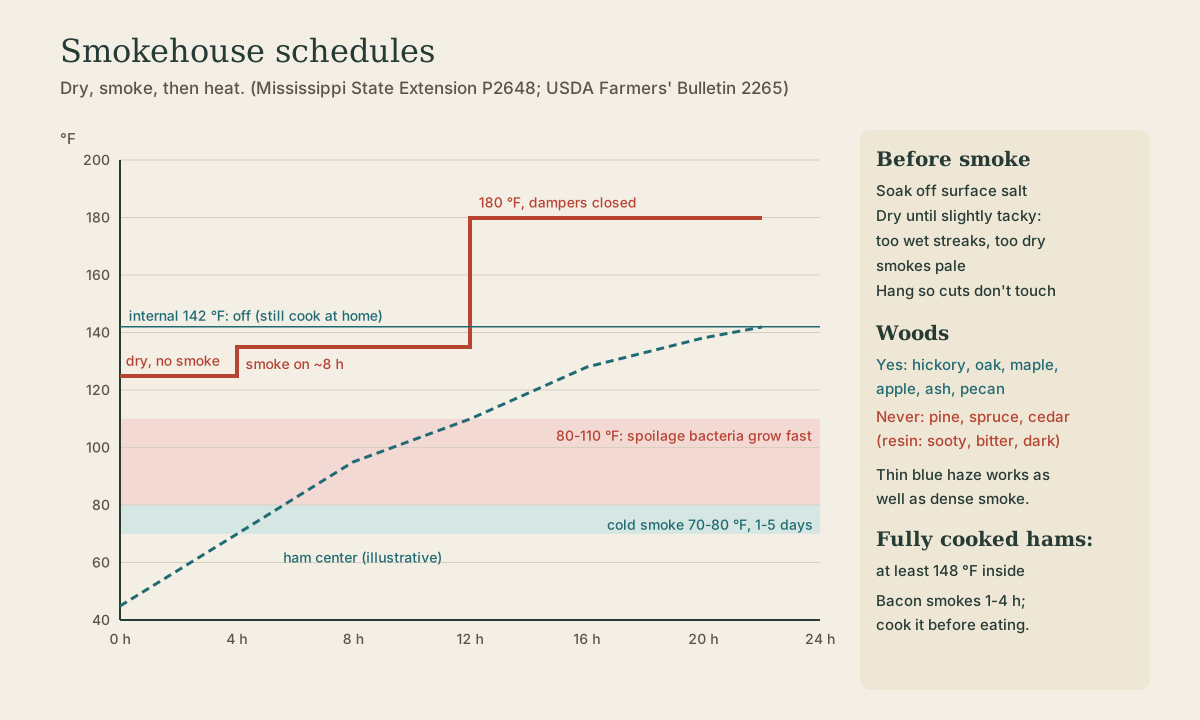
Mississippi State’s schedule takes about 24 hours in three stages 2:
- Dry: about 125°F, all dampers open, no smoke, until excess moisture is gone.
- Smoke: about 8 hours at about 135°F, dampers partly closed, smoke on.
- Heat: dampers closed, smoke continuing, house raised to about 180°F and held until the ham’s center reaches 142°F.
A ham taken off at 142°F still needs cooking at home. Hams sold as “fully cooked” reach at least 148°F inside 2. USDA gives similar schedules and says hams should stay in until 152 to 155°F if they’re meant to be fully cooked 1.
Bacon smokes shorter: Mississippi State says 1 to 4 hours for pickled bacon 2. Oregon State smokes bacon at 225 to 250°F to an internal 160°F, which cooks it fully 3.
Cold smoking
Cold smoking keeps the house below 100°F, ideally 70 to 80°F, with enough heat to make smoke but not to cook. It runs 1 to 5 days and can stop and start 2. Cold-smoked meat has more salt and less moisture than hot-smoked, and it depends entirely on a full cure, because spoilage bacteria grow fast from 80 to 110°F 2. Meat that isn’t fully dry cured and aged must be wrapped and frozen as soon as it’s smoked and cooled 2. Late fall and early winter in Wisconsin are cold-smoking weather.
Quick check
Enough heat to make smoke but not to cook; spoilage bacteria grow fast from 80 to 110°F.
A smokehouse for one hog
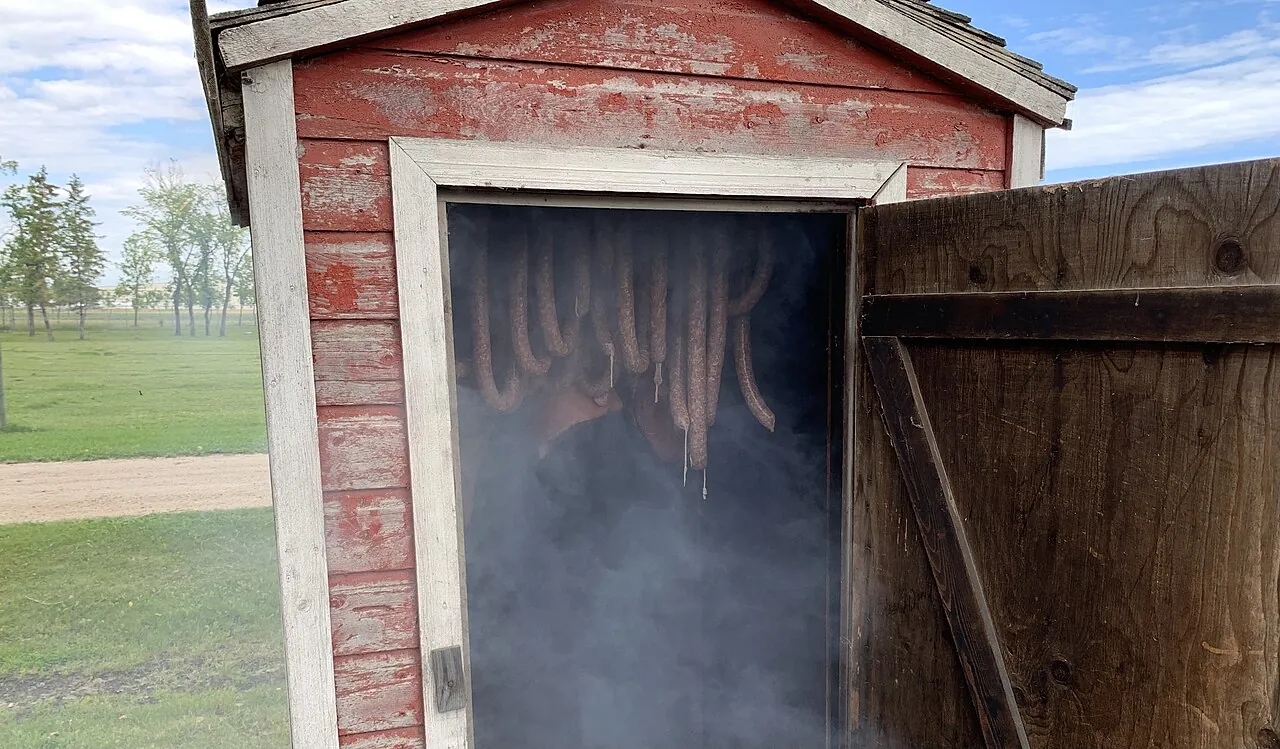
USDA’s bulletin describes a temporary smokehouse 1:

- A barrel with both ends knocked out stands over the upper end of 10 to 12 feet of stovepipe (or a covered trench) that slopes down to a fire pit. The long pipe cools the smoke.
- The meat hangs from broomsticks across the top, under a cleated lid with a 1-inch gap covered by muslin or burlap.
- A sheet of metal over the pit, with earth mounded around it, controls the draft.
An old refrigerator or a small frame shed works the same way, and permanent smokehouses with an outside firebox make temperature control easier 1. Whatever the build, keep insects and rodents out 1.
Playback is optional. If the player is unavailable, open the video at its source.
Trichinae
Trichinae (the parasite behind trichinosis) are rare in modern pork, but USDA still treats them as a risk. They’re destroyed by heating the meat throughout to 137°F, or by freezing: -20°F for 6 to 12 days, -10°F for 10 to 20 days, or 5°F for 20 to 30 days 1. Products that look ready to eat but haven’t been cooked must have been treated one of those ways 1.
Try it
Build a cold-smoke rig from what’s on hand: a fire pit or small wood stove, 10 feet of stovepipe on a slope, and a barrel or old refrigerator at the top with a dial thermometer through the side. Run it empty with apple or maple sawdust for an afternoon and log the temperature every half hour. When it holds 70 to 80°F with a thin blue haze, smoke the bacon from the curing lesson, then cook it before eating.
What to take from this
Rinse off surface salt and dry cured meat until it’s tacky before it goes in the smoke. Use hardwoods only, never pine, spruce, or cedar. A hot-smoked ham dries at about 125°F, smokes about 8 hours at 135°F, then heats at 180°F until it’s 142°F inside; fully cooked hams reach at least 148°F. Cold smoking stays below 100°F (ideally 70 to 80°F) and depends on a full cure. A barrel on a long stovepipe smokes one hog’s cuts.
Lesson complete
Nice work.
Sources for this lesson
- 1H. Russell Cross. Pork Slaughtering, Cutting, Preserving, and Cooking on the Farm (Farmers' Bulletin 2265). U.S. Department of Agriculture (Project Gutenberg edition). 1978. verifiedIssued June 1978, revised 1981. Sausage from trimmings, more than 50 percent lean, 20-30 percent fat, ground through 1/2-in. then 1/8-in. plates, 2 lb salt, 6 oz pepper, 1-2 oz sage per 100 lb, seasoned sausage frozen no more than 2-3 months; dry cure 8-2-2 in three rubs, 36-42 F, bellies about 7 days per inch; sweet pickle cure 3-1/2 to 4 days per pound, ropy brine; soak 2 minutes per day in cure; smokehouse from a barrel and buried stovepipe; hardwoods only; ham and bacon smoking schedules; trichinae destroyed at 137 F or by specified freezing; lard rendering near 212 F and never above 255 F, leaf fat best, organ fat separately, no copper or brass, cool fast and stir to creamy.
- 2J. Byron Williams, Courtney A. Crist. Curing Pork Products at Home (Publication 2648). Mississippi State University Extension. 2022. verifiedClean, cold, covered; dry cure about 7 days per inch of thickness at 32-40 F, hams in three or four rubbings 3-5 days apart, extra cure at exposed bones to prevent bone souring; soak before smoking; hardwoods only; hot smoking in three stages (about 125 F drying, about 135 F with smoke for about 8 hours, about 180 F until 142 F inside); fully cooked hams reach at least 148 F; cold smoking below 100 F, ideally 70-80 F, for 1-5 days; spoilage bacteria grow rapidly from 80 to 110 F; aging dry-cured hams about 6 months at 70-75 F and 55-65 percent humidity.
- 3Joy Waite-Cusic, Jared Hibbard-Swanson. Making Cured Bacon at Home (PNW 784). Oregon State University Extension. 2025. verifiedDry cure or wet brine; Prague Powder #1 is 6.25 percent sodium nitrite and 93.75 percent salt, dyed pink and not the same as Himalayan pink salt; 1 teaspoon per 5 pounds of meat; dry-cured bacon is capped at 200 ppm nitrite commercially; Cure #2 not recommended for bacon (nitrosamines at high heat); cure 5-7 days at 40 F, flipping daily; smoke at 225-250 F to 160 F internal; refrigerate up to 7 days, freeze within 4 months.