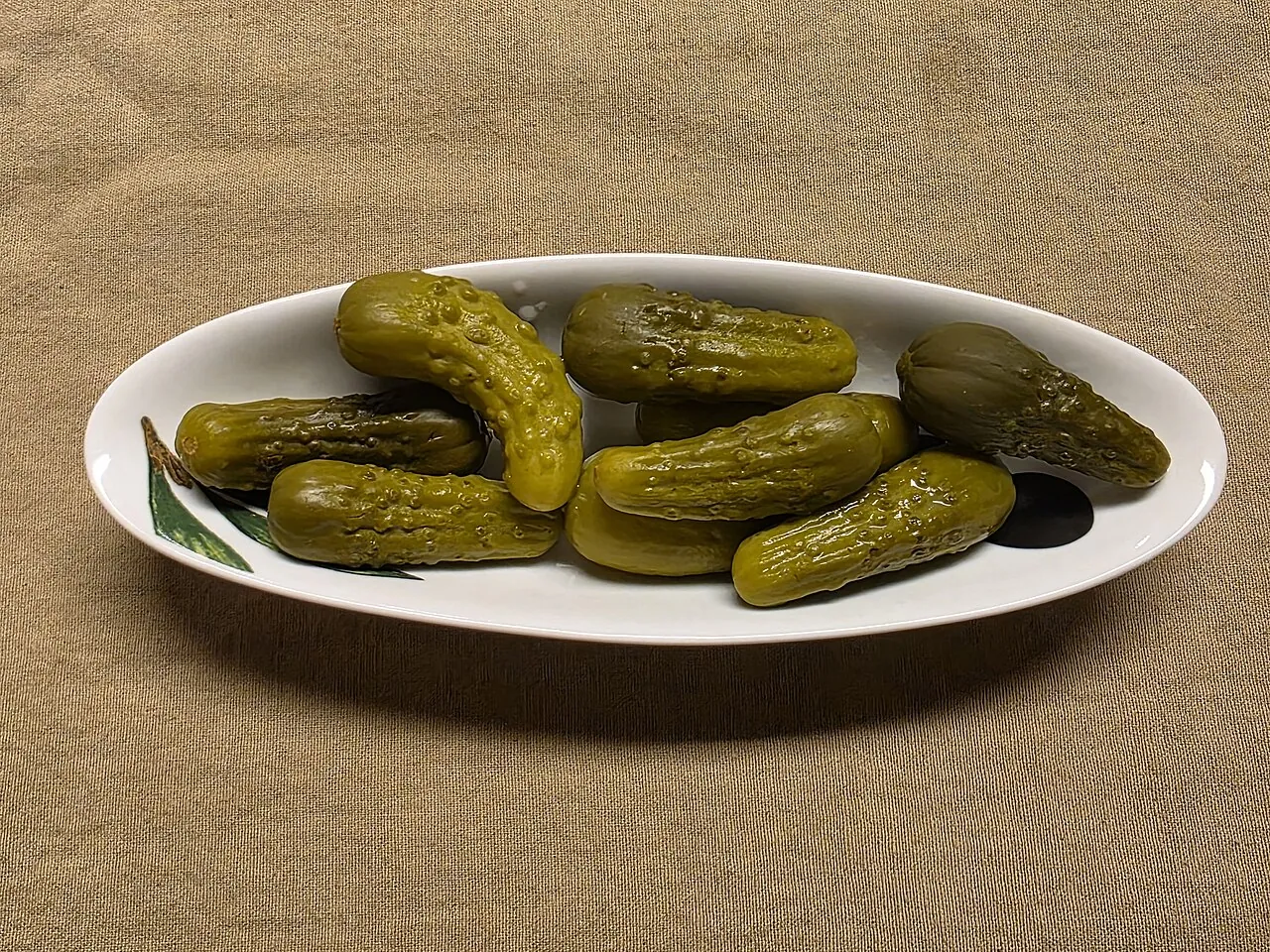
Pickles
Fresh-pack and fermented pickles safely: why acid level is the safety factor, pickling salt and 5% vinegar, trimming the blossom end, a worked quick fresh-pack dill recipe, low-temperature pasteurization for crisper pickles, firming agents, and why never to cut salt in fermented pickles or vinegar in fresh ones.
- 5 min
- 8 steps
- 3 questions
- Lesson 26 of 55
In this lesson
- Kinds of pickles
- Acid is the safety factor
- Ingredients
- Worked recipe: quick fresh-pack dills
- Crisper pickles
- Salt and fermentation
- Try it
- What to take from this
Picking up where you left off.
Kinds of pickles

- Fermented: regular dill pickles and sauerkraut cure for about 3 weeks as lactic acid bacteria convert sugars to acid; refrigerator dills ferment about a week.
- Fresh-pack (quick-process): not fermented. Vegetables may be brined a few hours or overnight, then covered with vinegar and seasonings.
- Fruit pickles: fruit heated in a spiced syrup acidified with vinegar or lemon juice.
- Relishes: chopped fruit and vegetables cooked with vinegar and spices.
Acid is the safety factor
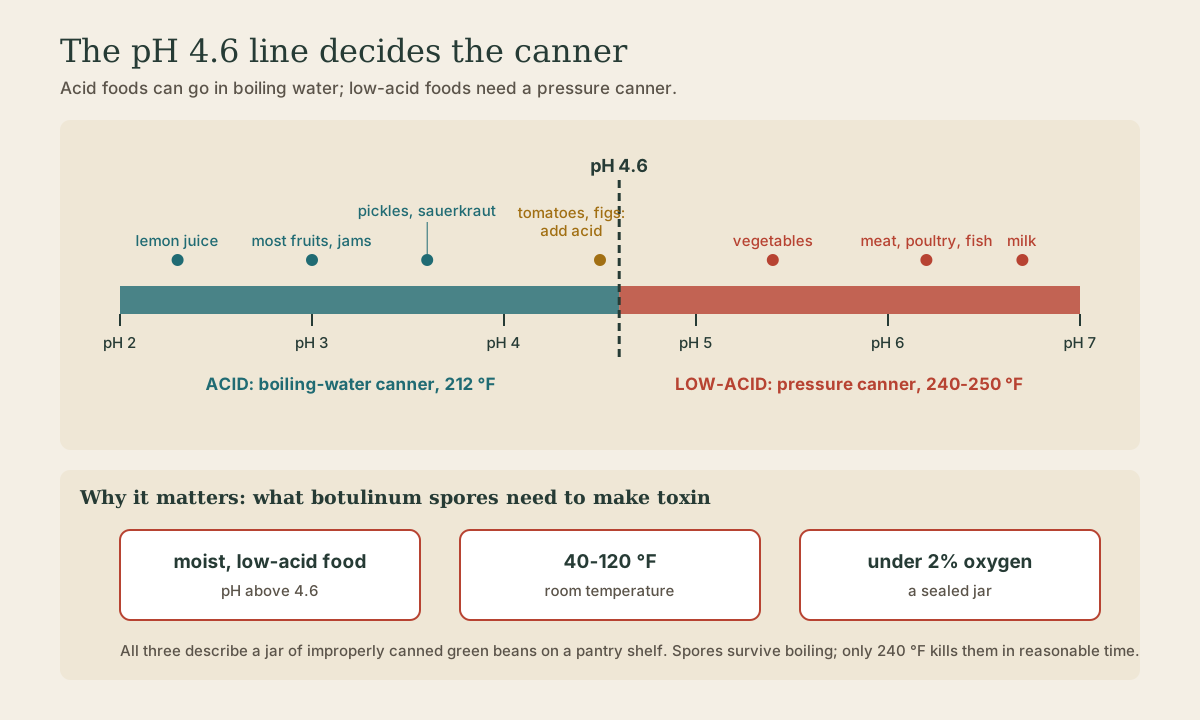
Cucumbers and other vegetables are low-acid. Pickling makes them acid foods, below pH 4.6, which is what allows a boiling-water canner 1. So the USDA’s cautions are firm 1:
- Don’t alter vinegar, food, or water proportions, and don’t use vinegar of unknown acidity.
- Use only tested recipes.
- There must be a minimum, uniform level of acid throughout the product to prevent botulinum growth.
Quick check
Use 5% acidity vinegar and don’t alter vinegar, food, or water proportions.
Ingredients
- Produce: fresh, firm, free of spoilage; pickling cucumbers, picked small and used within a day.
- Blossom end: cut off and discard 1/16 in. from the blossom end; it may contain an enzyme that softens pickles.
- Salt: canning or pickling salt. Anticaking agents in table salt cloud the brine, and flake salt varies too much in density.
- Vinegar: white distilled or cider vinegar of 5% acidity. White keeps light-colored vegetables bright.
- Sugar: white or brown; corn syrup or honey only when a recipe calls for them.
- Measure carefully: the ratio of produce to other ingredients affects safety, not just flavor.
Quick check
Leave about 1/4 in. of stem on the other end.
Worked recipe: quick fresh-pack dills
From the USDA guide, about 7-9 pints 2:
- Wash 8 lb of 3- to 5-in. pickling cucumbers, cut 1/16 in. off the blossom end, and leave 1/4 in. of stem.
- Dissolve 3/4 cup pickling salt in 2 gallons of water, pour over the cucumbers, and let stand 12 hours. Drain.
- Combine 1-1/2 quarts of 5% vinegar, 1/2 cup salt, 1/4 cup sugar, and 2 quarts water, with 2 tbsp mixed pickling spice tied in cloth. Bring to a boil.
- Fill hot jars with cucumbers; add 1 tsp mustard seed and 1-1/2 heads of fresh dill (or 1-1/2 tsp dill seed) per pint.
- Cover with the boiling solution, leaving 1/2 in. headspace. Remove bubbles, wipe rims, and lid.
- Process in a boiling-water canner: raw-packed pints 10 minutes at 0-1,000 ft, 15 minutes at 1,001-6,000 ft, or use the low-temperature pasteurization method 2.
Playback is optional. If the player is unavailable, open the video at its source.
Crisper pickles
- Low-temperature pasteurization: for cucumber pickles, process 30 minutes in water held at 180 °F, never below, checked with a thermometer; it prevents spoilage and gives a firmer pickle 1.
- Food-grade lime: soak cucumbers 12-24 hours in lime water, then remove the excess by draining, rinsing, and soaking in fresh water for 1 hour, three times. Excess lime must be removed for safety 1.
- Alum is safe for fermented pickles but unnecessary, and doesn’t firm quick pickles 1.
- Fresh, cold cucumbers picked that day matter more than any additive.
Salt and fermentation
Fresh-pack pickles can be made with reduced salt using tested recipes, though texture and flavor suffer 1. Fermented pickles and sauerkraut are different: the salt favors the desirable bacteria and inhibits others, so it’s vital to safety and texture. Don’t cut the salt in fermented recipes 1. (Fermentation gets its own lesson in Sauerkraut and Fermented Pickles.)
Quick check
Reduced-salt recipes exist only for fresh-pack (vinegar) pickles.
Try it
Make a half batch of quick fresh-pack dills from the USDA recipe with cucumbers from the garden or farmers’ market. Process half the jars in boiling water and half by low-temperature pasteurization, and compare crispness after a month.
What to take from this
Pickling makes vegetables acid foods; the acid is the safety factor, so never change the vinegar, water, or produce proportions in a tested recipe, and use 5% vinegar and pickling salt. Trim the blossom end. Quick fresh-pack dills are brined 12 hours, packed with dill and mustard seed, covered with boiling vinegar solution at 1/2 in. headspace, and processed 10 minutes per pint up to 1,000 ft (15 above), or pasteurized at 180 °F for crispness. Never cut the salt in fermented pickles.
Lesson complete
Nice work.
Sources for this lesson
- 1Complete Guide to Home Canning, Guide 1: Principles of Home Canning (2015 revision). U.S. Department of Agriculture and National Center for Home Food Preservation. 2015. verifiedBotulinum toxin forms in moist low-acid food at 40-120 °F with under 2% oxygen; pH 4.6 divides acid and low-acid foods; low-acid foods processed at 240-250 °F (10-15 psi); altitude adjustments above 1,000 ft; headspace 1/4, 1/2, and 1-1 1/4 in.; sterilize jars for processes under 10 minutes; vent pressure canners 10 minutes; check dial gauges yearly; no open-kettle, oven, microwave, or dishwasher canning; test seals after 12-24 hours; store below 95 °F; spoilage signs and detoxifying suspect jars by boiling 30 minutes; pickling salt and 5% vinegar; don't alter tested recipes.
- 2Complete Guide to Home Canning, Guide 6: Preparing and Canning Fermented Foods and Pickled Vegetables (2015 revision). U.S. Department of Agriculture and National Center for Home Food Preservation. 2015. verifiedQuick fresh-pack dill pickles (12-hour brine, vinegar and salt solution, 1/2 in. headspace; raw pack pints 10 minutes at 0-1,000 ft, 15 minutes at 1,001-6,000 ft); bread-and-butter pickles; sauerkraut and fermented dills.