Sauerkraut and Fermented Pickles
Lactic fermentation in a crock: how salt steers which bacteria grow, the USDA sauerkraut method at 3 tablespoons of salt per 5 pounds of cabbage, keeping vegetables under brine, time by temperature, fermented dill pickles per gallon, signs of spoilage, and storing or canning the finished batch.
- 6 min
- 8 steps
- 3 questions
- Lesson 27 of 55
In this lesson
- How it works
- Containers and weights
- Sauerkraut step by step
- Temperature and time
- Fermented dill pickles
- Keeping the batch
- Try it
- What to take from this
Picking up where you left off.
How it works
Fermented vegetables are preserved by lactic acid bacteria that live on the vegetables themselves. Given salt, no air, and the right temperature, they turn the vegetables’ sugars into lactic acid, which sours them and keeps spoilage organisms out 1. Regular dill pickles and sauerkraut take about three weeks; refrigerator dills about a week 1.
Salt is what steers it: it draws juice out of the vegetables to make the brine and favors the desirable bacteria over others. That’s why the USDA says not to cut the salt in fermented recipes, and not to use reduced-sodium salt substitutes in them 2. Use canning or pickling salt; table salt is safe but its anticaking agents can cloud the brine, and flake salt varies too much in density to measure 2.
Containers and weights
From USDA Guide 6 2:
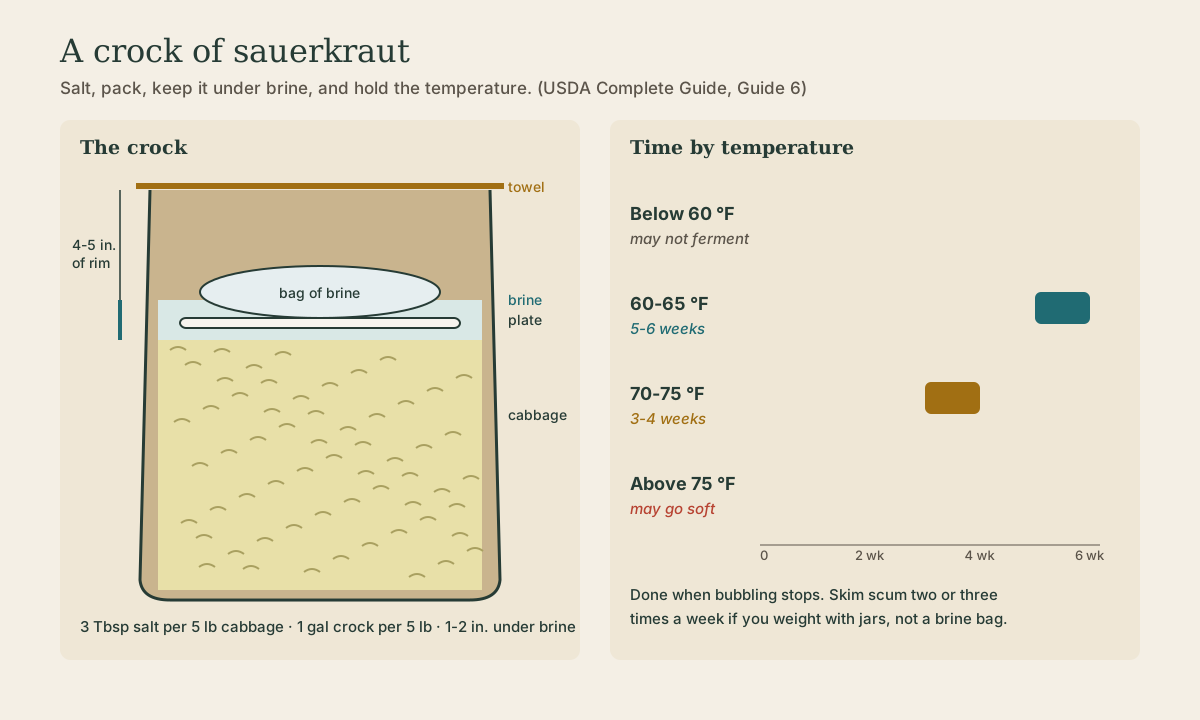
- Allow 1 gallon of container for every 5 pounds of fresh vegetables; a 5-gallon stone crock holds about 25 lb of cabbage or cucumbers.
- Food-grade plastic and glass work as well as stoneware. Never garbage bags or trash liners. Quart and half-gallon Mason jars work for kraut but tend to lose more to spoilage.
- Keep the vegetables 1 to 2 inches under brine. Use a plate just smaller than the opening, weighted with 2 or 3 sealed quart jars of water, or a heavy food-grade bag holding 3 quarts of water with 4-1/2 tablespoons of salt (so a leak won’t dilute the brine).
- Cover with a clean, heavy towel against insects and molds.
- Wash the crock, plate, and jars in hot soapy water and rinse with very hot water first.
Sauerkraut step by step
USDA’s recipe uses 25 lb of cabbage and 3/4 cup of canning salt for about 9 quarts 2:
- Use firm, fresh heads, and start the kraut within 24 to 48 hours of harvest.
- Work 5 lb at a time. Remove the outer leaves, rinse, quarter, core, and shred to about the thickness of a quarter.
- Put the cabbage in the crock with 3 tablespoons of salt, mix with clean hands, and pack firmly until the salt draws out the juice.
- Repeat until all the cabbage is in. Leave 4 to 5 inches between the cabbage and the rim.
- If the juice doesn’t cover the cabbage, add boiled and cooled brine of 1-1/2 tablespoons of salt per quart of water.
- Add the plate and weights and cover with a towel.
Playback is optional. If the player is unavailable, open the video at its source.
Quick check
That’s 3/4 cup for 25 lb. Don’t cut the salt in fermented recipes.
Temperature and time
- 70-75 °F: fully fermented in about 3 to 4 weeks.
- 60-65 °F: about 5 to 6 weeks.
- Below 60 °F: it may not ferment.
- Above 75 °F: it may go soft 2.
With a brine bag on top, leave the crock alone until the bubbling stops. With jars as weights, check two or three times a week and skim off any scum 2. In a Wisconsin house, a fall batch in a 65 °F back room is slow but reliable; a summer batch in a hot kitchen risks soft kraut.
Quick check
70-75 °F takes 3-4 weeks; 60-65 °F 5-6 weeks; above 75 °F it may soften.
Fermented dill pickles
Per gallon of container 2:
- 4 lb of 4-in. pickling cucumbers, with 1/16 in. cut off the blossom end and 1/4 in. of stem left on.
- 2 tbsp dill seed or 4 to 5 heads of fresh or dry dill.
- Brine of 1/2 cup salt, 1/4 cup 5% vinegar, and 8 cups water.
- Optional: 2 cloves garlic, 2 dried red peppers, 2 tsp mixed pickling spices.
Put half the dill and spices in the crock, add the cucumbers and the rest, pour on the brine, and weight them under it. Ferment at 70-75 °F for about 3 to 4 weeks; 55-65 °F is acceptable but takes 5 to 6 weeks; above 80 °F they go soft. Check several times a week and skim scum or mold promptly. If the pickles become soft, slimy, or smell bad, discard them 2.
Quick check
Surface scum and mold are skimmed off as you go; softness, slime, and a bad odor mean spoilage.
Keeping the batch
- Refrigerated: fully fermented kraut keeps several months tightly covered; fermented pickles about 4 to 6 months in the original container if scum is removed regularly 2.
- Canned: kraut can be hot packed (brought slowly to a boil) or raw packed with 1/2-in. headspace and processed in a boiling-water canner, hot-packed pints 10 minutes and quarts 15 at 0-1,000 ft. For pickles, heat the brine to a boil, simmer 5 minutes, pack with 1/2-in. headspace, and process raw-packed pints 10 minutes and quarts 15 at 0-1,000 ft, or use low-temperature pasteurization 2. Canning stops the fermentation and makes it shelf-stable, but softens the texture.
Try it
Make a half-gallon jar batch first: 5 lb of cabbage and 3 tablespoons of salt, packed into two half-gallon jars with a small brine-filled bag in each. Keep them at 65-70 °F and taste a forkful each week until it’s sour enough, then refrigerate.
What to take from this
Lactic acid bacteria sour vegetables under salt, without air, at the right temperature. Use 3 tablespoons of canning salt per 5 lb of cabbage, pack until juice covers it, keep it 1-2 in. under brine with a brine-filled bag, and ferment at 70-75 °F for 3-4 weeks (5-6 at 60-65 °F). Fermented dills use 1/2 cup salt, 1/4 cup vinegar, and 8 cups water per gallon. Skim scum; discard anything soft, slimy, or foul. Refrigerate or can the finished batch, and never cut the salt.
Lesson complete
Nice work.
Sources for this lesson
- 1Complete Guide to Home Canning, Guide 1: Principles of Home Canning (2015 revision). U.S. Department of Agriculture and National Center for Home Food Preservation. 2015. verifiedBotulinum toxin forms in moist low-acid food at 40-120 °F with under 2% oxygen; pH 4.6 divides acid and low-acid foods; low-acid foods processed at 240-250 °F (10-15 psi); altitude adjustments above 1,000 ft; headspace 1/4, 1/2, and 1-1 1/4 in.; sterilize jars for processes under 10 minutes; vent pressure canners 10 minutes; check dial gauges yearly; no open-kettle, oven, microwave, or dishwasher canning; test seals after 12-24 hours; store below 95 °F; spoilage signs and detoxifying suspect jars by boiling 30 minutes; pickling salt and 5% vinegar; don't alter tested recipes.
- 2Complete Guide to Home Canning, Guide 6: Preparing and Canning Fermented Foods and Pickled Vegetables (2015 revision). U.S. Department of Agriculture and National Center for Home Food Preservation. 2015. verifiedQuick fresh-pack dill pickles (12-hour brine, vinegar and salt solution, 1/2 in. headspace; raw pack pints 10 minutes at 0-1,000 ft, 15 minutes at 1,001-6,000 ft); bread-and-butter pickles; sauerkraut and fermented dills.