Freezing
Freezing garden vegetables well: why blanching matters, the water-blanching method and its timing rules, a table of blanching times, cooling and draining, dry and tray packs, containers and headspace, freezing at 0 °F, and how long frozen food keeps its quality.
- 5 min
- 7 steps
- 3 questions
- Lesson 33 of 55
In this lesson
- Why blanch
- Water blanching
- Blanching times
- Packing
- Freeze and store
- Try it
- What to take from this
Picking up where you left off.
Why blanch
Freezing stops microbes from growing but doesn’t stop the vegetables’ own enzymes, which keep slowly breaking down flavor, color, and texture in the freezer. Blanching, a short scald in boiling water or steam, stops that enzyme action; it also cleans off dirt and microbes, brightens color, and slows vitamin loss 1.
Timing matters both ways: under-blanching stimulates the enzymes and is worse than no blanching at all, while over-blanching loses flavor, color, vitamins, and minerals 2.
Quick check
Blanching also cleans them, brightens color, and slows vitamin loss. Under-blanching is worse than none.
Water blanching
From NCHFP and UNH Extension 1 2:
- Wash, sort by size, trim, and cut the vegetables.
- Bring 1 gallon of water per pound of vegetables to a rolling boil (2 gallons per pound for leafy greens).
- Lower the vegetables in a basket, cover, and keep the heat high. The water should return to a boil within 1 minute; if not, you’ve added too much at once.
- Start timing when the water boils again.
- Cool immediately in ice water or cold water at 60 °F or below, about a pound of ice per pound of vegetables, for the same time as the blanch (corn on the cob, twice as long). Stir during cooling.
- Drain thoroughly.
Steam blanching takes about 1-1/2 times as long, with the food held at least 3 inches above the water. Microwave blanching may not inactivate all the enzymes 1.
Quick check
If it takes longer than a minute to boil again, there’s too much food for the water: use 1 gallon per pound.
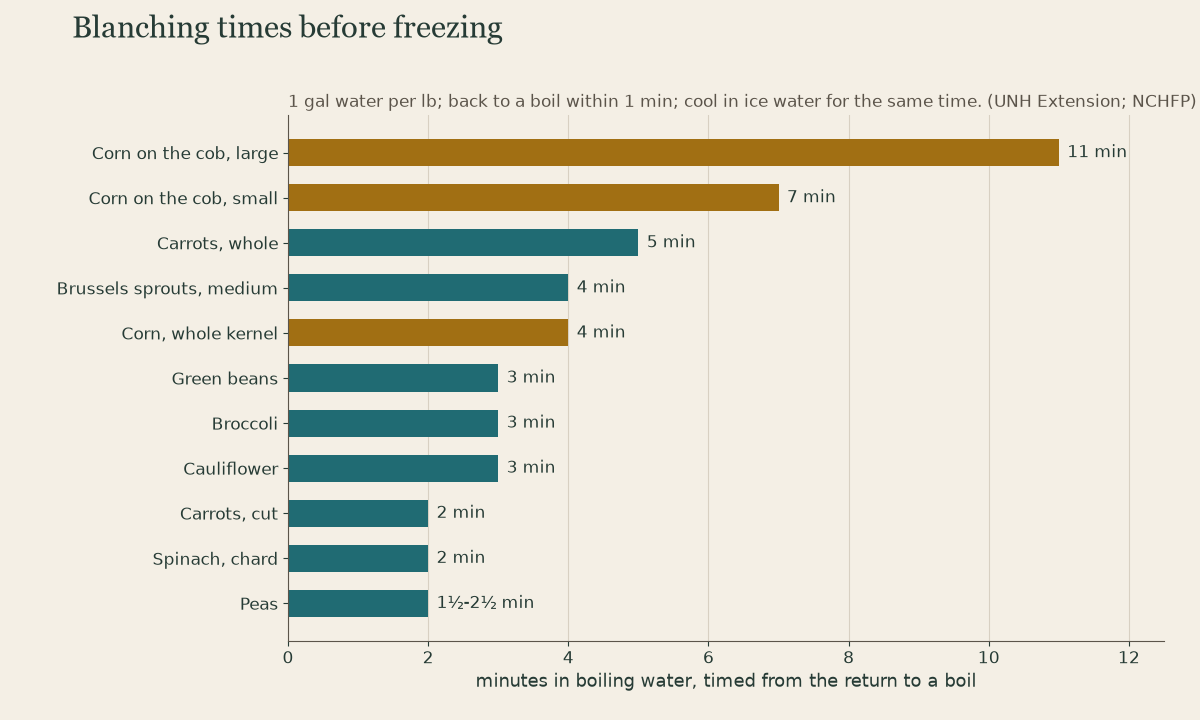
Blanching times
From UNH Extension 2:
| Vegetable | Minutes |
|---|---|
| Green or wax beans (2-4 in. pieces) | 3 |
| Broccoli (1-1-1/2 in. florets) | 3 (steam 5) |
| Cauliflower (1 in. pieces) | 3 |
| Brussels sprouts | 3-5 by size |
| Carrots | cut 2, small whole 5 |
| Peas | 1-1/2 to 2-1/2 |
| Spinach, chard | 2 (collards 3) |
| Corn, whole kernel | 4, then cut |
| Corn on the cob | 7 / 9 / 11, small / medium / large |
| Bell peppers | strips 2, halves 3; or freeze raw |
Beets are cooked until tender rather than blanched, then peeled and sliced; herbs are frozen raw 2.
Playback is optional. If the player is unavailable, open the video at its source.
Packing
- Dry pack: pack tightly in containers or freezer bags, press out the air, and seal 2.
- Tray pack: spread a single layer on a tray, freeze, then bag; the pieces stay loose and pour out 2.
- Headspace: leave about 1/2 inch for most cut vegetables, since food expands as it freezes; none for loose-packed pieces like broccoli and asparagus 2.
- Containers should be moisture-vapor resistant, leak-proof, freezer grade, easy to seal and label, and hold half a gallon or less; regular glass breaks in the cold, so use wide-mouth jars made for freezing 2.
- Get the air out: lower a bagged food into water to push the air out before sealing 3; air left in the package causes freezer burn.
Freeze and store
Freeze at 0 °F or lower, and don’t overload the freezer at once, which slows freezing 2; spread new packages out until they’re solid. At 0 °F, frozen vegetables keep high quality 8 to 12 months 2. Label every package with contents and date, and eat the oldest first.
Poultry and game go in the freezer the same way, flat and airless; poultry is chilled and rested in the refrigerator first (see the Butchering course’s poultry lessons) 3.
Quick check
They stay safe longer, but quality slowly declines; freezer burn comes from air in the package.
Try it
Put up a bushel of sweet corn: sort ears by size, blanch them at 7, 9, or 11 minutes, cool them twice as long, cut the kernels off, and dry pack them in pint bags with 1/2 inch of headspace. Freeze half a dozen ears whole for comparison.
What to take from this
Blanch vegetables before freezing to stop enzymes, timing from the return to a boil (within 1 minute with 1 gallon of water per pound), then cool in ice water for the same time and drain well. Green beans, broccoli, and cauliflower take 3 minutes, peas about 2, corn on the cob 7-11 by size. Dry pack or tray pack, leave 1/2 inch headspace for most, press out air, freeze at 0 °F without overloading, and use within 8-12 months.
Lesson complete
Nice work.
Sources for this lesson
- 1Blanching Vegetables. National Center for Home Food Preservation. verifiedBlanching stops enzyme action that causes loss of flavor, color, and texture, cleans, brightens color, and slows vitamin loss; 1 gallon water per pound; water back to a boil within 1 minute; time from the return to boiling; steam blanching takes about 1-1/2 times longer; microwave blanching may not inactivate enzymes; cool in water 60 °F or below with about 1 lb ice per lb of vegetables, for the same time as blanching; drain thoroughly.
- 2Freezing Vegetables. University of New Hampshire Cooperative Extension. verifiedUnder-blanching is worse than none, over-blanching loses flavor and nutrients; 2 gallons water per lb for leafy greens; cool for the blanching time (corn on the cob twice as long); dry pack or tray pack; freeze at 0 °F or lower without overloading the freezer; 8-12 months quality; times: green beans 3, broccoli 3, cauliflower 3, carrots whole 5 cut 2, peas 1-1/2 to 2-1/2, greens 2, corn on the cob 7-11 by size, kernels 4 minutes.
- 3Julie Garden-Robinson. Food Freezing Basics: Freezing Poultry and Fish (FN615). North Dakota State University Extension. 2005. verifiedChill home-slaughtered poultry in the refrigerator below 40 °F, 6 hours for broiler-fryers and 24 hours for older birds, or 2-3 hours in ice water; wrap giblets separately; flat compact packages; remove air by submerging the bag in water; never stuff before freezing; pink meat or dark bones in young birds are from hemoglobin and safe.