Assessing a Property: Land, Water, and Soil
Reading a piece of land before you buy or build on it: soils and septic limits in the USDA Web Soil Survey, wetlands from the DNR's maps and a walk for clues, floodplain in the DNR permit viewer, the well's report and a water test, and the septic system; then laying out the homestead around the well by Wisconsin's NR 812 setbacks (25 ft to a septic tank, 50 to a drainfield, barn, or animal yard, 100 to liquid-tight manure storage, 250 to an earthen pit), plus slope, aspect, and frost pockets.
- 5 min
- 7 steps
- 3 questions
- Lesson 1 of 55
In this lesson
- Soils
- Water on the land
- The well and septic
- Laying out around the well
- Slope, sun, and cold air
- Try it
Picking up where you left off.
A homestead lives or dies by things a listing doesn’t show: how the soil drains, where the water table sits, whether the low corner is a wetland, whether the well is sound, and whether there’s room to put a barn and a septic field where the rules allow. Most of that can be checked from public maps before you ever make an offer, and the rest on a walk.
Soils
Start with the USDA Web Soil Survey, which covers more than 95% of U.S. counties 1. Find the property by address, draw an Area of Interest around it, and you get a soil map with each soil type named, plus ratings for what each one is suited to 1:
- Drainage class. Well drained, somewhat poorly drained, or poorly drained. Poorly drained soils mean wet basements, late spring planting, and trouble with septic systems 1.
- Septic tank absorption fields. A “very limited” rating means a conventional drainfield may not work and you may be looking at a mound or holding tank.
- Dwellings with basements, farmland class, and garden suitability.
The survey is a screening tool; for a septic system, a certified soil tester digs pits and makes the official call 1.
Quick check
It’s a screening tool; a soil test pit by a certified soil tester settles it.
Water on the land
Wetlands are protected by law, and you need permits before building on them or filling them. Knowing they’re there before you buy saves legal trouble, flooded basements, and shifting foundations 2. The DNR’s process 2:
- Map review in the DNR’s Surface Water Data Viewer, which has the state wetland layers.
- Walk the land looking for clues: standing water in spring, water-stained leaves, wetland plants like cattails, sedges, and willows, and dark, mucky soil.
- Explore your options with the DNR before planning anything near them.
Floodplain maps are in the DNR’s permit viewer (the SW4P viewer) 2. A new well can’t be built in a floodway 3, and you don’t want the barn there either.
The well and septic
Ask for the well construction report, which gives depth, casing, and the water level, and test the water for bacteria, nitrate, and, where relevant, arsenic before closing 4. (See the wells lesson for what to look for at the well head.) Find out where the septic tank and drainfield are, how old they are, and when they were last pumped and inspected.
Then check county and town zoning: what’s allowed on the parcel, how many animals, and what permits you’ll need for outbuildings.
Laying out around the well
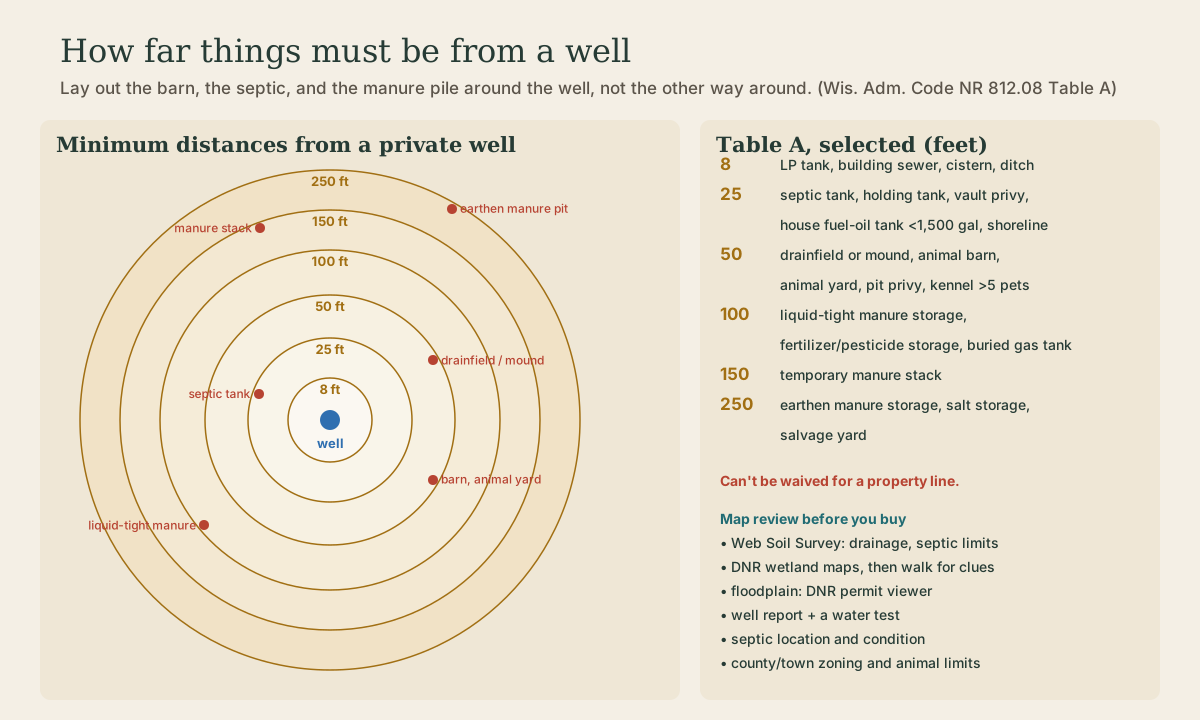
Wisconsin’s well code, NR 812 Table A, sets minimum distances between a well and anything that could contaminate it. They’re measured edge to edge and can’t be waived because of a property line 3. The ones that matter most on a homestead:
| From the well | At least |
|---|---|
| LP tank serving the house, building sewer, cistern, ditch | 8 ft |
| Septic tank, holding tank, vault privy, house fuel-oil tank (<1,500 gal), lake or stream shore | 25 ft |
| Drainfield or mound, animal barn, animal yard or calf hutch, pit privy, kennel of 6+ pets | 50 ft |
| Liquid-tight manure storage, fertilizer or pesticide storage, buried gasoline tank | 100 ft |
| Temporary manure stack | 150 ft |
| Earthen manure storage, salt storage, salvage yard | 250 ft |
Plan the rest of the layout around those circles: the barn and animal yard at least 50 feet off, and the manure pile at least 150, preferably downhill from the well, so surface water from them runs away from it, not toward it.
Quick check
A septic tank needs 25 feet; the drainfield needs 50. Property lines don’t waive the distances.
Quick check
Earthen manure storage needs 250 feet; a temporary manure stack 150.
Slope, sun, and cold air
On the walk, also note:
- Aspect. A south- or southeast-facing slope warms earliest in spring, the place for the garden and orchard.
- Frost pockets. Cold air drains downhill and pools in low spots; valley bottoms can be several degrees colder than the slopes above, which matters for fruit blossoms and tender plants.
- Wind. In Wisconsin, winter winds come mostly from the northwest; a woodlot or windbreak on that side cuts heating and snow drifting.
- Access. Where the driveway will drift shut, and where a truck can reach the barn and woodpile.
Try it
Pick a property you know, or one for sale, and spend an hour with the Web Soil Survey and the DNR’s viewers: list its soil types and their septic ratings, mark any mapped wetlands and floodplain, and sketch where a well, septic field, barn, and manure pile could go and still meet the Table A distances.
Lesson complete
Nice work.
Sources for this lesson
- 1How to Use the Web Soil Survey to Find Information about Your Land (SL530). UF/IFAS Extension (Mary G. Lusk). 2025. verifiedThe USDA-NRCS Web Soil Survey (websoilsurvey.nrcs.usda.gov) covers more than 95% of U.S. counties with soil properties, management descriptions, and cautions about limitations. Steps: Start WSS, find the property by address or coordinates, draw an Area of Interest, then view the Soil Map and the Soil Data Explorer for suitabilities and limitations (e.g., septic absorption fields, dwellings, drainage). Drainage properties affect foundations and septic placement; onsite investigation is still needed.
- 2Locating wetlands. Wisconsin Department of Natural Resources. verifiedWetlands are protected by law and permits are required before building on or affecting them. Knowing whether wetlands are present helps buyers avoid legal trouble, flooded basements, and shifting foundations. Steps: map review, a walk to search for wetland clues, then explore options; developed with the Wisconsin REALTORS Association and others. The DNR Surface Water Data Viewer holds wetland layers; floodplain layers moved to the Storm Water, Waterway and Wetland Permit (SW4P) Viewer in May 2026.
- 3Wis. Adm. Code NR 812.08, Table A: Minimum Separation Distances for Wells. Wisconsin Legislative Reference Bureau (current to Register February 2026). verifiedSeparation distances are measured from the well edge to the nearest edge of the source and can't be waived because of a property line. Selected distances (feet): animal barn or pen 50; animal shelter 50; animal yard incl. calf hutch 50; cistern 8; ditch 8; sanitary building drain/sewer 8; storm sewer 8; LP gas tank serving a single-family residence 8; fuel oil tank under 1,500 gal serving a residence 25; buried gasoline tank 100; fertilizer or pesticide storage (potable wells) 100; manure hopper/reception tank 50; manure loading area 50; temporary manure stack 150; earthen manure storage 250; fabricated liquid-tight manure storage 100; milkhouse drain outlet 50; kennel over 5 pets 50; POWTS dispersal component (drainfield or mound) under 12,000 gal/day 50; POWTS holding tank 25; POWTS treatment component (septic tank) 25; pit privy 50; vault privy 25; salt storage 250; salvage yard 250; lake, pond, river, or stream shoreline 25; silage earthen trench 250. Wells may not be built in a floodway except as allowed.
- 4Test your private well water annually. Wisconsin Department of Natural Resources. verifiedBacteria once a year and when taste, color, or smell change; nitrate once a year and before use by a woman who is or may become pregnant; arsenic every five years for most, every year in Outagamie, Winnebago, and Brown counties or after a previous detection. Use a certified lab's kit and get samples there within 48 hours. Stop drinking if bacteria are present; over 10 ppm nitrate, avoid for pregnancy and don't give to infants under six months or use for formula.