Advocacy, Lobbying, Campaigns, and Public Resources
Keeping speech roles straight: government communication, nonprofit advocacy and limited lobbying, the 501(c)(3) ban on candidate campaigns, neutral candidate forums, splitting officeholder and candidate roles, and why a personal-capacity footer isn't magic.
- 6 min
- 12 steps
- 3 questions
- Lesson 35 of 36
In this lesson
- Four speech lanes
- Advocacy is larger than lobbying
- Candidate campaign intervention is different
- Neutral candidate-event checklist
- The officeholder-candidate split
- The nonprofit-director-candidate split
- Advocacy to the city
- Government communication about a nonprofit
- Issue-campaign scenario
- Personal-capacity footer is not magic
- Build a role card
- Working rule
Open alongside this lesson
-
Frequently Asked Questions About the Ban on Political Campaign Intervention (opens in a new tab)
A 501(c)(3) may not intervene for or against a candidate; context matters, so obtain advice before election-season activity.
-
Instructions for Schedule C — Political Campaign and Lobbying Activities (opens in a new tab)
Advocacy, legislative lobbying, administrative activity, and campaign intervention are not one category.
Picking up where you left off.
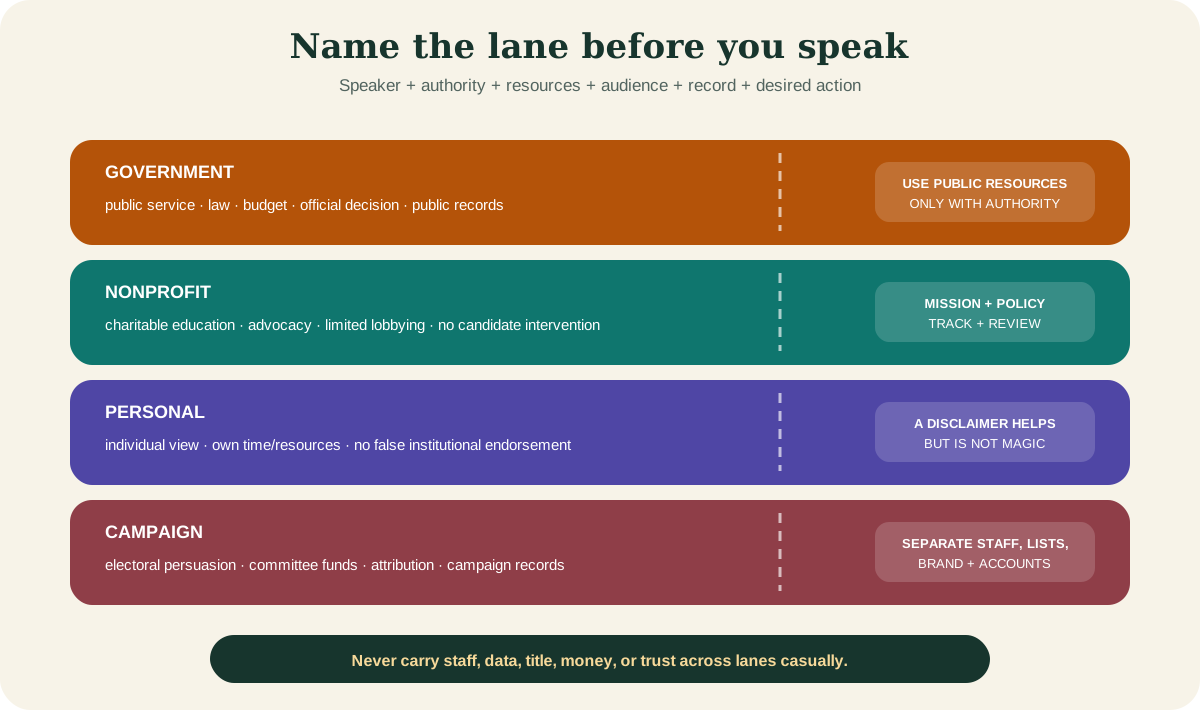
Community leaders speak in several capacities. Confusion begins when the audience cannot tell which institution, authority, money, or role stands behind the message.
Four speech lanes
Government communication
Explains public programs, safety, services, law, budgets, decisions, and proposals through authorized channels. It creates public records and must respect constitutional, statutory, ethical, and local constraints.
Nonprofit communication
Advances charitable mission through education, research, convening, public comment, advocacy, and limited lobbying under applicable rules. A 501(c)(3) may conduct some lobbying but may not intervene in candidate campaigns 1.
Personal speech
An individual may express personal political views, subject to employment, fiduciary, confidentiality, ethics, and other applicable obligations. The speaker should not imply institutional endorsement.
Campaign communication
Seeks election or defeat, raises/spends campaign funds, recruits volunteers, and communicates as a candidate or committee under campaign-finance and attribution rules.
The same sentence can be lawful in one lane and improper in another because of speaker, audience, timing, resources, and context.
Advocacy is larger than lobbying
Nonprofit advocacy can include:
- public education and research;
- sharing program evidence with officials;
- administrative comment;
- coalition participation;
- nonpartisan voter education;
- litigation where appropriate;
- community organizing;
- legislative lobbying within limits.
Lobbying definitions and reporting depend on the governing tax framework and election, including whether an organization has made a 501(h) election. Schedule C instructions explain federal reporting categories 2. Confirm the nonprofit’s actual status and policy with tax counsel.
Quick check
Advocacy is broader than lobbying, and candidate intervention is a separate, prohibited category.
Candidate campaign intervention is different
For a 501(c)(3), organizational intervention for or against a candidate is prohibited 3. Risk can arise through:
- endorsement or opposition;
- contributions or in-kind support;
- selective mailing lists, space, staff, equipment, or publicity;
- biased candidate events;
- ratings or voter guides that favor candidates;
- issue messages shaped by timing, targeting, language, history, and coordination;
- social-media activity through institutional accounts.
Do not treat “we never used the word vote” as a safe harbor.
Neutral candidate-event checklist
Before an event:
- written charitable/nonpartisan purpose;
- objective, preexisting invitation criteria;
- equal opportunity for qualifying candidates;
- broad, nonpartisan subject coverage;
- independent questions and moderator;
- no fundraising, endorsements, campaign signs, or preferential links;
- equal time and comparable format;
- opening/closing neutrality statement;
- accessible venue and communication;
- recording/publication rules applied equally;
- no campaign control over audience or content;
- board approval and qualified legal/tax review;
- plan if a candidate declines.
Inviting only candidates for a nonpartisan policy forum may still be possible under carefully structured facts, but election-season activity should not be improvised.
The officeholder-candidate split
An incumbent mayor running for reelection remains mayor. Separate:
| Official | Campaign |
|---|---|
| city email, calendar, website, seal | campaign accounts and branding |
| city staff work | campaign-paid/volunteer work |
| public meetings and records | campaign events and committee records |
| service information | electoral persuasion |
| authorized official travel | campaign travel/accounting |
| city photograph under policy | campaign-created/authorized media |
| public safety and operations | canvassing, fundraising, endorsements |
Do not use public staff, equipment, data, access, events, or authority to advantage the campaign. Wisconsin ethics standards prohibit use of public position for improper substantial benefit 4.
City records should not be quietly transferred into campaign systems. Publicly available information may be used under the same rules available to others, but privileged access and staff-created campaign work are different issues.
The nonprofit-director-candidate split
If a Shake Rag director runs for local office:
- disclose the candidacy and likely conflicts;
- stop using title where it suggests endorsement;
- do not request lists, staff, learner stories, venues, equipment, photographs, or donor introductions for campaign use;
- let disinterested leaders manage any city/candidate matter;
- recuse where policy/law requires;
- separate social accounts and signatures;
- avoid discussing confidential board business in the campaign;
- resign from a role if conflicts become unmanageable, after thoughtful governance review.
Dual service may be possible; ungoverned dual use is not.
Advocacy to the city
A nonprofit may communicate public evidence:
“Our 2026 program served 416 unique learners, paid 18 artists, and used six historic campus buildings. The attached methods define each measure. The organization requests that the city include accessible pedestrian connection and cultural-resource data in the planning scope.”
Then identify:
- is specific legislation involved?
- who approved the position?
- which grant or donor restrictions apply?
- how are staff time and expense tracked?
- is the claim nonpartisan and factual?
- is a board member also a city decision-maker?
- what public meeting/record will capture the request?
Submitting the statement through a noticed city process can make the advocacy more transparent and useful 5.
Government communication about a nonprofit
A mayor may explain an adopted city grant or public partnership. Avoid:
- implying personal ownership of council action;
- soliciting donations with city systems without authority;
- endorsing one private organization outside policy;
- promising permits, contracts, votes, or appointments;
- using the nonprofit as campaign validation;
- releasing protected information;
- turning a city event into campaign content.
Use:
“The Council approved a one-year $25,000 services agreement after the published selection process. The nonprofit will deliver the listed workshops and quarterly reports. The agreement and vote are public. I supported the project for the reasons in the meeting record; the first performance review is scheduled for October.”
Issue-campaign scenario
A nonprofit launches “Save Our Studios” two months before a mayoral election. One candidate champions the issue; another questions cost. The nonprofit:
- uses a candidate’s quote;
- links to that campaign’s site;
- emails its donor list;
- schedules a rally beside the candidate’s event;
- says it is only discussing policy.
Red flags include timing, targeting, linkage, candidate reference, coordination, use of institutional resources, and one-sided presentation. Stop and obtain counsel. A safer charitable advocacy campaign would be designed around the issue and legislation/administrative decision, use factual evidence, maintain independence, avoid candidate preference, apply neutral event rules, and track lobbying where applicable.
Personal-capacity footer is not magic
“Views are my own” helps clarify role but does not cure:
- use of institutional resources;
- disclosure of confidential information;
- prohibited official action;
- campaign intervention by a 501(c)(3);
- a reasonable appearance of endorsement;
- duties attached to title or position.
Context controls.
Build a role card
For every public-facing leader:
| Role | Authorized subjects | Channels | Resources allowed | Records owner | Approval | Prohibited/conflict zones |
|---|---|---|---|---|---|---|
Review before campaign season, major city decisions, grant announcements, and joint events.
Working rule
Before speaking, name the hat, authority, audience, resources, record, and desired action.
When those are clear, leaders can advocate vigorously without converting public or charitable trust into private political capital.
Practice
Candidate events can create campaign-intervention risk; neutral criteria and equal, nonpartisan treatment are essential and should receive current legal/tax review.
Practice
Official, personal, and campaign activity need separate resources, channels, attribution, and authority.
Lesson complete
Nice work.
Sources for this lesson
- 1Exemption Requirements — 501(c)(3) Organizations. Internal Revenue Service. verifiedOfficial rules on exempt purposes, private benefit, lobbying limits, and political campaign intervention. Cited at: political limits.
- 2Instructions for Schedule C — Political Campaign and Lobbying Activities. Internal Revenue Service. verifiedCurrent reporting instructions, including the 501(h) expenditure-election framework. Cited at: lobbying reporting.
- 3Frequently Asked Questions About the Ban on Political Campaign Intervention. Internal Revenue Service. verifiedOfficial examples and questions about candidate events, voter education, issue positions, and the absolute campaign-intervention ban. Cited at: campaign ban.
- 4Standards of Conduct for Local Government Officials. Wisconsin Ethics Commission. verifiedPlain-language overview of Wisconsin's local governmental ethics rules. Cited at: standards.
- 5Agenda Center. City of Stoughton, Wisconsin. verifiedOfficial notices, agendas, packets, and minutes for the Common Council, committees, boards, and commissions. Cited at: public meeting records.
Further reading
- A Citizen's Guide to Wisconsin's Local Governmental Officials Code of Ethics. Wisconsin Ethics Commission. verifiedPlain-language guide to private benefit, financial interests, incompatible action, and public contracts for local officials.
- Prohibited Contributions. Wisconsin Ethics Commission. verifiedRules for prohibited sources, anonymous contributions, cash, and foreign nationals.
- Attribution Requirements. Wisconsin Ethics Commission. verifiedCurrent paid-for-by requirements and limited exceptions for campaign communications.