Legal Duties and the Governance Stack
The fiduciary duties of care, loyalty, and obedience for a Wisconsin nonprofit director, the governance stack from law to bylaws to policy, good-faith reliance on experts, conflicts defined by interest rather than intent, collective authority and quorum, and a restricted-gift case.
- 5 min
- 9 steps
- 3 questions
- Lesson 5 of 36
In this lesson
- The governing unit is the corporation
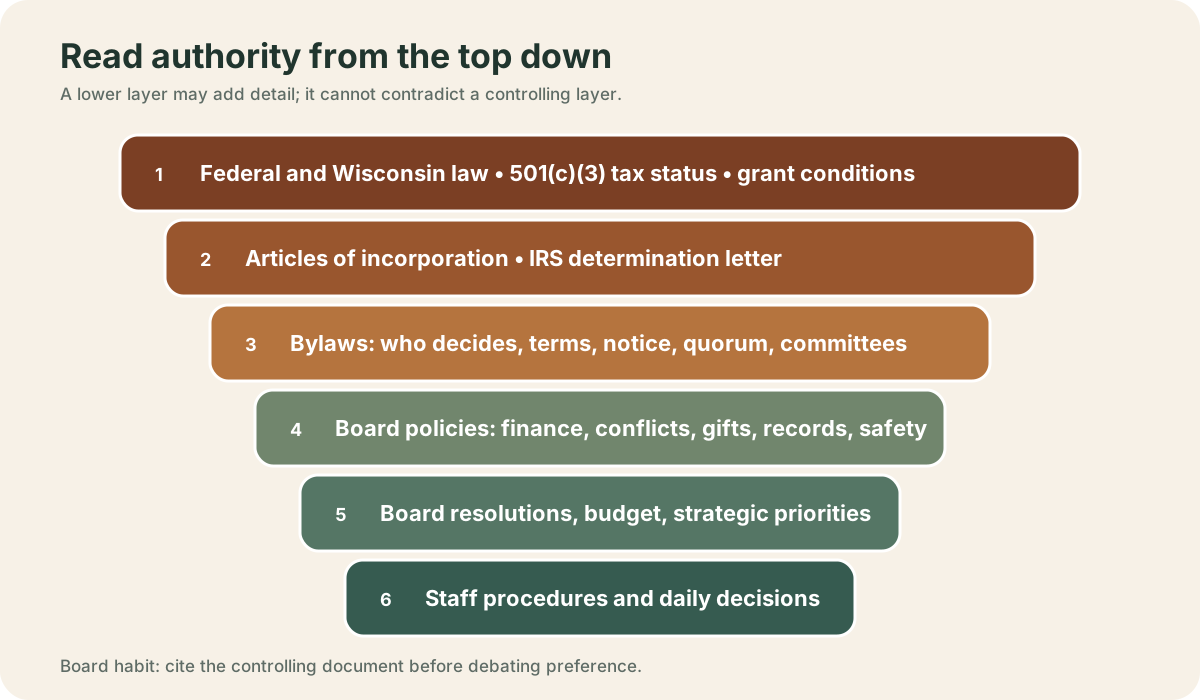
- Read the governance stack
- Duty of care: a repeatable method
- Duty of loyalty: interest, not intent
- Duty of obedience: mission plus rules
- Collective authority
- Decision exercise
- Board habit
Open alongside this lesson
-
Nonprofits (opens in a new tab)
Use this to find current statutes and regulators; obtain counsel for organization-specific interpretation.
Picking up where you left off.
A director does not merely advise a nonprofit. The board, acting collectively, governs the charitable corporation. Its responsibilities are commonly summarized as:
- care: prepare, ask informed questions, deliberate, and monitor;
- loyalty: put the organization ahead of personal, family, employer, donor, vendor, or factional interests;
- obedience: remain faithful to mission, law, governing documents, restrictions, and valid decisions.
These labels are memory aids, not substitutes for Shake Rag Alley’s current articles, bylaws, policies, contracts, grant terms, and legal advice. This course is education, not legal or tax advice.
The governing unit is the corporation
You do not represent “your” art medium, neighborhood, donor, or program. You bring knowledge of constituencies, then decide for the whole. Shake Rag’s mission combines arts education, rural creativity, and preservation of a historic campus 1. A choice that benefits workshops while making buildings unsafe is incomplete. So is a preservation choice that makes mission programming financially impossible.
The board must:
- safeguard mission and charitable status;
- select, support, evaluate, compensate, and if necessary replace the executive director;
- approve strategy and monitor outcomes;
- approve budgets, material commitments, and financial policies;
- oversee risk, compliance, ethics, and controls;
- ensure adequate resources and participate in development;
- renew itself through recruitment, education, evaluation, and succession;
- decide and speak through authorized collective processes.
Delegating work does not erase oversight.
Read the governance stack
| Layer | What it answers | Board question |
|---|---|---|
| Federal/state/local law | What must or must not happen | Is this lawful and current? |
| Articles and IRS status | Purpose and tax-exempt bounds | Does this serve exempt purpose? |
| Bylaws | Composition, officers, meetings, voting, committees | Who has authority? |
| Board policies | Durable rules for repeated cases | What principle controls? |
| Resolutions/plans | A specific decision or delegation | What exactly was authorized? |
| Executive procedures | How staff implement policy | Is this operational? |
| Custom | Habit, not necessarily authority | Is the habit valid? |
For every important action, finish: “The authority for this is…”
Duty of care: a repeatable method
Wisconsin permits good-faith reliance on competent officers, employees, counsel, accountants, committees, and experts within their competence, but not when contrary knowledge makes reliance unwarranted 2.
- Frame the decision. What is being approved, by whom, and by when?
- Demand decision-grade information. Alternatives, cost, cash timing, restrictions, risks, owner, success measures.
- Identify expertise. Does this require counsel, CPA, insurer, engineer, preservation specialist, or safeguarding expert?
- Deliberate. Test assumptions and conflicts, not only affirming evidence.
- Decide and record. Motion, vote, recusals, conditions, delegation.
- Monitor. Put the promised milestone back on the calendar.
Care is not endless delay or rewriting staff work. It is a reasonable process proportional to the stakes.
Quick check
Reliance is part of the duty of care, but contrary knowledge ends it.
Duty of loyalty: interest, not intent
A conflict may exist without bad intent:
- your company bids on campus work;
- a family member applies for employment or an instructor contract;
- you own nearby lodging affected by a rental decision;
- you serve a potential partner or competing grantee;
- a donor presses for a pet program;
- nonpublic information could benefit another interest.
Use disclose early → determine process → leave deliberation/vote when required → disinterested decision → record handling. “Everyone knows” is not disclosure; abstention alone may not cure a flawed transaction.
Duty of obedience: mission plus rules
A 501(c)(3) must operate for exempt purposes; private inurement is prohibited, private benefit must be incidental, lobbying is limited, and campaign intervention is prohibited 3. Obedience includes:
- honoring donor and grant restrictions;
- using assets for charitable purposes;
- making required filings;
- following valid contracts and policy;
- avoiding unauthorized private benefit;
- correcting practices that conflict with authority;
- protecting mission through leadership transitions.
“A donor will pay” is not a mission test. “We always do it” is not a compliance test.
Collective authority
An individual director normally has no operational authority merely from holding a seat. Authority comes from the board, bylaws, office, committee charter, or specific delegation.
Wisconsin’s default rule generally makes a majority of directors in office a quorum, with action by a majority present when a quorum exists, subject to articles/bylaws 4. Written action follows statute and governing documents; unanimous written consent is the baseline, with a possible two-thirds route only when authorized and notice requirements are met 5. Do not assume an informal email poll is valid action.
Decision exercise
An anonymous donor offers $80,000 if Shake Rag converts a historic building into a specialized studio within six months. The gift covers equipment, not structural work, staffing, insurance, maintenance, or accessibility.
- obedience: Does it fit mission, restrictions, preservation duties, code, and charitable purpose?
- loyalty: Does a director, donor intermediary, or vendor have an interest?
- care: What condition assessment, lifecycle budget, alternatives, demand evidence, and forecast are needed?
- authority: Which approval threshold applies?
- sustainability: What happens when restricted money ends?
- monitoring: What stop/go milestones are required?
The mature answer may be yes, no, or a negotiated redesign. The duty is a sound process.
Board habit
Require five lines atop every decision memo:
Decision requested · mission connection · authority · money/cash source · principal risks
That turns fiduciary vocabulary into a way of working.
Practice
Practice must fit governing documents and applicable law.
Practice
Obedience is loyalty to charitable purpose and lawful authority.
Lesson complete
Nice work.
Sources for this lesson
- 1About Us. Shake Rag Alley Center for the Arts. verifiedCurrent mission, staff and board roster, programs, campus history, and organization timeline. Cited at: mission.
- 2Wisconsin Statutes § 181.0850 — Reliance by directors or officers. Wisconsin Statutes via Justia. 2025. verifiedCurrent rules on good-faith reliance on officers, employees, experts, and board committees. Cited at: director reliance.
- 3Exemption Requirements — 501(c)(3) Organizations. Internal Revenue Service. verifiedOfficial rules on exempt purposes, private benefit, lobbying limits, and political campaign intervention. Cited at: exemption requirements.
- 4Wisconsin Statutes § 181.0824 — Quorum and voting. Wisconsin Statutes via Justia. 2025. verifiedCurrent default quorum and board-vote rules, subject to governing documents. Cited at: quorum and voting.
- 5Wisconsin Statutes § 181.0821 — Action without meeting. Wisconsin Statutes via Justia. 2025. verifiedCurrent text on written board action, including electronic writing and signatures. Cited at: action without meeting.
Further reading
- Nonprofits. Wisconsin State Law Library. verifiedOfficial Wisconsin legal research guide pointing to Chapter 181, agencies, forms, and nonprofit legal resources.
- Board Roles and Responsibilities. National Council of Nonprofits. verifiedGovernance practice on fiduciary stewardship, executive oversight, resources, fundraising, and advocacy.