Events, Sponsorships, In-Kind Gifts, and Gift Acceptance
Fundraising events and gifts that cost more than they look: event economics with staff hours, auctions versus licensed raffles in Wisconsin, sponsorship versus gift, the $250 acknowledgment rule, green-amber-red gift acceptance triage, in-kind decisions, and event postmortems.
- 5 min
- 8 steps
- 3 questions
- Lesson 20 of 36
In this lesson
- Event economics
- Auction versus raffle
- Sponsorship versus gift
- Acknowledgment rules
- Gift acceptance triage
- Gift review memo
- In-kind decision
- Event postmortem
Open alongside this lesson
-
Gift Acceptance Policies (opens in a new tab)
Use policy and professional review before accepting complex or burdensome property.
Picking up where you left off.
Fundraisers can generate money, relationships, mission visibility, and community. They can also consume hundreds of hours, create tax/gaming/alcohol risk, confuse gift value, and leave no follow-up.
Event economics
Build the event budget:
gross receipts
− direct cash costs
− value/cost of donor benefits
= accounting/net cash contribution (define precisely)
Then add:
staff hours × loaded hourly cost
volunteer hours (tracked separately, not casually monetized in accounts)
displaced program/campus use
risk and follow-up capacity
Example:
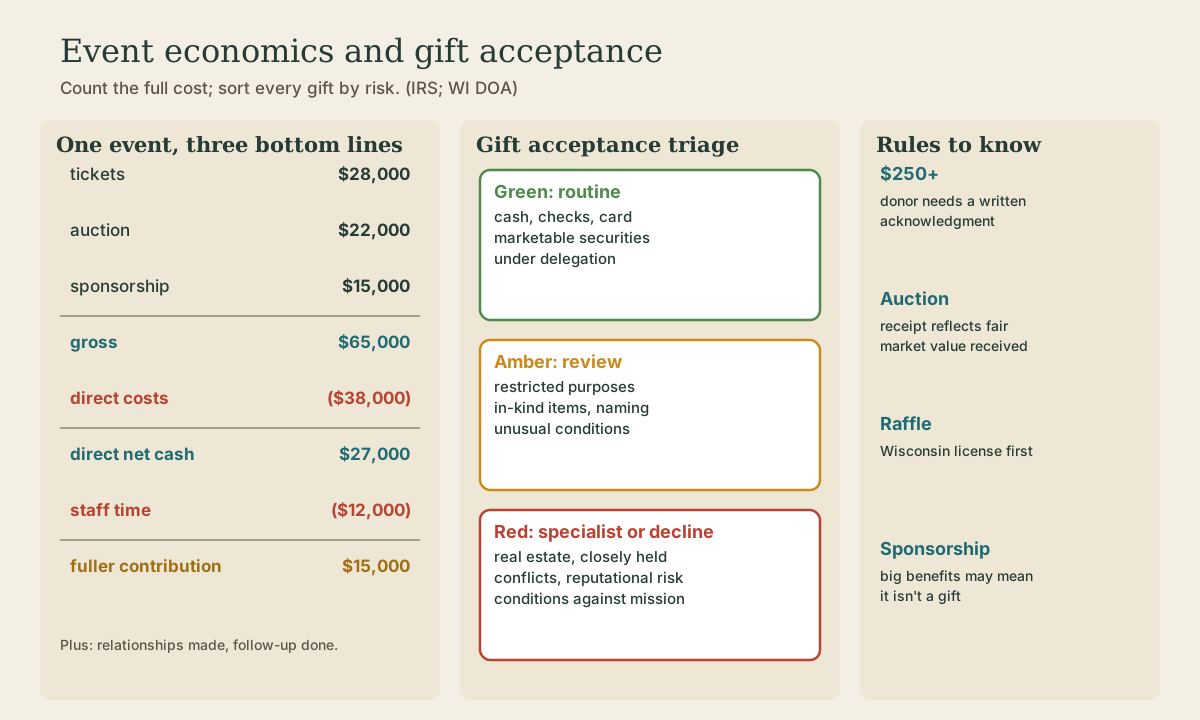
| Item | Amount |
|---|---|
| tickets | $28,000 |
| auction | $22,000 |
| sponsorship | $15,000 |
| gross | $65,000 |
| venue/food/production/processing | ($38,000) |
| direct net cash | $27,000 |
| staff loaded time | ($12,000) |
| fuller internal contribution | $15,000 |
If it also produces 25 qualified new relationships and strong mission experience, it may be excellent. If no data or follow-up is captured, gross revenue flatters it.
Set before launch:
- financial and mission goals;
- target audiences;
- gross/direct-net and fuller-cost definitions;
- staff/board/volunteer roles;
- licenses, insurance, safety, alcohol, contracts;
- donor benefit and acknowledgment treatment;
- data/consent/photography;
- weather/cancellation;
- follow-up assignments and 30-day review.
Auction versus raffle
An auction awards to the successful bidder. A raffle generally distributes chances and selects by chance. Wisconsin requires raffle licensing and distinguishes Class A/B activity 1. Do not rename chance-based gaming to avoid regulation. Confirm current licensing, ticket, drawing, prize, reporting, local, and tax rules before promotion.
Auction purchaser acknowledgment generally must account for the fair market value of goods/services received. Obtain donor-provided estimates for auction items and review unusual valuations; the organization should not act as the donor’s appraiser.
Sponsorship versus gift
Define what the sponsor receives:
- name/logo recognition;
- tickets/hospitality;
- product display or distribution;
- advertising language, links, endorsements;
- exclusivity;
- speaking/access;
- program or naming association.
Pricing must include benefit cost, delivery capacity, mission/reputation fit, and tax/accounting treatment. “Sponsorship” is not automatically a charitable contribution. Advertising and substantial return benefits may change treatment; consult current tax guidance.
Never give:
- governance influence;
- participant/donor personal data without valid basis/consent;
- endorsement inconsistent with mission;
- exclusivity that blocks programs or ethical relationships;
- unreviewed permanent naming.
Use a written agreement with deliverables, value, payment, dates, cancellation, brand approval, conduct, insurance, data, and remedy.
Acknowledgment rules
Federal substantiation rules make the donor responsible for obtaining a contemporaneous written acknowledgment for a contribution of $250 or more, while the organization should have a consistent acknowledgment system 2.
The acknowledgment states:
- organization name;
- cash amount, or description (not value) of noncash property;
- whether goods/services were provided;
- good-faith estimate of goods/services if provided, or qualifying intangible religious-benefit statement where applicable.
For a quid-pro-quo contribution over $75, the organization generally must provide a written disclosure stating that the deductible amount is limited to payment over the good-faith value of benefits, with the estimate and subject to exceptions/current rules 3.
Example:
Payment $200; dinner fair value $65 → potential contribution component $135.
The $75 test concerns the payment threshold for disclosure, not a claim that every $75 is deductible.
Do not say:
- “fully tax deductible” without confirming benefits;
- a value for donated property;
- that donated services are deductible;
- that a raffle ticket is a donation.
Quick check
The donor is responsible for getting it, but the organization should acknowledge consistently.
Gift acceptance triage
Green—routine under delegation
- cash/check/card;
- publicly traded securities through approved process;
- ordinary unrestricted online gifts;
- accepted program funds within policy.
Amber—review
- new restriction;
- in-kind goods with storage/use/disposal cost;
- artwork, equipment, vehicles;
- sponsorship with benefits;
- multiyear pledge;
- donor-requested naming/privacy;
- cryptocurrency or closely held interests if policy permits.
Red—specialized review or decline
- real estate with environmental/maintenance/liquidity risk;
- hazardous materials;
- property subject to debt or conditions;
- gifts requiring unauthorized control;
- assets with uncertain title/value/market;
- arrangements creating private benefit/conflict;
- reputationally incompatible sources;
- restrictions impossible to perform;
- gift whose ongoing cost exceeds benefit.
National Council of Nonprofits recommends a gift-acceptance policy to manage unusual gifts and donor restrictions before pressure arrives 4.
Gift review memo
donor and relationship · asset/amount · proposed restriction · mission fit · valuation source (not organization appraisal) · liquidity · carrying/disposal cost · legal/tax/accounting · environmental/safety · reputation · conflict · recognition/naming · required experts · recommendation · authorized approver
The gift committee/board should not provide donor tax advice; encourage independent advisers.
In-kind decision
Ask:
- Would we buy it in the approved plan?
- Is it safe, legal, insured, accessible, and appropriate?
- Who owns transport, storage, installation, maintenance, disposal?
- Does it impose artist, property, or donor restrictions?
- How is accounting value supported?
- Can we decline or dispose under the agreement?
“Free” is a price, not a total cost.
Event postmortem
Within 30 days:
- gross/direct net/fuller cost;
- goals versus actual;
- new/renewed/upgraded donors;
- qualified prospects and assigned next moves;
- sponsor delivery;
- incidents/near misses;
- participant/volunteer experience;
- board commitments;
- what to stop/start/continue;
- next-year decision.
Never schedule the next event before reading the last one.
Practice
Gross receipts can conceal cost and opportunity cost.
Practice
Benefits affect disclosure and potentially the deductible amount.
Lesson complete
Nice work.
Sources for this lesson
- 1Applying for a New Raffle License. Wisconsin Department of Administration. verifiedCurrent Wisconsin raffle-license eligibility and Class A/Class B overview. Cited at: raffle rules.
- 2Charitable Contributions — Written Acknowledgments. Internal Revenue Service. verifiedOfficial required content for acknowledgments supporting contributions of $250 or more. Cited at: $250 rule.
- 3Substantiating Charitable Contributions. Internal Revenue Service. verifiedOfficial $75 quid-pro-quo disclosure rule and $250 donor-acknowledgment rule. Cited at: quid pro quo.
- 4Gift Acceptance Policies. National Council of Nonprofits. verifiedPolicy guidance for restricted, noncash, hard-to-value, burdensome, and mission-conflicting gifts. Cited at: gift policy.
Further reading
- Ways to Support Shake Rag Alley. Shake Rag Alley Center for the Arts. verifiedCurrent volunteer, donation, planned-giving, event, and legal-name information.
- Sales Tax Exemptions for Nonprofit Organizations. Wisconsin Department of Revenue. verifiedOfficial state guidance on nonprofit purchases, sales, occasional sales, admissions, and fundraising events.
Previous: Donor Conversations, Major Gifts, Stewardship, and Planned Giving