Ethics, Conflicts, Gifts, and the Dual-Role Problem
Governing overlapping roles in a small community: the state, local, and nonprofit ethics rules that can apply at once, naming the two clients, a distance protocol for dual roles, gifts and event access, campaign relationships, and a dual-role register.
- 7 min
- 8 steps
- 3 questions
- Lesson 27 of 36
In this lesson
- Three ethics systems may apply at once
- Name the two clients
- The D-I-S-T-A-N-C-E protocol
- Gifts, meals, travel, awards, and event access
- Campaign relationships add a third boundary
- Scenario lab: the preservation consultant
- Build a dual-role register
Open alongside this lesson
-
A Citizen's Guide to Wisconsin's Local Governmental Officials Code of Ethics (opens in a new tab)
Use for issue spotting, then obtain advice for actual facts.
-
Request Advice (opens in a new tab)
Local ordinances, the municipal attorney, and the local ethics body may also apply.
Picking up where you left off.
Small communities create overlapping roles. The same person may be a donor, neighbor, artist, employer, customer, nonprofit director, commission member, campaign supporter, and public official. Overlap is not automatically corruption; it is a condition that must be governed.
Three ethics systems may apply at once
Public-office duties
Wisconsin law restricts a local public official from using office to obtain substantial benefit, taking official action substantially affecting a matter in which the official or associated business has a substantial financial interest, or accepting something that could reasonably be expected to influence official action or be a reward for it 1.
Local ordinances, employment rules, procurement law, incompatibility rules, due-process requirements, and a municipal ethics code may add restrictions. The state citizen guide also flags special concerns around public contracts in which an official has a private interest 2.
Nonprofit fiduciary duties
A nonprofit director must act for the corporation’s interests and manage interested transactions through the governing documents and Wisconsin’s conflict law. State law describes conditions under which a director conflict-of-interest transaction is not automatically voidable, including disclosure and approval by disinterested directors or fairness to the corporation 3. The actual bylaws and conflict policy may be stricter.
Federal tax-exemption concerns add private-benefit and excess-benefit limits. The IRS conflict-policy guidance emphasizes disclosure, removal from deliberation and vote, and disinterested decision-making 4.
Institutional trust
An action can be technically permitted and still be badly designed. Residents may reasonably doubt a no-bid award to an official’s nonprofit, a donor’s permanent naming condition, or private hospitality during a pending decision. Trust requires a process that an informed outsider can inspect.
Name the two clients
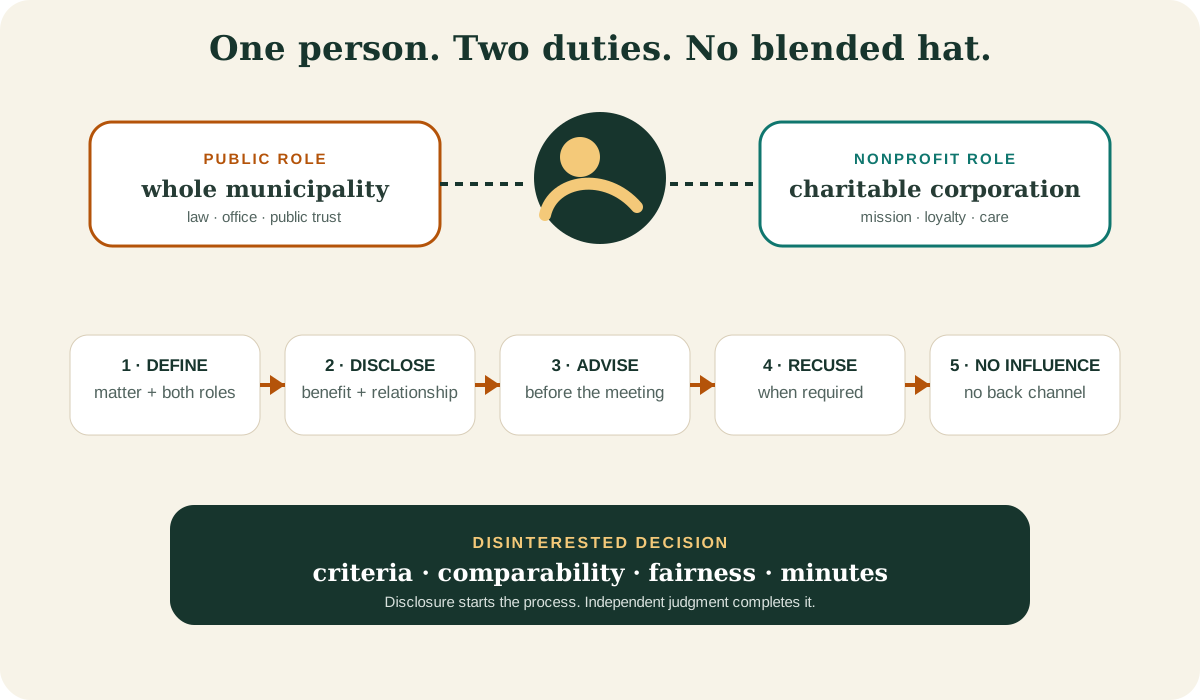
A person serving both as nonprofit director and city official does not have one blended duty called “help the community.”
- In the city role, the person serves public law, the whole municipality, and the responsibilities of the particular office.
- In the board role, the person serves the nonprofit corporation’s charitable mission and fiduciary obligations.
The person’s private reputation, friendships, political goals, and donor relationships are a third layer—not a bridge authorizing either institution.
Quick check
Overlap is normal; unmanaged overlap is what erodes trust.
The D-I-S-T-A-N-C-E protocol
Before participating in a matter touching both roles:
- Define the exact matter on each agenda.
- Identify financial, family, employment, donor, campaign, property, client, and organizational interests.
- Seek advice before the meeting from the correct attorney, clerk, ethics body, or counsel.
- Tell each institution through its required disclosure process.
- Abstain/recuse where required; leave discussion if policy or law requires it.
- No back-channel influence: do not lobby colleagues, supply selective information, or direct staff privately.
- Create the record: minutes should reflect disclosure and handling without publishing unnecessary private detail.
- Evaluate independently: disinterested decision-makers use criteria, comparability, procurement, and documented public/charitable value.
Recusal is not ceremonial. If you leave the room but privately write the motion, recruit votes, negotiate terms, or pressure staff, the substantive problem remains.
Gifts, meals, travel, awards, and event access
An arts organization may naturally invite the mayor to an opening, provide a meal to a board member, reimburse conference travel, or offer a commemorative item. The analysis differs by role and facts.
For a public official, ask:
- Who offered it and because of what role?
- What is its value and who benefits?
- Is a city decision, permit, grant, contract, appointment, or enforcement matter pending?
- Is attendance an assigned public duty with a documented public purpose?
- Is the item available to a broad class or only selected decision-makers?
- May the city pay, reimburse, decline, return, donate, or publicly disclose it?
- What do state guidance and local rules require?
Wisconsin Ethics Commission guidance addresses meals, admissions, travel, awards, discounts, and other items offered to local officials 5. Ask before accepting; do not attempt to legalize a gift after use.
For a nonprofit director, ask:
- Is the benefit necessary for board work or merely personal?
- Is it compensation, reimbursement, donor stewardship, program participation, or a perk?
- Did disinterested directors authorize it under policy?
- Could it create private benefit, taxable income, donor restriction, or reputational risk?
- Would the organization provide it consistently to similarly situated people?
Campaign relationships add a third boundary
A 501(c)(3) may not intervene for or against a candidate 6. If a nonprofit director runs for mayor:
- do not use donor or learner lists for the campaign;
- do not use nonprofit staff time, equipment, meeting space, branding, photographs, or events unless a lawful, neutral arrangement is available on equal terms and professionally reviewed;
- do not imply the board or organization endorsed the candidate;
- separate campaign email, calendar, files, social accounts, money, and volunteers;
- leave organizational decisions about candidate events to disinterested leaders under a preexisting policy.
The candidate retains personal rights, but should not turn a charitable platform into campaign infrastructure.
Scenario lab: the preservation consultant
Facts:
- The city is applying for a historic-resource survey grant.
- A Shake Rag board director owns a qualified preservation-consulting firm.
- The mayor is an unpaid member of Shake Rag’s advisory committee.
- The grant requires a municipal procurement process.
- The nonprofit has offered staff research and meeting space.
Build four separate analyses:
1. City procurement
Who writes the scope, issues the request, scores proposals, approves selection, and signs? Does the mayor have any appointment, budget, committee, or voting role? What state/local conflict or contract rule applies?
2. Nonprofit governance
Can the nonprofit support public engagement without selecting or favoring the director’s firm? Does use of nonprofit staff or space confer a material benefit? What must the board disclose and document?
3. Grant compliance
What does the funder require for qualification, competition, cost, records, public participation, reimbursement, and deliverables?
4. Public trust
Would a reasonable resident understand why the selection was fair? What should be disclosed, and what bidder-confidential information must remain protected?
A strong design may exclude both conflicted leaders from scope and selection, use written criteria and independent scorers, publish the process and final award, document in-kind assistance, and have counsel review the exact facts. It may also conclude that the firm should not bid. Do not predetermine the answer without the actual rules.
Build a dual-role register
Once per year—and whenever roles change—list:
| Relationship | City decisions touched | Nonprofit decisions touched | Financial/private benefit | Disclosure owner | Participation limit | Review date |
|---|---|---|---|---|---|---|
| board service | grants, contracts, appointments | city partnerships | none known | clerk + board secretary | fact-specific | quarterly |
| employer/client | procurement, zoning, licensing | vendors, donors | direct | ethics contact | likely recusal | before matter |
| campaign supporter | appointments, access | donor/event decisions | political | campaign + institution | separation | election period |
This is not a guilt list. It is an early-warning system.
Working rule
The smaller the community, the more explicit the process must be.
Familiarity makes collaboration possible. Documented boundaries keep familiarity from becoming favoritism—or appearing to.
Practice
Dual service is not automatically forbidden, but disclosure may need to be followed by recusal, nonparticipation, independent review, or other controls.
Practice
Public-official gift analysis is about source, purpose, value, influence, official duty, and applicable rules—not social custom.
Lesson complete
Nice work.
Sources for this lesson
- 1Standards of Conduct for Local Government Officials. Wisconsin Ethics Commission. verifiedPlain-language overview of Wisconsin's local governmental ethics rules. Cited at: state standards; @wis-stat-19-59|local official code.
- 2A Citizen's Guide to Wisconsin's Local Governmental Officials Code of Ethics. Wisconsin Ethics Commission. verifiedPlain-language guide to private benefit, financial interests, incompatible action, and public contracts for local officials. Cited at: contracts and official action.
- 3Wisconsin Statutes § 181.0831 — Director conflict of interest. Wisconsin Statutes via Justia. 2025. verifiedCurrent state-law treatment of interested-director transactions and added requirements in governing documents. Cited at: interested-director transactions.
- 4Form 1023 — Purpose of Conflict of Interest Policy. Internal Revenue Service. verifiedOfficial explanation of disclosure, recusal, private benefit, and compensation conflicts. Cited at: conflict process.
- 5Receipt of Items and Services by Local Government Officials and Employees. Wisconsin Ethics Commission. verifiedOfficial guidance on gifts, meals, travel, awards, discounts, and items offered because of public position. Cited at: items and services.
- 6Exemption Requirements — 501(c)(3) Organizations. Internal Revenue Service. verifiedOfficial rules on exempt purposes, private benefit, lobbying limits, and political campaign intervention. Cited at: campaign prohibition.
Further reading
- Wisconsin Statutes § 19.59 — Codes of Ethics for Local Government Officials. Wisconsin State Legislature. verifiedState standards governing private benefit, financial interests, and official action by local officials.
- Request Advice. Wisconsin Ethics Commission. verifiedCurrent process for requesting written or informal ethics advice; local officials should also consult their municipal attorney or local ethics body.
Previous: Open Government and Nonprofit Transparency Are Not the Same