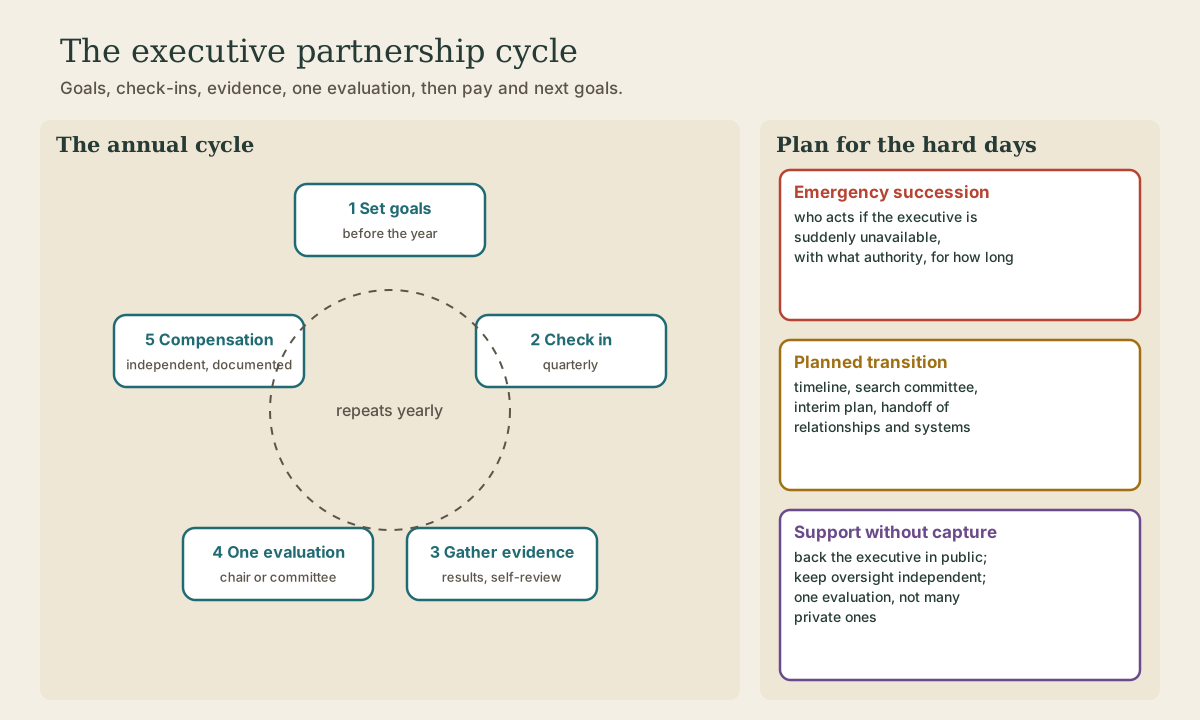
Executive Partnership: Goals, Evaluation, Compensation, and Succession
The board's one employee: setting five to seven weighted goals, quarterly check-ins, gathering evidence and consolidating one board evaluation, a disinterested compensation process, support without capture, emergency and planned succession, and handling performance concerns.
- 5 min
- 7 steps
- 3 questions
- Lesson 10 of 36
In this lesson
- The annual performance cycle
- Compensation process
- Support without capture
- Emergency succession
- Planned transition
- Difficult-performance protocol
- Board annual questions
Picking up where you left off.
The board has one direct employee: the executive director. That makes this relationship a core governance system, not an annual personnel form.
The annual performance cycle
1. Set goals before the year
Use five to seven weighted goals with:
- intended outcome;
- baseline and target;
- resources/assumptions;
- deadline and evidence;
- board contribution required;
- factors outside reasonable control;
- what “meets,” “exceeds,” or “needs improvement” means.
Balance domains:
| Domain | Possible goal |
|---|---|
| Mission | improve defined participant outcomes/access |
| Finance | maintain cash threshold and manage variance |
| Development | build a qualified pipeline, not only a revenue total |
| Campus | complete priority preservation/safety milestones |
| People | strengthen retention, supervision, and capacity |
| Strategy | deliver named strategic milestones |
| Governance | timely packets and early risk escalation |
Do not make the executive accountable for donor introductions directors promised but did not provide.
2. Check in quarterly
The chair facilitates a structured conversation:
- evidence and trend;
- changed assumptions;
- barriers requiring board action;
- goal or resource adjustments;
- development/support;
- emerging risk.
Document agreed changes. Moving a goal transparently is better than pretending an obsolete goal still governs.
3. Gather evidence
Sources may include dashboards, financials, milestones, audits, staff data, participant feedback, development results, and direct board experience. If staff or partners provide input, use a defined process and protect against retaliation, popularity contests, and identifiable gossip.
4. Consolidate one board evaluation
Individual directors supply input; the authorized process turns it into one board message. Include:
- results against goals;
- leadership strengths;
- gaps with concrete examples;
- contextual factors;
- development/support plan;
- goals for next period;
- compensation decision handled separately but coherently.
The executive gets an opportunity to respond and correct facts.
Compensation process
Compensation should be reasonable, competitive enough to sustain leadership, aligned with role complexity, and affordable. It should not be based on sacrifice mythology.
A defensible process uses:
- disinterested decision-makers;
- appropriate comparability data—similar budget, staff, region, mission complexity, property responsibility;
- total compensation: salary, bonus, retirement, health, housing/lodging, reimbursements, benefits;
- role and performance evidence;
- contemporaneous minutes documenting data, deliberation, conflicts, and vote.
IRS Form 990 instructions describe procedures associated with a rebuttable presumption of reasonableness for compensation transactions 1. Use qualified advice for actual decisions.
Avoid:
- letting the executive set their own pay;
- using one internet salary;
- benchmarking only to larger urban institutions;
- treating a raise as a substitute for fixing impossible workload;
- tying all pay to short-term fundraising;
- recording vague minutes.
Quick check
Pay should be reasonable, sustainable, and affordable, not based on sacrifice.
Support without capture
The chair should be a reliable thought partner, not the executive’s private supervisor or defender. The full board retains authority.
Good support includes:
- prompt decisions;
- clear priorities and delegation;
- useful introductions and fundraising participation;
- feedback without ambush;
- protection from director micromanagement;
- resources for professional development;
- realistic workload and staffing;
- space to deliver bad news early.
Healthy challenge includes:
- testing evidence and assumptions;
- asking what is not working;
- distinguishing explanation from excuse;
- requiring corrective plans;
- acting when serious issues persist.
Emergency succession
The board should approve a short plan before a crisis:
- triggering events: incapacity, sudden leave, death, termination, disappearance;
- who activates the plan;
- temporary executive authority and limits;
- second-in-command or external interim options;
- payroll, bank, contracts, grants, facilities, safeguarding, communications access;
- board and staff contacts;
- funder, insurer, counsel, donor, instructor, partner, and public communications;
- compensation for added duties;
- decision path for an interim and permanent search;
- review after activation.
Do not publish sensitive credentials in the plan. Specify secure custody and access testing.
Planned transition
When departure is anticipated:
- clarify who owns the process;
- assess strategy and role before copying the old description;
- define executive, board, staff, and stakeholder roles;
- create transition, search, and communications plans;
- preserve funder/donor/partner relationships institutionally;
- agree how the departing executive participates;
- onboard with goals, authority, board norms, and 90-day support;
- resist expecting one person to embody every organizational relationship.
Succession planning is continuous capacity building, not disloyalty 2.
Difficult-performance protocol
If performance is concerning:
- name the gap with evidence;
- distinguish capacity, clarity, resources, conduct, and context;
- review prior goals/feedback;
- obtain HR/legal advice when stakes warrant;
- set a fair corrective plan with dates and support;
- protect confidentiality and non-retaliation;
- preserve board unity and due process;
- prepare continuity options.
For fraud, abuse, harassment, retaliation, or safety allegations, use the relevant investigation/incident pathway—not an ordinary performance plan.
Board annual questions
- Can the executive state the board’s top three outcomes?
- Does the board know what only the executive currently knows?
- Are goals achievable with approved resources?
- Is compensation process independent and documented?
- Can payroll, grants, facilities, and communications continue tomorrow without the executive?
- Is leadership strength distributed across a team and systems?
The strongest executive partnership makes accountability clear enough that candor is safe.
Practice
Evaluation should be prospective, evidence-based, multi-dimensional, and collective.
Practice
Emergency succession protects continuity without preselecting a permanent leader.
Lesson complete
Nice work.
Sources for this lesson
- 1Instructions for Form 990 — Rebuttable Presumption of Reasonableness. Internal Revenue Service. verifiedCurrent three-part process for disinterested approval, comparability data, and contemporaneous documentation. Cited at: compensation process.
- 2Succession Planning for Nonprofits. National Council of Nonprofits. verifiedPractice guidance for planned and emergency executive and board leadership transitions. Cited at: succession planning.
Further reading
- Executive Compensation. National Council of Nonprofits. verifiedBoard process for annual review, reasonable compensation, comparability, independence, and minutes.
- Recommended Board Practices. BoardSource. verifiedCurrent recommendations on board composition, meetings, assessment, executive partnership, strategy, and personal giving.
Previous: Strategy That Governs: Outcomes, Choices, and a Board Dashboard