Open Government and Nonprofit Transparency Are Not the Same
The five different things 'transparent' can mean: Wisconsin's open meetings and public records laws for cities, corporate and federal disclosure duties for nonprofits, where the line blurs in partnerships, and designing a records lane into every joint project.
- 7 min
- 8 steps
- 3 questions
- Lesson 26 of 36
In this lesson
- Municipal open meetings
- Municipal public records
- Nonprofit records and disclosure
- When the boundary becomes fact-specific
- Design a “records lane” into every partnership
- Scenario: the private planning breakfast
- Transparency brief
Open alongside this lesson
-
Wisconsin Open Meetings Law Compliance Guide (opens in a new tab)
Use the current edition and municipal counsel for actual notice, quorum, agenda, and closed-session decisions.
-
Wisconsin Public Records Law Compliance Guide (opens in a new tab)
Use the current edition for records, custodians, electronic communications, balancing, redaction, fees, and timing.
Picking up where you left off.
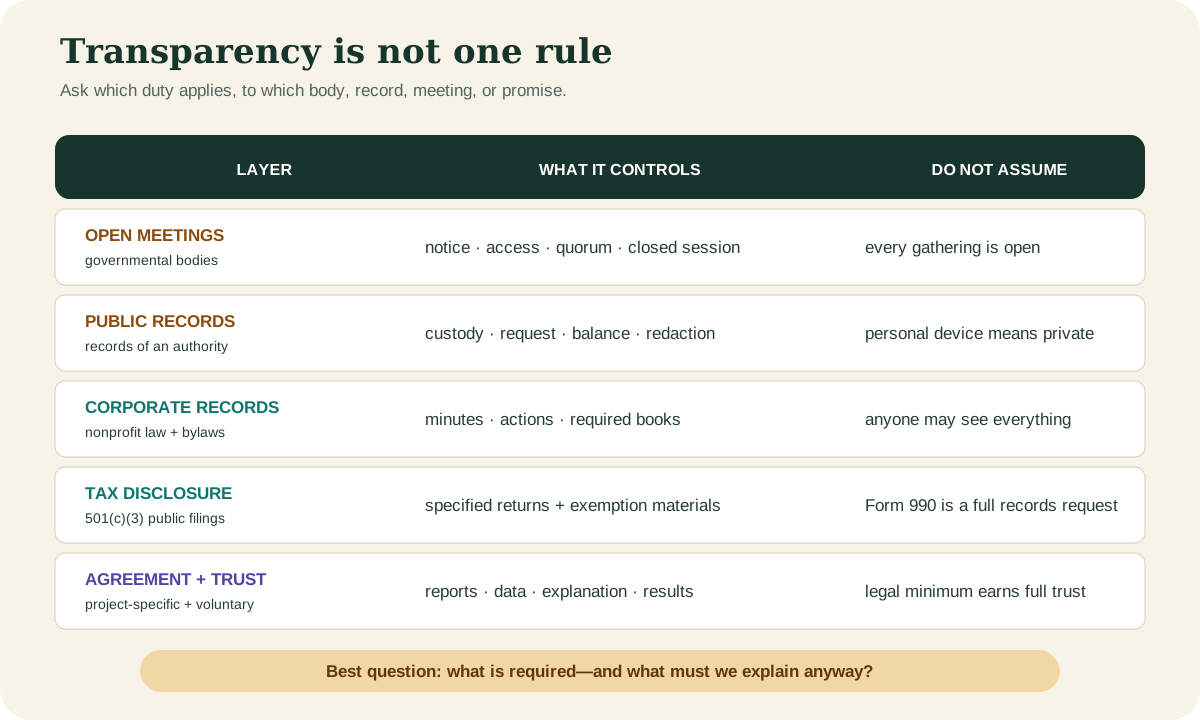
“Transparent” can mean at least five different things:
- a meeting legally must be noticed and open;
- a public record must be produced unless an exception or balancing analysis supports withholding;
- a nonprofit must maintain corporate records;
- a tax-exempt organization must make specified federal filings available; or
- an institution voluntarily explains more than the legal minimum because trust requires it.
These duties overlap, but substituting one for another creates mistakes.
Municipal open meetings
Wisconsin’s Open Meetings Law generally requires meetings of governmental bodies to be preceded by public notice and held in open session unless a statutory exemption permits a properly conducted closed session 1.
Start with four questions:
- Is there a governmental body? A council, committee, board, commission, or other collective body created by constitution, statute, ordinance, rule, or order may qualify. Do not decide by name alone.
- Is there a meeting? The law’s analysis considers the number of members, governmental business, and purpose. Email, text, phone, video, or serial communication can matter.
- Was notice sufficient? The notice must identify time, date, place, and subject matter with enough specificity to inform the public; timing and special circumstances matter.
- Is closure authorized and properly executed? A closed-session exemption is not a general “sensitive topic” label. The body follows the statutory process and limits discussion to the announced basis.
The walking-quorum trap
A mayor or alderperson cannot safely avoid an open meeting by contacting members one at a time to build agreement. A walking quorum can arise when a series of gatherings or communications is used to produce collective agreement among enough members to control action 2.
Practical discipline:
- distribute information through an approved channel;
- do not ask members to “reply all” with positions;
- do not privately tally commitments;
- treat social gatherings carefully when governmental business emerges;
- ask the clerk or attorney before using a novel deliberation process.
Stoughton’s Agenda Center is a useful observation lab because it shows how public notices, agendas, packets, and minutes create an inspectable decision trail 3.
Quick check
Legal duties differ by institution; voluntary openness is a choice that builds trust.
Municipal public records
Wisconsin’s Public Records Law starts from broad access to records of an authority, subject to statutory exceptions and the common-law balancing test 4.
A record is about content and custody, not merely location. Public business conducted through a personal email account or device does not become private simply because the hardware is private. Conversely, not every note or piece of data is automatically a responsive public record; definitions, retention rules, pending requests, exemptions, and balancing require care.
Leaders should:
- know the legal custodian and records policy;
- use public systems for public work;
- separate campaign, personal, nonprofit, and city accounts;
- preserve responsive material when a request or hold arises;
- never delete, edit, backfill, or move records to defeat access;
- route requests promptly rather than improvising;
- explain redactions and denials through the lawful process.
There is no universal ten-day production rule in Wisconsin’s statute. Responses must be made “as soon as practicable and without delay,” with reasonableness depending on the request and circumstances 5. Stoughton’s records page identifies local procedure and custodians; use it rather than inventing a mayoral process 6.
Nonprofit records and disclosure
An ordinary private nonprofit board is not automatically a governmental body merely because it serves the public, has tax-exempt status, receives a grant, or includes public officials. Wisconsin nonprofit law requires corporate records such as minutes and actions without a meeting 7. Federal tax rules require public availability of specified exemption materials and annual returns, subject to rules and exceptions 8.
That is different from:
- a right for any person to attend every board or committee meeting;
- a right to every internal email or donor record;
- a public-records balancing process;
- a promise that all board discussion will be published.
Still, “not legally public” is not a strategy. A cultural nonprofit asking for public trust should usually explain mission, leadership, audited or filed financial information, outcomes, conflicts process, major policies, public funding, and how community members can be heard. Protect legitimate confidentiality—personnel, learners, donors, security, legal advice, negotiations—without using it as a reflex.
When the boundary becomes fact-specific
Ask counsel before assuming either extreme when:
- government created or controls the entity;
- officials appoint or constitute much of its governing body;
- the entity performs delegated governmental functions;
- public property, staff, or authority are deeply integrated;
- a statute or ordinance assigns a special status;
- an agreement makes records, meetings, or reports public;
- a city holds copies of nonprofit records;
- a nonprofit holds records on the city’s behalf.
Wisconsin DOJ provides advisory material on quasi-governmental corporations because the answer depends on the entity’s origin, control, function, and relationship with government—not its friendly-sounding label 9.
Design a “records lane” into every partnership
Every city-nonprofit agreement should answer:
| Question | Example answer |
|---|---|
| Who creates the record? | nonprofit attendance report; city payment record |
| Who owns/retains it? | each party retains its originals under its schedule |
| What reaches the city? | aggregate deliverables, invoice support, accessibility report |
| What sensitive data is excluded? | learner names unless necessary and authorized |
| What may become public? | records in city custody subject to applicable law |
| Who handles requests? | each party’s designated records contact |
| How long is material retained? | agreement plus applicable law/policy |
| How is secure deletion handled? | after holds, audit, grant, and retention periods end |
Do not send participant-level data “just in case.” Define the minimum evidence the city needs to verify public value and the nonprofit can lawfully provide.
Scenario: the private planning breakfast
The mayor, two alderpersons, a city staff member, Shake Rag’s board chair, and executive director meet privately to discuss a possible grant and facility partnership. No votes occur.
Do not begin with “it is informal.” Ask:
- Which city governmental bodies are implicated?
- Are enough members present to trigger quorum concerns for any body?
- Is governmental business being discussed?
- Was the gathering created to exercise collective responsibility?
- Could serial follow-ups create a walking quorum?
- Which records are created and whose custody will they enter?
- Is the nonprofit receiving confidential negotiation information?
- What should be moved into a noticed public process?
The safe design may be a staff-level exploratory meeting with no quorum, followed by a noticed informational presentation and later action by the correct bodies. The actual design belongs with the clerk and municipal attorney.
Transparency brief
For one proposed partnership, produce two columns:
- legally required: notice, agenda, meeting access, records, filing, contract report, tax disclosure;
- trust-building: plain-language project page, decision timeline, selection criteria, accessible participation, conflict explanation, budget-to-actual summary, outcomes, and lessons learned.
The best transparency system lets a reasonable resident answer:
What is being decided, by whom, with what money and evidence, when can I influence it, and where will I see the result?
Practice
Do not automatically import city law into a private board or assume the public interface is irrelevant. Analyze the actual body, authority, records, and agreement.
Practice
A series of communications used to reach agreement among enough members can create a walking-quorum problem.
Lesson complete
Nice work.
Sources for this lesson
- 1Wisconsin Open Meetings Law. Wisconsin Department of Justice. verifiedOfficial compliance resources and current DOJ guide for public notice, open sessions, and walking quorums. Cited at: official overview; @cc-doj-open-meetings-guide|notice, access, and closed sessions.
- 2Wisconsin Open Meetings Law Compliance Guide. Wisconsin Department of Justice. 2025. verifiedCurrent official guide to governmental-body status, notice, access, closed sessions, electronic participation, walking quorums, and enforcement. Cited at: walking quorums.
- 3Agenda Center. City of Stoughton, Wisconsin. verifiedOfficial notices, agendas, packets, and minutes for the Common Council, committees, boards, and commissions. Cited at: official meeting records.
- 4Wisconsin Public Records Law. Wisconsin Department of Justice. verifiedOfficial compliance resources and current DOJ guide for records access, retention, and electronic communications. Cited at: official overview; @cc-doj-public-records-guide|records and balancing.
- 5Wisconsin Public Records Law Compliance Guide. Wisconsin Department of Justice. 2025. verifiedCurrent official guide to authorities, custodians, records, requests, balancing, redaction, electronic records, fees, and enforcement. Cited at: response time.
- 6Public Records. City of Stoughton, Wisconsin. verifiedStoughton's current records-request procedure and legal-custodian information. Cited at: local process.
- 7Wisconsin Statutes § 181.1601 — Corporate records. Wisconsin Statutes via Justia. 2025. verifiedCurrent corporate-record requirements, including minutes and actions without meetings. Cited at: corporate records.
- 8Exempt Organization Public Disclosure and Availability Requirements. Internal Revenue Service. verifiedOfficial public-inspection and copying rules for annual returns and exemption applications. Cited at: public inspection.
- 9Office of Open Government Advisories and Attorney General Opinions. Wisconsin Department of Justice. verifiedOfficial index including Wisconsin analysis of whether a corporation is quasi-governmental and subject to open-government duties. Cited at: advisories.
Further reading
- Form 990 Part VI — Governance. Internal Revenue Service. verifiedOfficial explanation of governance questions and the distinction between legal requirements and reported practices.