Advocacy, the Annual Board Cycle, and Your Capstone Meeting
Advocacy within 501(c)(3) limits and a capstone meeting: nonpartisan education, direct and grassroots lobbying, the campaign ban, an annual board cycle by quarter, and a studio-conversion board packet with missing facts, conditions, a conflict, deliberation lenses, a predevelopment motion, and minutes.
- 7 min
- 12 steps
- 3 questions
- Lesson 24 of 36
In this lesson
- Classify the communication
- Advocacy decision memo
- Useful board advocacy roles
- A practical annual board cycle
- Board packet
- Your pre-meeting questions
- Conflict process
- Deliberation
- Draft a valid motion
- Minutes
- Your final deliverable: first-year board book
Open alongside this lesson
-
Frequently Asked Questions About the Ban on Political Campaign Intervention (opens in a new tab)
A 501(c)(3) is prohibited from intervening in candidate campaigns; obtain advice before election-season activity.
-
Instructions for Schedule C — Political Campaign and Lobbying Activities (opens in a new tab)
Advocacy, lobbying, and campaign intervention are different legal categories.
Picking up where you left off.
Nonprofits can educate, convene, share expertise, and advocate. A 501(c)(3) may conduct some lobbying within applicable limits but is prohibited from intervening in campaigns for or against candidates 1. The categories must not be blurred.
This is educational, not legal advice. Adopt an advocacy/election policy and obtain qualified review for real activity.
Classify the communication
Nonpartisan education
Research, public forums, reports, and explanation of arts, preservation, youth, or rural-community issues without candidate favoritism.
Controls:
- evidence and methodology;
- balanced, nonpartisan presentation where appropriate;
- no coordination with candidates;
- consistent access rules;
- approved spokesperson/data/privacy.
Direct lobbying
Communication with a legislator or covered government official that refers to specific legislation and reflects a view, under applicable definitions.
Grassroots lobbying
Communication to the public that refers to specific legislation, reflects a view, and includes a call to action, under applicable definitions.
Administrative advocacy
Comments on regulations, agency implementation, funding administration, permits, or public plans may be treated differently from legislation depending on facts.
Candidate campaign intervention
Organizational support/opposition, contributions, endorsements, biased candidate events, selective resources, or communications favoring a candidate are prohibited. Context matters: timing, targeting, language, history, and coordination.
Directors retain personal political rights but must:
- act in personal capacity;
- not use organizational resources, lists, title, events, or implied endorsement;
- avoid statements that reasonably appear organizational;
- follow conflict/confidentiality/social-media policy.
Advocacy decision memo
Before consequential action:
charitable-purpose connection · audience · specific legislation/candidate context · communication text · direct/grassroots/education classification · cost/time tracking · approval authority · grant restrictions · election timing · coalition role · spokesperson · legal review · records/reporting
Some organizations elect the 501(h) expenditure test; Schedule C instructions explain lobbying reporting/election concepts 2. Do not assume Shake Rag has or should make that election; verify current status with tax counsel.
Useful board advocacy roles
- approve issue priorities tied to mission;
- ensure factual, nonpartisan education;
- share program/campus evidence with policymakers;
- host properly structured learning visits;
- join coalition work under approved bounds;
- monitor time/cost and grant restrictions;
- protect against candidate use of the organization;
- distinguish personal and organizational speech.
Example nonpartisan message:
“Shake Rag’s programs and historic campus show how rural arts education connects artists, learners, visitors, and preservation. Here are current participation, access, economic, and facilities facts. We welcome discussion of policies affecting arts learning and historic-community capacity.”
Do not fabricate economic impact.
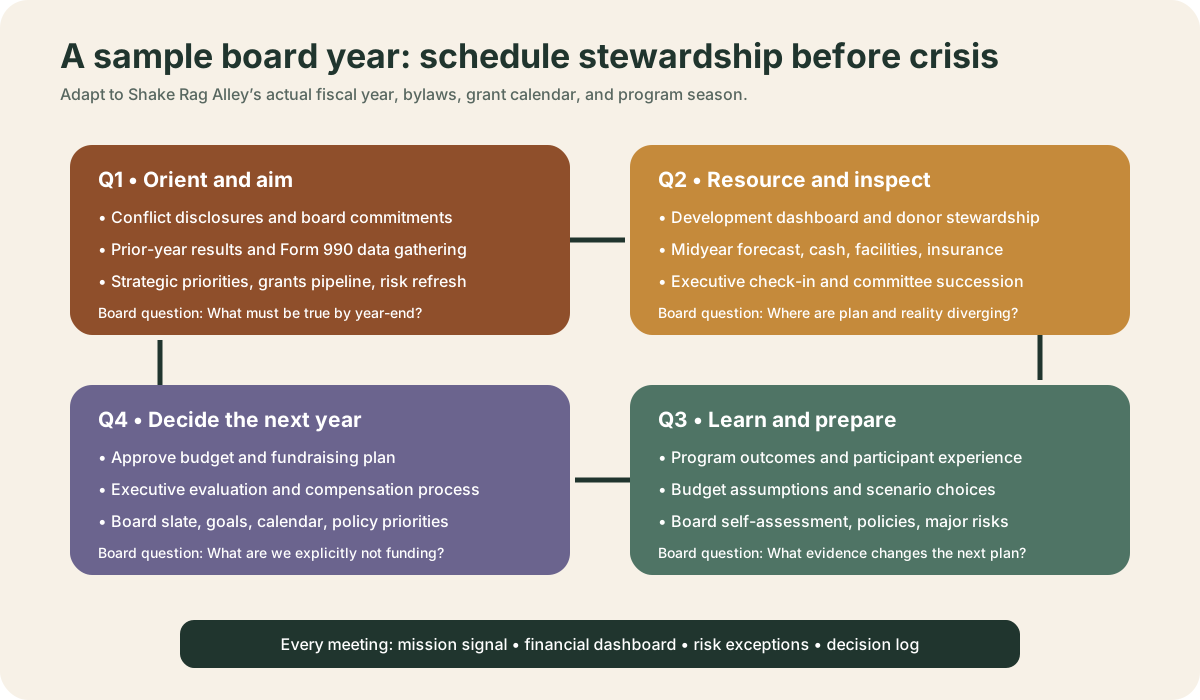
A practical annual board cycle
Adapt to Shake Rag’s actual fiscal/program year and bylaw calendar:
Quarter 1 — orient and launch
- conflict/confidentiality disclosures;
- board agreements and committee charters;
- strategy/annual goals and executive goals;
- current budget/cash/grant restrictions;
- insurance and emergency contacts;
- development commitments;
- youth-safety and incident refresher.
Quarter 2 — program and pipeline
- program outcome/access dashboard;
- facilities condition/capital priorities;
- spring/summer risk readiness;
- qualified donor and grant pipeline;
- Form 990/preparer timetable;
- board recruitment matrix.
Quarter 3 — build next year
- scenario and budget assumptions;
- program portfolio/economics;
- annual appeal/events/sponsorship;
- executive midyear check;
- policy register and filings;
- succession and officer pipeline.
Quarter 4 — decide and evaluate
- approve integrated budget/capital plan;
- executive evaluation and compensation;
- strategy/dashboard review;
- board/committee self-assessment;
- nominate/elect/onboard;
- approve development plan;
- Form 990 review under current timetable;
- annual risk/insurance/control review.
Monthly/quarterly throughout: finance/cash, restrictions/grants, incidents, development moves, strategy exceptions, action log.
Capstone: The Foundry Studio Decision
This scenario is fictional but designed from Shake Rag’s real operating lenses.
Board packet
Decision requested
Approve or decline a two-year project converting a currently limited-use historic building into a mixed-media teaching studio and community demonstration space.
Mission case
- expands artist-led learning;
- preserves and activates historic fabric;
- creates community programming;
- may strengthen lodging/visitor experience.
Proposed economics
| Source/use | Year 0–1 |
|---|---|
| foundation capital grant (restricted) | $180,000 |
| donor commitments (restricted) | $90,000 |
| state arts project grant, pending | $6,000 |
| required organizational cash | $64,000 |
| total construction/equipment | $340,000 |
Additional:
- $28,000 annual staff/operations beginning year 2;
- forecast earned revenue $36,000 at 70% enrollment;
- direct program costs $19,000;
- projected annual direct contribution before shared facility/admin = $17,000;
- $45,000 recommended construction contingency not yet funded;
- grant reimbursement creates a possible $75,000 cash gap for 90 days;
- building assessment found roof/water and electrical uncertainties;
- one donor requests permanent naming and priority seats;
- a director’s company is one of three bidders;
- planned youth demonstrations introduce tool/supervision needs;
- lodging guests would share an egress path during events.
Strategic evidence
- 120 expressions of interest, but only 38 include probable timing/price;
- two instructors are interested; contracts not negotiated;
- partner letter supports public demonstrations;
- no accessibility review completed;
- no final insurer/preservation/code review;
- staff estimates 0.35 FTE setup load not included in budget.
Current financial context
Public FY2024 Form 990 shows $678,006 revenue, $504,699 expense, and $993,533 net assets, with contributions at 60.3% and program-service revenue 27.5% 3. The packet does not include current unrestricted liquidity or restriction detail.
Your pre-meeting questions
Categorize:
Missing before any approval
- current unrestricted cash and 13-week project cash forecast;
- restriction and match confirmation;
- construction scope, contingency, condition/code/access findings;
- preservation and insurer requirements;
- lifecycle cost and maintenance;
- conflict handling and bid comparability;
- naming/gift terms;
- grant award/allowability;
- staff capacity;
- youth and egress risk plan;
- demand sensitivity and cancellation threshold.
Can be a condition
- final contracts within a capped budget;
- written funder modification;
- insurer sign-off;
- accessible design review;
- minimum enrollment/pre-sale;
- staff hire;
- policy/training completion.
Monitoring after approval
- cost/schedule/contingency;
- cash and reimbursement;
- fundraising/pledge collection;
- incidents;
- enrollment and outcomes;
- full program contribution;
- building condition and maintenance.
Conflict process
The bidding director discloses the relationship before discussion, provides no informal influence, follows the conflict policy, leaves as required, and the disinterested board documents fairness and decision. If the bidder is selected, approval does not end monitoring.
Deliberation
Assign six lenses:
- mission/strategy;
- participant/community/access;
- finance/cash/restrictions;
- property/preservation;
- people/capacity/safety;
- development/grants/reputation.
Each reports:
strongest case for · strongest case against · missing evidence · reversible option · recommended condition
Possible choices:
- decline;
- defer for decision-grade evidence;
- approve design/predevelopment only with a small cap;
- approve full project with conditions;
- redesign scope/phases.
Draft a valid motion
A defensible predevelopment motion might be:
“I move that the board authorize up to $18,000 of unrestricted funds for code, accessibility, preservation, insurance, demand, and final-cost due diligence; require the conflicted procurement process described in the conflict policy; authorize no construction or restricted-fund expenditure; and require management to return by [date] with a reconciled scope, sources/uses, 13-week cash forecast, lifecycle operating plan, youth-safety plan, naming recommendation, written grant conditions, and proposed full-project motion.”
This is often better than an emotional yes/no when essential evidence is missing.
Quick check
It spends a capped amount to learn what the full decision needs.
Minutes
Record:
- packet and expert reports reviewed;
- conflict disclosure/recusal/departure/return;
- key alternatives and material factors;
- exact motion/amendments;
- vote result;
- delegated cap/conditions;
- monitoring date.
Do not make the minutes a transcript or conceal the conflict.
Your final deliverable: first-year board book
Create:
- one-page mission/history/public-value map;
- governance stack and current authority questions;
- board–staff decision-rights matrix;
- annual calendar;
- 15-signal dashboard with definitions/thresholds;
- current financial trend, liquidity, restriction, reserve, and capital view;
- compliance matrix;
- top-ten risk register;
- policy register;
- development commitment and qualified relationship actions;
- one grant go/no-go and logic model;
- executive goals/evaluation/succession calendar;
- three decisions the board must prepare this year;
- your own 90-day and first-year commitments.
The test is not whether you can recite nonprofit vocabulary. It is whether you can help the board make a lawful, mission-grounded, financially honest decision—and ensure the decision becomes accountable action.
Practice
Campaign intervention is prohibited; lobbying is a different, limited category.
Practice
A board must frame a decision before deliberating it.
Lesson complete
Nice work.
Sources for this lesson
- 1Exemption Requirements — 501(c)(3) Organizations. Internal Revenue Service. verifiedOfficial rules on exempt purposes, private benefit, lobbying limits, and political campaign intervention. Cited at: political limits; @irs-campaign-ban|campaign prohibition.
- 2Instructions for Schedule C — Political Campaign and Lobbying Activities. Internal Revenue Service. verifiedCurrent reporting instructions, including the 501(h) expenditure-election framework. Cited at: lobbying.
- 3Shake Rag Alley Inc — IRS Form 990 Filings. ProPublica Nonprofit Explorer. verifiedSearchable presentation of IRS filing data. The course uses the fiscal-2024 filing filed August 20, 2025 and compares prior years. Cited at: FY2024.
Further reading
- Frequently Asked Questions About the Ban on Political Campaign Intervention. Internal Revenue Service. verifiedOfficial examples and questions about candidate events, voter education, issue positions, and the absolute campaign-intervention ban.
- Public Charity Support Test. Internal Revenue Service. verifiedOfficial five-year public-support tests reported on Schedule A.
- About Us. Shake Rag Alley Center for the Arts. verifiedCurrent mission, staff and board roster, programs, campus history, and organization timeline.
- Ways to Support Shake Rag Alley. Shake Rag Alley Center for the Arts. verifiedCurrent volunteer, donation, planned-giving, event, and legal-name information.
- Charitable and Professional Organization Forms. Wisconsin Department of Financial Institutions. verifiedCurrent Wisconsin charitable registration and annual financial-report forms.
- Recommended Board Practices. BoardSource. verifiedCurrent recommendations on board composition, meetings, assessment, executive partnership, strategy, and personal giving.
Previous: Grant Budgets, Match, Award Setup, Reporting, and Closeout