Meetings That Decide: Agendas, Minutes, and Committees
Running meetings that decide: building the board year backward from deadlines, labeling agenda outcomes, the decision memo, what does and doesn't belong in a consent agenda, Wisconsin notice and quorum defaults, a well-built motion, minutes, committee charters, and executive sessions.
- 5 min
- 11 steps
- 3 questions
- Lesson 7 of 36
In this lesson
- Build the year first
- Label agenda outcomes
- The decision memo
- Consent agenda
- Notice, quorum, and voting
- Motion anatomy
- Minutes: enough, not everything
- Committees
- Executive sessions
- Close the loop
Picking up where you left off.
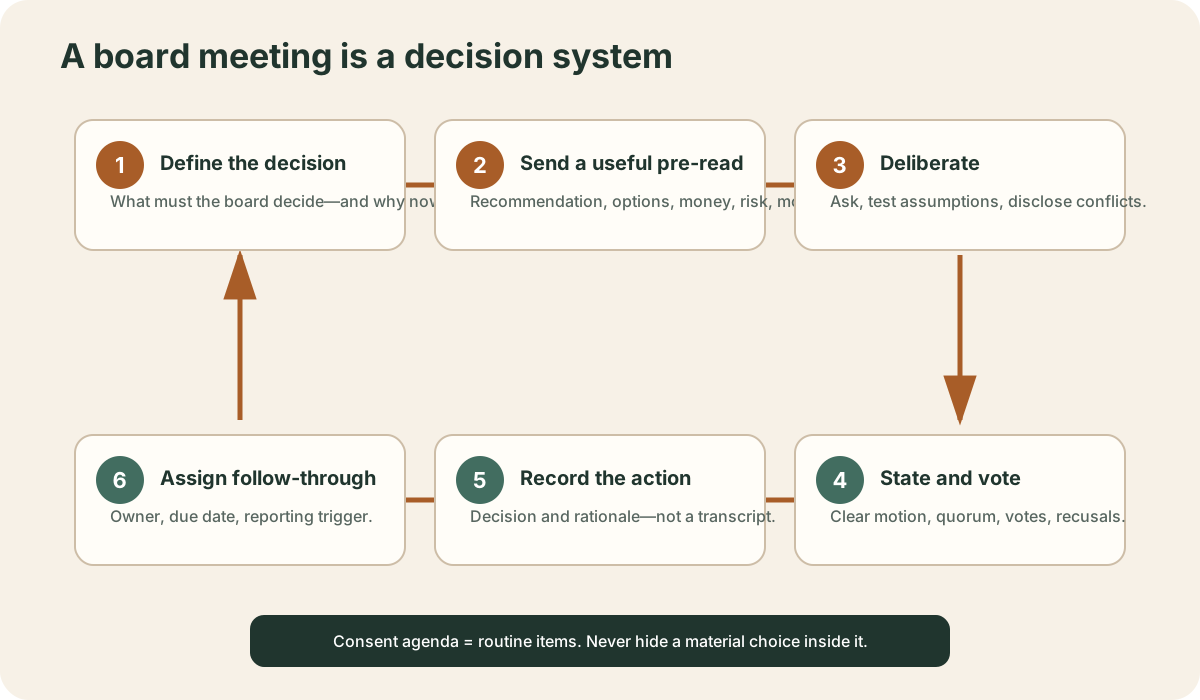
A useful meeting converts preparation into decisions, decisions into accountable work, and results into learning. It is not a serial recital of reports.
Build the year first
Schedule backward from budget approval, Form 990 and Wisconsin filings, grant deadlines, catalog decisions, appeals and events, executive evaluation, officer elections, insurance renewals, facilities work, conflict disclosures, policy reviews, and the retreat. Give each item a lead, committee path, packet date, decision date, and monitoring date.
Label agenda outcomes
- C — consent: routine approval;
- I — information: shared awareness;
- D — discussion: input now, decision later;
- A — action: vote expected;
- E — education: board learning;
- X — executive session: legitimate confidential matter.
Put the hardest decision before attention fades. A 105-minute model:
| Min. | Item | Type |
|---|---|---|
| 5 | call, quorum, conflicts, agenda | A |
| 5 | consent agenda | A |
| 10 | mission moment tied to outcomes | E/I |
| 20 | executive dashboard exceptions | I/D |
| 25 | capital decision | A |
| 20 | development pipeline/assignments | D/A |
| 10 | committees and monitoring | I/A |
| 5 | action recap/next decisions | I |
| 5 | process reflection | D |
The decision memo
Every action item should state:
- exact proposed motion;
- why now and mission connection;
- background/current state;
- alternatives, including defer/do nothing;
- total financial effect, cash timing, funding source, restriction, lifecycle cost;
- people, program, access, property, legal, and reputation effects;
- management recommendation and assumptions;
- conflicts and expert advice;
- implementation owner, milestones, and escalation trigger.
Send clarification questions before the meeting; save judgment and tradeoffs for deliberation.
Consent agenda
It can include prior minutes, routine reports, or renewals with no changes. Any director should be able to request removal under board procedure. Never bury an insider transaction, unexplained variance, controversial contract, or material risk in consent.
Quick check
Any director can pull an item from consent, and material matters belong on the action agenda.
Notice, quorum, and voting
Use Shake Rag’s current bylaws. Wisconsin defaults matter where governing documents are silent:
- special-meeting notice generally states date, time, place, and when required purpose 1;
- a majority of directors in office is the default quorum, and action generally requires a majority present once quorum exists, subject to governing documents 2;
- action without a meeting must meet statutory and governing-document requirements 3.
Checklist:
correct body · notice · permitted method · quorum · conflicts handled · clear motion · sufficient vote · result announced · minutes/action log
If directors leave or recuse, verify that quorum remains.
Motion anatomy
“I move that the board approve up to $42,000 from the board-designated capital reserve for the roof stabilization in Attachment B, authorize the executive director to contract within that cap after confirming insurance and preservation requirements, and require reports at the September and November meetings.”
This names amount, source, scope, delegation, conditions, and monitoring. “Approve the roof” does not. The chair restates the exact final motion before voting.
Minutes: enough, not everything
Record:
- body, meeting type, date/time/place or technology;
- chair, secretary, directors present/absent, guests;
- quorum;
- agenda and prior-minutes approval;
- conflicts, recusals, departures, returns;
- motions, amendments, and results;
- reports formally received when material;
- executive-session entry/exit and any formal action;
- adjournment, approval date, secretary.
Avoid adjectives, gossip, routine attribution, and unnecessary sensitive detail. Record sufficient process for executive compensation, insider transactions, major assets, restrictions, and expert reliance, with counsel for sensitive matters.
Draft promptly; approve and store under policy. Correct approved minutes through recorded process, never silent rewriting.
Maintain a separate action log:
| Action | Owner | Due | Status | Return |
|---|---|---|---|---|
| preservation scope | Executive | Aug 15 | amber | Aug packet |
| thank five new donors | named directors | Aug 5 | green | development chair |
Committees
Every committee charter states:
- purpose and authority;
- membership, appointment, terms, chair;
- board committee versus advisory/task group;
- decisions permitted and prohibited;
- quorum/voting and record method;
- annual deliverables and review/sunset;
- staff liaison and reporting.
Committees recommend unless valid authority says they decide. They never relieve directors of their own duties.
- Finance: reports, budget, cash, controls, reserves, filings—not all finance responsibility.
- Governance: recruitment, orientation, evaluation, bylaws, policy, succession—not an insiders’ club.
- Development: case, pipeline, assignments, stewardship—not fundraising so others can opt out.
Executive sessions
Use a written policy. Define purpose, attendees, record, whether action occurs, how the executive is informed, and how retaliation/factionalism are prevented. Executive session is not a license for casual criticism.
Close the loop
End with:
- What did we decide?
- Who owns what by when?
- What returns to the board, and when?
Then ask: Did we stay at the right altitude? Did relevant voices have room?
Practice
Minutes formally record process and action, not every comment.
Practice
Purpose, limits, deliverables, and reporting should be set in advance.
Lesson complete
Nice work.
Sources for this lesson
- 1Wisconsin Statutes § 181.0822 — Call and notice of meetings. Wisconsin Statutes via Justia. 2025. verifiedCurrent default notice rules, subject to articles and bylaws. Cited at: meeting notice.
- 2Wisconsin Statutes § 181.0824 — Quorum and voting. Wisconsin Statutes via Justia. 2025. verifiedCurrent default quorum and board-vote rules, subject to governing documents. Cited at: quorum and voting.
- 3Wisconsin Statutes § 181.0821 — Action without meeting. Wisconsin Statutes via Justia. 2025. verifiedCurrent text on written board action, including electronic writing and signatures. Cited at: written action.
Further reading
- Recommended Board Practices. BoardSource. verifiedCurrent recommendations on board composition, meetings, assessment, executive partnership, strategy, and personal giving.
Previous: Board, Executive Director, and Staff: One Organization, Different Work