Place, Access, Preservation, and Public Projects
Planning public projects in historic places: starting from ownership, condition, and use rather than a rendering, eight gates for a responsible project, accessibility as a program question, preservation beyond the facade, public art, shared facilities, and lifecycle cost.
- 6 min
- 10 steps
- 3 questions
- Lesson 32 of 36
In this lesson
- Begin with the place, not the rendering
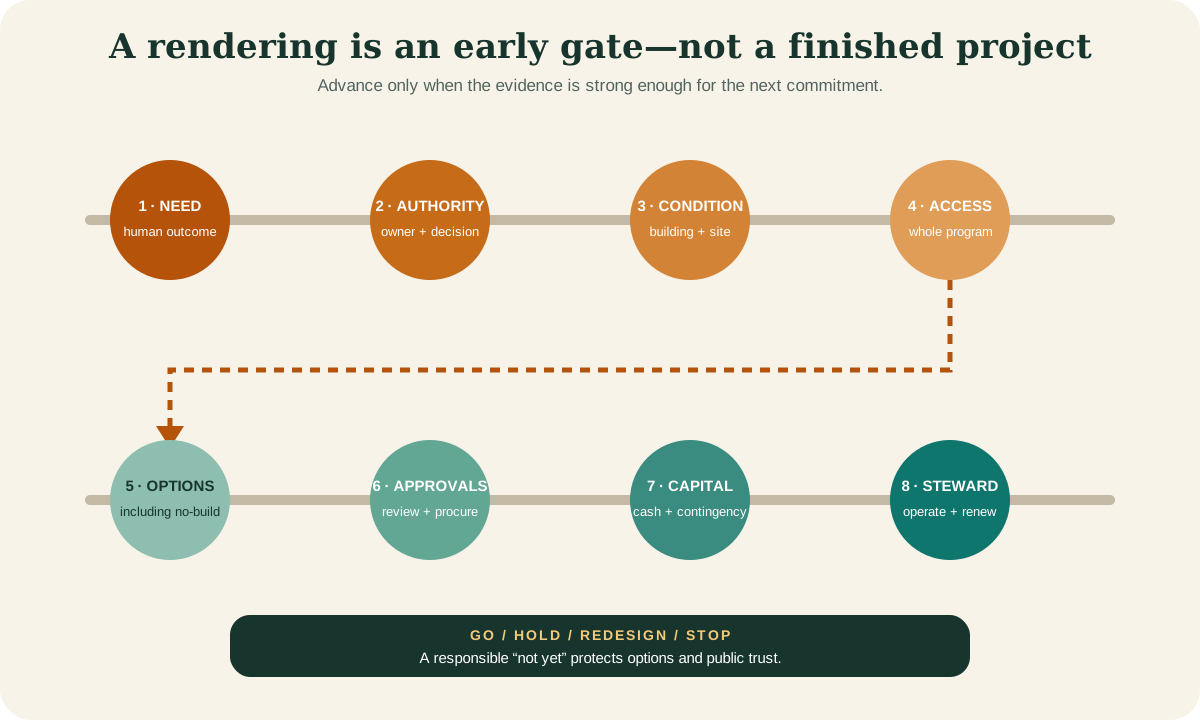
- Eight gates for a responsible project
- Accessibility is a program question
- Preservation is more than façade
- Public art and commemorative decisions
- Shared-facility matrix
- Lifecycle-cost lab
- Project brief
- Working rule
Open alongside this lesson
-
The ADA and City Governments — Common Problems (opens in a new tab)
Review the facilities, meetings, effective-communication, policy, and contracted-service examples.
-
Historic Preservation Commission (opens in a new tab)
Use the current commission materials and local code for an actual project.
Picking up where you left off.
Historic places make institutional promises visible. A repaired wall, accessible path, studio conversion, public artwork, street closure, wayfinding sign, or shared facility changes how people move, gather, remember, and belong. It also creates decades of cost and responsibility.
Begin with the place, not the rendering
Before announcing a project, assemble:
- ownership, easements, leases, covenants, restrictions, and boundaries;
- current use, occupancy, and public-program status;
- measured drawings and site conditions;
- structure, roof, water, electrical, fire/life safety, environmental, and security information;
- accessibility barriers and effective-communication needs;
- historic designation, period of significance, character-defining features, and review authority;
- zoning, land use, parking, traffic, utilities, and neighboring uses;
- insurance and incident history;
- deferred maintenance and lifecycle replacement;
- current and future operations;
- people whose knowledge or access is missing.
Shake Rag’s historic campus is central to its public identity and programs 1, while Mineral Point’s Historic Preservation Commission explicitly connects heritage protection with education, civic identity, tourism, business, and welfare 2. These values can reinforce one another, but tradeoffs need evidence.
Quick check
Begin with the place, not the rendering.
Eight gates for a responsible project
1. Need and outcome
What human, program, preservation, or public problem must be solved? “The building is beautiful” is not enough.
2. Authority and ownership
Who owns, leases, regulates, funds, and operates the site? Which body must approve? Does the mayor have executive, commission, recommending, or no direct authority?
3. Existing condition
What can be safely reused? What is failing? What uncertainty remains behind finishes or underground? Include investigation and contingency.
4. Access and participation
How will people with mobility, vision, hearing, cognitive, speech, sensory, and other disabilities use the program—not merely enter one doorway? Title II requires program access, effective communication, reasonable modification, and nondiscrimination in public services 3.
5. Concept and alternatives
Develop at least:
- repair/status quo;
- policy or program change without construction;
- minimum intervention;
- phased improvement;
- full project;
- alternate site or shared use.
6. Approvals and procurement
Map zoning, preservation, building/fire, environmental, public-works, council, board, grant, donor, insurer, lender, and contractor pathways. Stoughton’s code is one current entry point for local municipal requirements, but staff and current ordinances control actual interpretation 4.
7. Capital and cash
Include:
- design and investigation;
- construction and contractor conditions;
- contingency;
- permits and professional fees;
- owner-furnished equipment;
- escalation;
- temporary operations;
- financing and reimbursement bridge;
- fundraising cost;
- ineligible costs;
- closeout.
8. Operations and stewardship
Who will staff, clean, heat, cool, inspect, insure, schedule, secure, repair, update technology, handle accommodations, and eventually replace major components?
Accessibility is a program question
For a workshop in a historic building:
- Can a learner discover accessible information before registering?
- Can they travel from arrival to check-in, restroom, classroom, emergency exit, social areas, and lodging where offered?
- Can worktables, tools, demonstrations, safety communication, and materials be used?
- Can the program make reasonable modifications without changing an essential requirement?
- Are captions, interpreters, audio description, tactile or digital materials, and alternative formats planned?
- Can a companion or personal assistant participate appropriately?
- Are staff trained to respond without demanding unnecessary medical disclosure?
DOJ guidance for city governments includes facilities, communication, policy, and contracted-service problems because access is broader than construction 5.
Do not assume “historic” means “exempt,” and do not assume access requires erasing every significant feature. Determine the actual legal standard, program, building, alteration, funding, and preservation facts with qualified professionals.
Preservation is more than façade
A preservation plan should identify:
- significance and documented history;
- communities and labor represented or missing;
- condition and causes of deterioration;
- treatment standard;
- compatible use;
- material and craft implications;
- energy, moisture, and resilience;
- access and life safety;
- archaeological or landscape concerns;
- maintenance after capital work;
- interpretation and source transparency.
A historic survey—such as the 2026 CLG-funded work in Mineral Point and Stoughton—creates knowledge for later decisions. It is not itself a promise to designate, regulate, repair, or fund every resource 6.
Public art and commemorative decisions
Before commissioning:
- identify decision authority and selection process;
- define site, audience, purpose, lifespan, and budget;
- pay artists for proposal labor where feasible;
- disclose juror and sponsor conflicts;
- establish community participation without turning popularity into the only artistic criterion;
- cover fabrication, engineering, permit, rights, installation, lighting, landscaping, maintenance, conservation, insurance, vandalism, relocation, and deaccession;
- document copyright, reproduction, attribution, and moral-rights issues with counsel;
- plan interpretation and accessible experience;
- state what happens if the site changes.
“Permanent” is a maintenance obligation, not a poetic adjective.
Shared-facility matrix
For a city-owned building operated with a nonprofit:
| Issue | Questions |
|---|---|
| access | public hours, keys, scheduling, priority, nondiscrimination |
| condition | baseline report, inspections, maintenance, capital renewal |
| improvements | design approval, permits, ownership, removal at end |
| cost | rent, utilities, custodial, security, insurance, indirect cost |
| program | minimum services, quality, artist pay, cancellation |
| rights | speech, viewpoint, religion, politics, public forum, brand |
| records/data | city custody, nonprofit systems, participant privacy |
| incidents | emergency command, reporting, investigation, communication |
| end | notice, continuity, property, records, improvements, public explanation |
Constitutional/public-forum questions can be especially important in public cultural spaces. Obtain municipal counsel; do not rely on a generic template.
Lifecycle-cost lab
Suppose a studio renovation costs $400,000. Estimated annual new costs:
- staffing: $32,000;
- utilities/cleaning/security: $14,000;
- insurance/compliance/technology: $6,000;
- planned maintenance reserve: $8,000.
Annual cost is $60,000. Over ten years, before inflation and major replacement, that is $600,000—more than the initial capital gap. If annual earned contribution is $28,000, the remaining annual support need is $32,000.
The decision is therefore not “Can we raise $400,000?” It is:
Can the partners preserve, operate, program, access, and renew this place for its intended life without weakening other obligations?
Project brief
Prepare a five-page predevelopment brief:
- need, users, outcome, alternatives;
- authority/ownership/approvals;
- condition/preservation/access/risk;
- sources, uses, cash, contingency, lifecycle operations;
- participation, procurement, schedule, decision gates, exit.
Label known facts, assumptions, allowances, and unresolved conditions separately.
Working rule
A public cultural place succeeds when the mission, building, access, money, authority, and long-term steward fit one another.
If one part is fictional, the rendering is not yet a project.
Practice
Access and preservation require early, fact-specific design and professional/legal review; neither should be reduced to a slogan.
Practice
A funded building without funded stewardship can deepen mission and public risk.
Lesson complete
Nice work.
Sources for this lesson
- 1About Us. Shake Rag Alley Center for the Arts. verifiedCurrent mission, staff and board roster, programs, campus history, and organization timeline. Cited at: campus and mission.
- 2Historic Preservation Commission. City of Mineral Point, Wisconsin. verifiedCurrent commission mission and responsibilities linking cultural heritage, education, civic identity, tourism, business, and community welfare. Cited at: commission mission.
- 3State and Local Governments — Title II of the ADA. U.S. Department of Justice. verifiedOfficial overview of program access, effective communication, reasonable modifications, and disability nondiscrimination for public entities. Cited at: public duties.
- 4Code of Ordinances, Stoughton, Wisconsin. City of Stoughton and CivicPlus Municode. verifiedOnline municipal code, codified through Ordinance No. 039-2025 as of verification; confirm later amendments with the Clerk. Cited at: local code.
- 5The ADA and City Governments — Common Problems. U.S. Department of Justice. verifiedPractical municipal examples covering facilities, communication, meetings, programs, policies, and contracted services. Cited at: city examples.
- 6Certified Local Government Grants. Wisconsin Historical Society. verifiedCurrent eligibility, project types, reimbursement model, procurement expectations, public-engagement requirements, deadlines, and awards, including 2026 survey awards to Mineral Point and Stoughton. Cited at: survey awards and eligible work.
Further reading
- Plan Commission. City of Mineral Point, Wisconsin. verifiedCurrent description of the mayor, council, and citizen commission charged with physical, social, and economic planning work.
- Mineral Point Historic District. Wisconsin Historical Society. verifiedState record for the National Register historic district and its period of significance.