Arts, Preservation, Tourism, and Honest Impact
Telling the truth about cultural impact: creative placemaking as community-developed work, the paired 2026 preservation grants to Mineral Point and Stoughton, an evidence ladder from activity to outcome, numbers not to confuse, and an honest impact brief.
- 7 min
- 10 steps
- 3 questions
- Lesson 31 of 36
In this lesson
- Creative placemaking as a public practice
- A rare paired case: two Wisconsin cities
- The evidence ladder
- Do not confuse these numbers
- The three-number rule
- Culture is not only an economic tool
- Build an honest impact brief
- The public leader’s question
- Working rule
Open alongside this lesson
-
Certified Local Government Grants (opens in a new tab)
Both municipalities received survey awards; use the grant page to separate eligible planning/survey work from rehabilitation.
-
Art and History at Shake Rag Alley (opens in a new tab)
Use this historical account as one source, then distinguish current facts and measured outcomes.
Picking up where you left off.
Arts and preservation leaders often tell a true but incomplete story:
Creative activity brings people together, preserves identity, attracts visitors, supports artists, and strengthens local economies.
Each clause can be plausible. None should be presented as automatically proven for a specific project.
Creative placemaking as a public practice
The National Endowment for the Arts describes creative placemaking as integrating arts, culture, and design into efforts that advance community-developed economic, physical, and social change 1. The important words are community-developed and integrating. A mural, festival, studio, or historic survey does not become placemaking merely by existing outdoors.
Ask:
- What place-based problem or opportunity was identified?
- Who framed it?
- Which people have creative authority and compensation?
- What public, physical, social, or economic systems must change?
- Who benefits, who bears cost, and who might be displaced or excluded?
- What can the arts contribute that another tool cannot?
- What remains a housing, transportation, infrastructure, safety, or governance problem?
Quick check
Placemaking integrates arts into change the community itself shapes.
A rare paired case: two Wisconsin cities
The Wisconsin Historical Society’s current Certified Local Government grant page lists 2026 awards to:
- City of Mineral Point: up to $34,500 for a citywide historic-resources survey;
- City of Stoughton: up to $30,000 for a historic-resources survey 2.
This is an unusually clear bridge between the two learning paths.
The program is for Certified Local Governments. It uses reimbursement, requires eligible preservation work, and sets procurement/qualified-consultant expectations. Its current page says the grants can support surveys, nominations, planning, education, and related preservation activity but not rehabilitation, restoration, or repair 2.
That creates real roles:
Municipality
- applicant/grantee and legal authority;
- scope, procurement, contract, records, payment, match if any, compliance, and final acceptance;
- public-process and commission responsibilities;
- integration with planning and policy.
Nonprofit and cultural partners
- identify histories, buildings, collections, and knowledge holders;
- support accessible public engagement;
- contribute archival and interpretive expertise;
- connect artists, residents, learners, property owners, and visitors;
- help translate the final survey into education or future projects;
- avoid controlling procurement or promising a designation/result.
Residents and owners
- surface overlooked resources and histories;
- correct errors and add evidence;
- explain meaning, use, and concern;
- understand what a survey does and does not regulate.
This is partnership without blurred accountability.
The evidence ladder
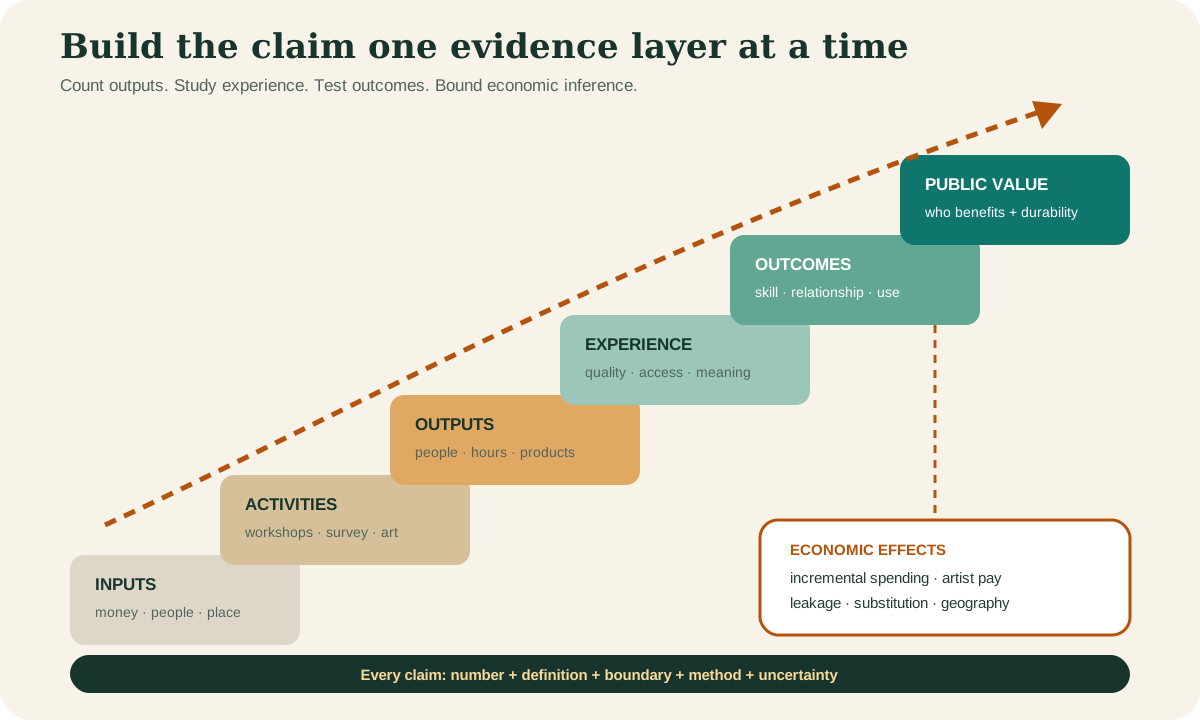
Inputs
Money, volunteer time, staff, artist labor, public property, facilities, collections, expertise, and political attention.
Activities
Workshops, research, performances, preservation surveys, exhibitions, public art, lodging, tours, youth programs, or planning sessions.
Outputs
Participants, hours, events, artist contracts, buildings surveyed, reports produced, visitors, volunteer hours, room nights, local purchases.
Experience and quality
Belonging, challenge, beauty, learning environment, welcome, access, artistic quality, relevance, safety, and participant agency.
Outcomes
Skills, continued creative practice, preservation knowledge, stronger relationships, increased access, improved decision quality, stabilized historic resources, or changed policy.
Public value
Who benefits beyond the direct participant? Are benefits broadly accessible, geographically relevant, equitable, durable, and worth public opportunity cost?
Economic effects
Incremental visitor spending, artist income, local procurement, business revenue, employment, tax receipts, property investment, and displacement or substitution. These require careful geography, baseline, time period, and assumptions.
Do not confuse these numbers
Attendance
Count unique people, visits, tickets, or seats? A three-day attendee may be one visitor and three admissions. Publish the method.
Visitor origin
“Non-local” might mean outside ZIP code, municipality, county, or state. Define it.
Gross spending
If 1,000 visiting parties report $120 average local spending, gross reported spending is $120,000. That is not automatically net new impact.
Incremental spending
Ask:
- Would they have come anyway?
- Would local residents have spent the money elsewhere locally?
- How much leaks to non-local suppliers?
- Did the event displace other visitors or activity?
- Is the sample representative?
- Are lodging, food, tickets, and retail double-counted?
Multiplier
An input-output multiplier is model-dependent. Never apply a borrowed national or statewide multiplier to a small local event without appropriate data and professional method.
Causality
A thriving downtown and strong arts activity may occur together. That correlation does not prove the arts organization caused every improvement. NEA rural-arts research finds important associations and audience patterns, including non-local attendance and civic roles, but it is not a causal evaluation of Shake Rag or a Stoughton project 3.
The three-number rule
Every public impact claim should include:
- number — “642 participants”;
- definition — “unique registrations, not visits”;
- boundary — “program year 2026; canceled registrations excluded; residence self-reported.”
For calculated claims, add formula and assumptions:
“Estimated gross off-site visitor spending = responding non-local parties × reported mean spend. This is not a net economic-impact estimate; response rate was 58%, and no multiplier was used.”
Culture is not only an economic tool
Economic evidence matters because public and charitable resources are scarce. But reducing arts and history to visitor spending can:
- undervalue resident meaning and learning;
- turn artists into marketing decoration;
- favor high-income tourists over local access;
- ignore preservation, memory, experimentation, and civic voice;
- create pressure to inflate claims.
Audience-impact research notes that qualitative evidence is abundant while quantitative measurement of complex arts experiences is difficult 4. The response is not to abandon measurement. Use a portfolio:
- reach: who participated and who did not;
- quality: peer/participant assessment and artistic standards;
- learning: demonstrated knowledge, skill, or continued practice;
- relationship: repeat partnership, trust, network, volunteer behavior;
- place: preservation condition, use, access, resident experience;
- economy: artist pay, local purchases, visitor behavior, business evidence;
- equity/access: barriers, accommodations, subsidized participation, geographic reach;
- durability: what persists after the event or grant.
Build an honest impact brief
For a Shake Rag program or Stoughton cultural initiative:
- Write the strongest public claim leaders currently want to make.
- Underline each causal verb: caused, created, transformed, drove, saved.
- Replace unsupported causality with measured contribution: served, paid, convened, preserved, supported, was associated with.
- Add the evidence method and missing counterfactual.
- Include one cost, tradeoff, access gap, or uncertainty.
- State what will be measured next year.
Example:
“The program paid 18 artists, recorded 416 unique participants from 11 Wisconsin counties, and purchased $21,300 from vendors with Mineral Point addresses. Of 132 responding visiting parties, 61% reported that the workshop was the primary reason for their trip. These figures describe direct activity and self-reported motivation; they do not estimate net regional impact or displacement.”
The public leader’s question
The mayor should not ask only, “Will this bring people downtown?” The board should not ask only, “Will this grow revenue?”
Both should ask:
What combination of cultural, civic, physical, learning, access, and economic value are we purchasing—and what evidence would let a skeptical resident understand the claim?

Working rule
Tell the largest story the evidence supports, not the largest story the audience will applaud.
Credible restraint compounds. Inflated impact language may win a headline and weaken the next grant, partnership, or public decision.
Practice
Attendance is an output. Economic additionality and longer-term outcomes require separate evidence and assumptions.
Practice
The case illustrates municipal eligibility and responsibility for preservation planning; the current program page says the grants do not fund rehabilitation work.
Lesson complete
Nice work.
Sources for this lesson
- 1Creative Placemaking. National Endowment for the Arts. verifiedFederal framework for integrating arts, culture, and design into community-developed economic, physical, and social outcomes. Cited at: framework.
- 2Certified Local Government Grants. Wisconsin Historical Society. verifiedCurrent eligibility, project types, reimbursement model, procurement expectations, public-engagement requirements, deadlines, and awards, including 2026 survey awards to Mineral Point and Stoughton. Cited at: 2026 awards; eligible and ineligible work.
- 3New Research Report Highlights Economic Impact of the Arts in Rural Communities. National Endowment for the Arts. 2017. verifiedNational research summary on rural arts participation, non-local audiences, civic leadership, and economic context; useful evidence but not proof of a specific project's causal impact. Cited at: rural arts context.
- 4Audience Impact Study Literature Review. National Endowment for the Arts. verifiedReview showing the abundance of qualitative accounts and the difficulty of measuring arts experiences and impacts quantitatively. Cited at: measurement limits.
Further reading
- Historic Preservation Commission. City of Mineral Point, Wisconsin. verifiedCurrent commission mission and responsibilities linking cultural heritage, education, civic identity, tourism, business, and community welfare.
- Visit Stoughton. City of Stoughton, Wisconsin. verifiedCity page connecting tourism, the Arts Council, Opera House, festivals, and the downtown arts and entertainment district.
- Mineral Point, Wisconsin. Advisory Council on Historic Preservation. verifiedFederal historic-preservation profile of Mineral Point’s mining, architecture, tourism, and adaptive reuse.
- Megan O'Connell. Art and History at Shake Rag Alley. PBS Wisconsin. 2014. verifiedAn 18-minute historical lecture with a full transcript; use as a 2014 institutional-history source, not a current operations source.
- About Us. Shake Rag Alley Center for the Arts. verifiedCurrent mission, staff and board roster, programs, campus history, and organization timeline.