Board Giving and Fundraising Expectations
What directors owe in giving and fundraising: four separate commitments, the tradeoffs of personally meaningful gifts, minimums, give/get, and tailored commitments, fundraising roles that don't require asking, a personal commitment worksheet, ethical limits, and follow-up without shame.
- 5 min
- 8 steps
- 3 questions
- Lesson 17 of 36
In this lesson
- Distinguish four commitments
- Models and tradeoffs
- What to ask Shake Rag
- A board commitment menu
- Personal commitment worksheet
- Ethical boundaries
- Accountability without shame
Picking up where you left off.
There is no universal legal rule that a nonprofit director must donate a particular dollar amount. Shake Rag Alley’s current board policy and recruitment agreement control the organizational expectation; ask for them rather than guessing.
BoardSource recommends that all directors make a personally meaningful contribution and that expectations be clear 1. That can build credibility with funders who ask about board participation, but a rigid wealth screen can shrink community representation and undervalue time, expertise, relationships, and lived experience.
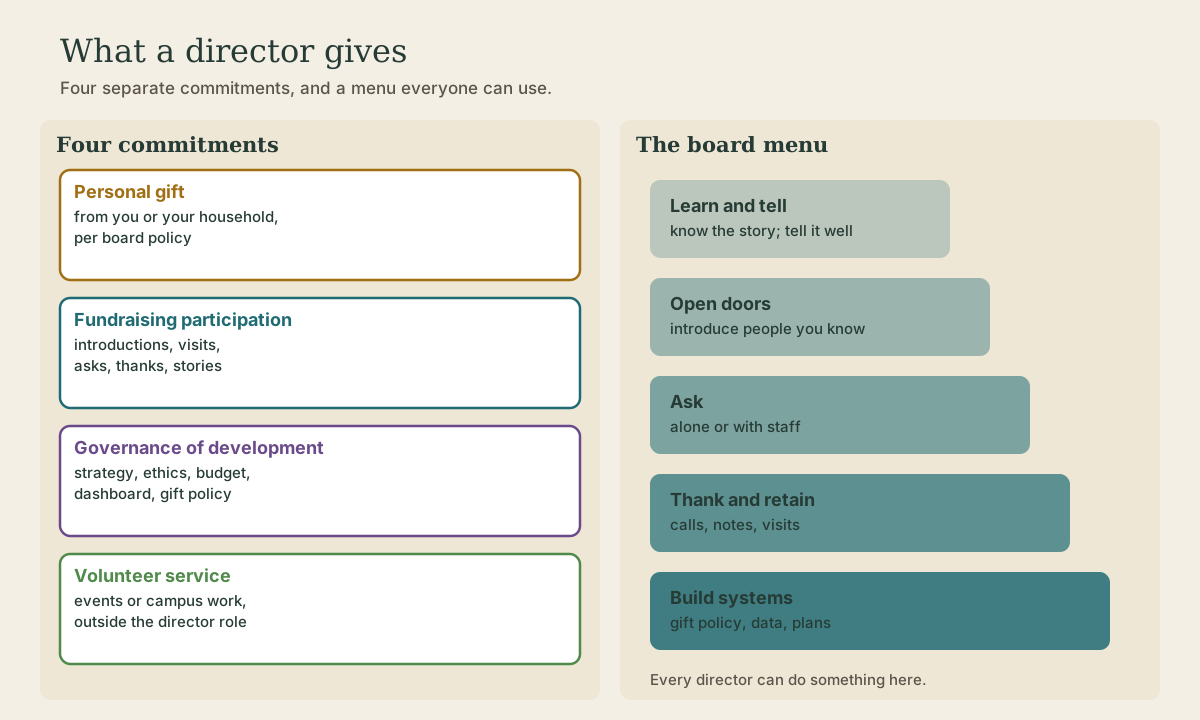
Distinguish four commitments
- Personal gift: a contribution from the director/household, according to policy.
- Fundraising participation: introductions, visits, asks, thanks, events, stories, prospect thinking.
- Governance of development: strategy, ethics, risk, budget, dashboard, gift policy.
- Volunteer service: event or campus work outside the director role.
Do not blur them. A large gift does not excuse poor governance; many volunteer hours do not automatically meet a giving policy; fundraising participation is more than buying a ticket.
Models and tradeoffs
Personally meaningful gift + 100% participation
Every director gives at a level meaningful to them, with confidential handling.
Strength: inclusive, clear participation.
Risk: vague unless timing, privacy, and other fundraising roles are defined.
Minimum gift
Each director gives a set amount.
Strength: measurable.
Risk: can exclude skilled community voices, encourage token compliance, and confuse wealth with commitment.
Give/get
Each director gives and/or secures a target.
Strength: links board to resource needs.
Risk: transactional recruiting, pressure on personal networks, ambiguous credit, inequity, and weakened donor stewardship if people chase totals.
Tailored commitment
Each director agrees to a gift and specific development activities within a common framework.
Strength: aligns diverse capacity with real work.
Risk: needs tracking and accountability.
A strong policy can combine personally meaningful giving with specific participation and accommodations. Do not invent an exception privately; make the policy equitable.
Quick check
It links the board to resource needs but can weaken stewardship if people chase totals.
What to ask Shake Rag
- Is there a minimum, “meaningful gift,” give/get, or other expectation?
- Is 100% participation a goal?
- When in the fiscal year should the gift be completed?
- Are event tickets, auction purchases, sponsorship, matching gifts, and in-kind gifts counted?
- Are amounts confidential? Who tracks participation?
- What if financial circumstances change?
- Which fundraising activities are expected?
- May directors solicit vendors, instructors, participants, or staff? Under what ethics?
- How are donor relationships assigned and recorded?
- What happens when a commitment is not met?
Shake Rag’s public support page says donations fund roughly 30% of annual operating costs, offers recurring giving such as $20/month, names planned giving through the Lantern Society, and reports over 1,000 volunteer hours annually 2. These are public options, not proof of the board’s private expectations.
A board commitment menu
Every director chooses a gift commitment plus at least three actions:
Learn and tell
- learn the two-minute case;
- attend programs;
- collect a consented story;
- explain unrestricted versus restricted support.
Open doors
- identify five aligned people/institutions;
- make two warm introductions;
- host a four-person studio/campus conversation;
- invite a prospect to a mission experience.
Ask
- join a staff-led donor visit;
- make a renewal or first-gift ask;
- ask a business about sponsorship;
- invite a planned-gift conversation without offering tax/legal advice.
Thank and retain
- make monthly thank-you calls;
- write notes;
- report back on impact;
- welcome first-time donors;
- help recover lapsed relationships.
Build systems
- review the case;
- improve prospect research;
- help evaluate event economics;
- recruit development expertise;
- review gift acceptance or dashboard.
Personal commitment worksheet
Complete and share through the designated process:
Gift: I will give $ / a personally meaningful amount by . It will be [unrestricted/restricted under accepted policy].
Introductions: I will introduce ___ and ___ by .
Cultivation: I will host/attend .
Solicitation role: I am comfortable [leading/joining/preparing/not yet asking].
Stewardship: I will thank ___ donors per quarter.
Skills: I can help with .
Boundaries/conflicts: Avoid/coordinate .
Support needed: case language/training/staff partner/list.
Review date: ___.
Do not send personal contact lists around by email. Add qualified prospects and consent/context through the approved donor system.
Ethical boundaries
Directors must not:
- imply gifts buy board decisions, contracts, admissions, or access;
- pressure staff, instructors, or vulnerable participants;
- promise naming, restriction, recognition, tax value, or confidentiality without authority;
- use donor information for another organization or business;
- invent urgency or exaggerate outcomes;
- accept a gift that undermines mission or creates unbudgeted liability;
- give individual tax/legal advice.
Use:
“I can share why I support Shake Rag. Staff can confirm the accepted gift structure, recognition, and acknowledgment.”
Accountability without shame
The governance/development chair reports completion rates and assignments, usually not director amounts to the full group unless policy says so. Follow up early:
“You committed to two introductions by September. Is the barrier the names, wording, staff timing, or a change in capacity? Let’s reset to a specific contribution.”
Repeated nonperformance belongs in annual board evaluation and renomination. Money is one form of contribution; reliability is nonnegotiable.
Practice
No universal amount applies; clarity, participation, means, and the organization’s approved policy matter.
Practice
Development has many essential roles; each director should commit to specific ones.
Lesson complete
Nice work.
Sources for this lesson
- 1Board Members and Personal Contributions. BoardSource. verifiedGuidance on 100 percent participation, personally significant gifts, and tradeoffs in give/get policies. Cited at: personal contributions.
- 2Ways to Support Shake Rag Alley. Shake Rag Alley Center for the Arts. verifiedCurrent volunteer, donation, planned-giving, event, and legal-name information. Cited at: giving and volunteering.
Further reading
- Nonprofit Fundraising and the Board’s Role. BoardSource. verifiedBoard and staff roles in contributed-income strategy, donor portfolios, cultivation, solicitation, and stewardship.
- Board Roles and Responsibilities. National Council of Nonprofits. verifiedGovernance practice on fiduciary stewardship, executive oversight, resources, fundraising, and advocacy.