From Handshake to Operating Agreement
Turning 'we'll partner' into a working agreement: choosing between an MOU, grant agreement, contract, or lease, a partnership canvas, a RACI that respects authority, service standards, monitoring, change control, and planning for failure and exit.
- 6 min
- 10 steps
- 3 questions
- Lesson 30 of 36
In this lesson
- Choose the right instrument
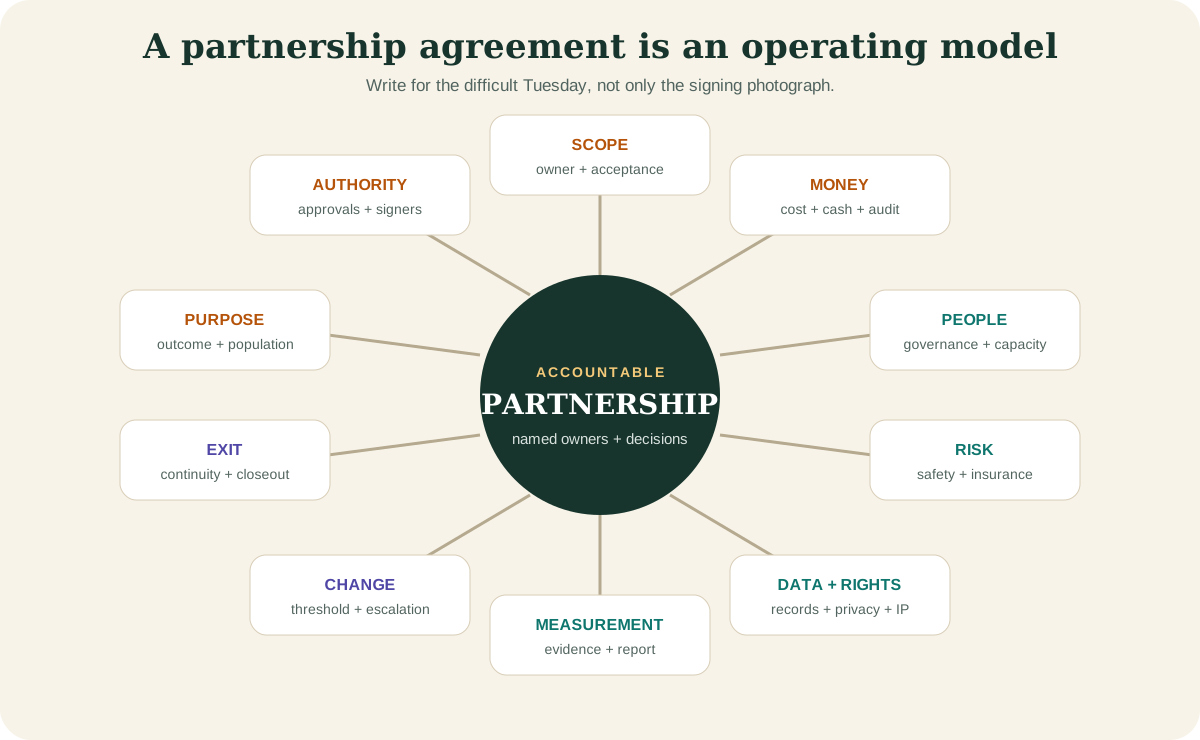
- The P-A-R-T-N-E-R-S canvas
- Build a RACI that respects authority
- Service standards, not slogans
- Government responsibility does not vanish
- Monitoring rhythm
- Change control
- Failure and exit design
- Agreement stress test
Open alongside this lesson
-
Board Development Resources (opens in a new tab)
Use the MOU and collaboration materials to frame discussion; obtain counsel for the actual instrument.
-
The Grant Lifecycle (opens in a new tab)
A shared project continues through award, implementation, reporting, and closeout—not just application.
Picking up where you left off.
“We will partner” is not yet a plan. A partnership becomes governable when leaders can describe the work on a difficult Tuesday: who decides, who pays, who is on site, whose policy applies, where the records live, how a failure is reported, and what happens when the grant ends.
Choose the right instrument
Names vary and legal effect depends on content, authority, and jurisdiction. Common tools include:
- memorandum of understanding (MOU): documents roles, coordination, or shared intent; it can still create real obligations depending on its language;
- grant agreement: supplies funds for a defined purpose with conditions, reporting, remedies, and closeout;
- services contract: buys specified work or outputs;
- facility-use agreement or lease: allocates space, time, maintenance, improvements, security, utilities, access, and liability;
- license or permit: authorizes limited use subject to public rules;
- data-sharing agreement: defines lawful purpose, fields, security, access, retention, disclosure, incident response, and deletion;
- fiscal sponsorship/subaward arrangement: requires careful control, charitable-purpose, tax, grant, and accounting analysis;
- intergovernmental agreement: used among public entities where authorized.
Do not assume an “MOU” is nonbinding or a “contract” captures every operational issue. Counsel should choose and draft the actual instrument.
Quick check
Legal effect depends on content and authority, not the document’s name.
The P-A-R-T-N-E-R-S canvas
Purpose
State the public and charitable outcomes, populations, geography, and evidence. Avoid “promote the arts” as the entire scope.
Authority and approvals
List the city ordinance, appropriation, council or delegated action, nonprofit board/staff authorization, grant approval, and signatories. Attach or cite the approving records.
Responsibilities and deliverables
For each output:
- owner;
- collaborators;
- deadline;
- standard or acceptance test;
- required accessibility;
- evidence;
- approver;
- remedy or correction period.
Terms and money
Define amount, source, budget, indirect cost, invoice schedule, advance/reimbursement, match, procurement, tax, audit, allowable cost, interest, unspent funds, and amendment.
Named governance
Create:
- executive sponsors;
- project leads;
- meeting rhythm;
- decision-rights matrix;
- change-control route;
- conflict process;
- escalation ladder;
- reporting calendar.
Exposure and risk
Address insurance, indemnity as legally appropriate, safety, youth protection, professional qualifications, permits, weather, cancellation, accessibility, property damage, cybersecurity, privacy, emergency authority, and incident reporting.
Records, data, and intellectual property
State who creates, owns, licenses, holds, publishes, protects, retains, and destroys:
- attendance and participant data;
- photographs and permissions;
- oral histories and cultural knowledge;
- designs, maps, curriculum, research, and reports;
- financial and procurement records;
- public communications;
- software/accounts;
- records subject to public access or funder audit.
Story and communication
Set brand approvals, spokespeople, required acknowledgments, factual review, crisis coordination, political neutrality, public-record caveats, and the right to publish honest results.
Build a RACI that respects authority
RACI means:
- Responsible: performs work;
- Accountable: owns final completion/decision;
- Consulted: gives input before action;
- Informed: receives result.
Example:
| Work | City council | City staff | Nonprofit board | Nonprofit staff | Community advisory group |
|---|---|---|---|---|---|
| approve public funds | A | R | I | I | I |
| accept grant/contract | I | C | A or delegated | R | I |
| design workshops | I | C | I | A/R | C |
| issue city permit | I | A/R | I | C | I |
| recruit participants | I | C | I | A/R | C |
| approve public report | I | A for city claims | I | A for nonprofit claims | C |
RACI does not override law. It translates lawful authority into work.
Service standards, not slogans
Replace:
“The nonprofit will provide accessible arts programming.”
With:
“The nonprofit will deliver six two-hour workshops between May 1 and August 31 for up to 90 total participants; reserve at least 20 no-cost local places through published criteria; provide step-free program access, accessible registration, captioned orientation media, and an accommodation contact; compensate six instructors under written agreements; submit aggregate enrollment, ZIP-region, completion, access-request response, participant-feedback, artist-payment, budget, and incident data by September 30.”
Then ask whether those measures are lawful, useful, proportionate, and resourced.
Government responsibility does not vanish
When a public entity contracts with a private organization to deliver a public program, Title II responsibility remains relevant. DOJ’s municipal guidance describes public entities’ obligation to ensure contracted services are accessible 1. The agreement should allocate implementation without pretending legal responsibility has been exported.
Similarly, the city should not demand unnecessary personal data merely because it funds the project. Define aggregate proof when individual identity is not needed.
Monitoring rhythm
Monthly project dashboard
- scope delivered / due;
- budget and cash;
- accessibility and participation;
- risks/incidents;
- changes awaiting approval;
- public questions/complaints;
- next 30-day decisions.
Quarterly governance review
- outcome trajectory;
- grant/contract compliance;
- procurement and conflict exceptions;
- financial forecast;
- data/records quality;
- staffing and partner capacity;
- continuation, redesign, or exit.
Closeout
- accepted deliverables;
- final invoice and reconciliation;
- asset/property disposition;
- unspent funds;
- final records and retention;
- public results;
- participant follow-through;
- audit window;
- lessons and renewal decision.
Government grants and contracts often fail through cash timing, changing terms, incomplete cost recovery, or excessive administration 2. Monitoring should surface those issues early rather than reward silent subsidy.
Change control
Every project changes. Define thresholds:
- project leads may move line items up to 5% within the approved total, if funder terms permit;
- scope, accessibility, population, property, schedule, or total cost changes require written approval;
- no party may commit the other in public without authorization;
- emergency actions protect life/property first, then trigger rapid notice and ratification as required;
- grant modifications must be approved by the funder before incompatible spending.
The numbers are examples, not recommended legal terms.
Failure and exit design
Trigger review for:
- missed deliverables;
- material budget variance or cash shortfall;
- loss of key staff or venue;
- safety or rights incident;
- undisclosed conflict;
- data breach;
- ineligible cost or funder concern;
- loss of public or charitable authority;
- repeated inaccessible service;
- reputation or mission conflict.
An exit clause should address notice, cure, termination, participant continuity, refund, property, records, public explanation, and grant obligations. No agreement should abandon learners mid-program because two institutions stopped speaking.
Agreement stress test
Before signing, simulate:
- The event is canceled by severe weather.
- A child is injured.
- The city receives a records request for project email and participant data.
- The grant reimbursement is 60 days late.
- The nonprofit wants to change the target population.
- A council member criticizes the program publicly.
- A director’s company submits a bid.
- The facility becomes inaccessible.
- The executive director resigns.
- The partnership ends with equipment and unspent funds remaining.
If the agreement supplies no owner or process, revise it.
Working rule
Write the agreement for implementation, conflict, and ending—not just the signing ceremony.
The best partnership document turns goodwill into durable, inspectable behavior while preserving each institution’s authority.
Practice
Purpose matters, but operational accountability requires explicit ownership and acceptance.
Practice
Designing a responsible ending protects the mission and public even when the partnership changes.
Lesson complete
Nice work.
Sources for this lesson
- 1The ADA and City Governments — Common Problems. U.S. Department of Justice. verifiedPractical municipal examples covering facilities, communication, meetings, programs, policies, and contracted services. Cited at: contracted services.
- 2Government-Nonprofit Contracting Reform. National Council of Nonprofits. verifiedPractice and policy issues in government grants and contracts, including full cost, indirect cost, payment timing, and administrative burden. Cited at: contracting challenges.
Further reading
- Board Development Resources. University of Wisconsin–Madison Division of Extension, Dane County. verifiedWisconsin-based resources on board purpose, roles, meetings, collaboration, memoranda of understanding, and organizational practice.
- Wisconsin Public Records Law Compliance Guide. Wisconsin Department of Justice. 2025. verifiedCurrent official guide to authorities, custodians, records, requests, balancing, redaction, electronic records, fees, and enforcement.
- A Citizen's Guide to Wisconsin's Local Governmental Officials Code of Ethics. Wisconsin Ethics Commission. verifiedPlain-language guide to private benefit, financial interests, incompatible action, and public contracts for local officials.
- The Grant Lifecycle. Grants.gov. verifiedOfficial federal pre-award, award, implementation, reporting, and closeout lifecycle.
Previous: Follow the Money: Grant, Contract, Gift, Sponsorship, or Tax