Strategy That Governs: Outcomes, Choices, and a Board Dashboard
Strategy as choosing where scarce money, time, and property go and what to stop: a one-page strategy, a theory of change, scoring the program portfolio, a 10-to-15-signal dashboard with defined denominators and honest status colors, and base, downside, and opportunity scenarios.
- 5 min
- 7 steps
- 3 questions
- Lesson 9 of 36
In this lesson
- A one-page strategy
- Theory of change
- Portfolio lens
- A dashboard, not a scrapbook
- Scenario planning
- Board exercise
Picking up where you left off.
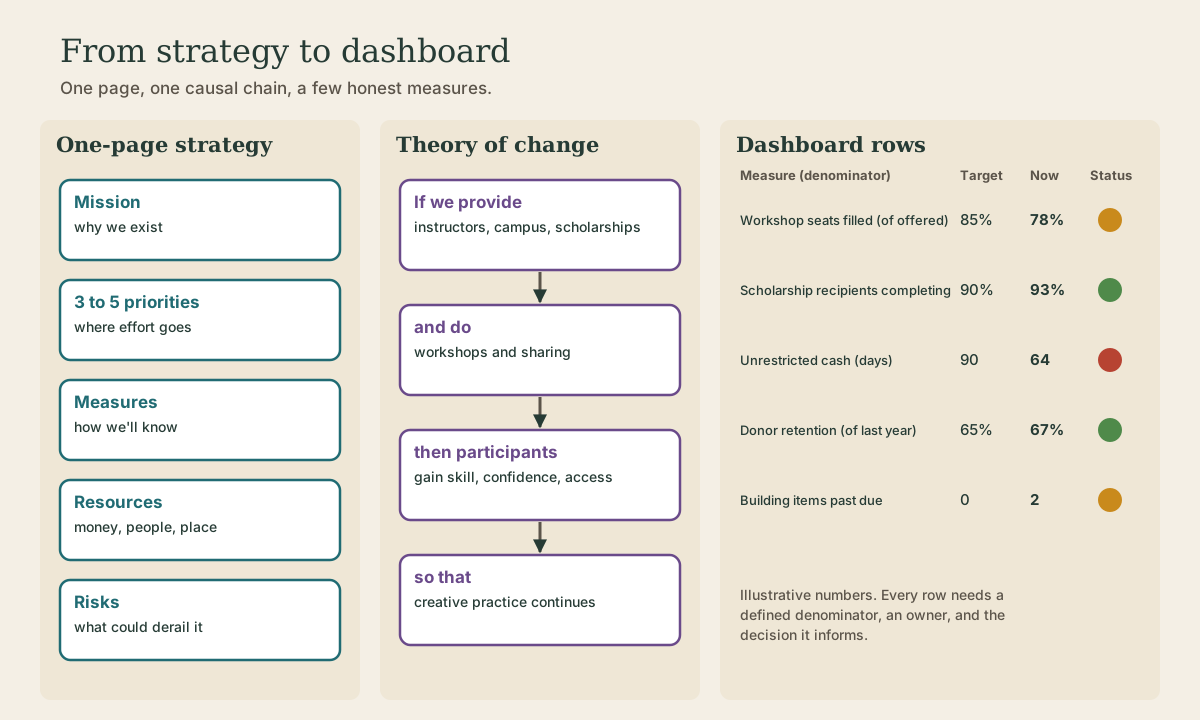
A mission says why the organization exists. Strategy says where it will concentrate scarce money, time, property, relationships, and attention—and what it will not do.
Shake Rag’s public mission joins art learning, rural creative experience, and preservation 1. Its catalog spans adult workshops, youth programs, literary and performing activity, and a campus experience 2. The board’s strategic problem is not “arts versus buildings.” The campus is part of the learning proposition, and programs produce both impact and resources. The problem is finding a durable system.
A one-page strategy
Require explicit answers:
- Public need: What human or community condition are we trying to change?
- People: Whom do we primarily serve? Who is missing or faces barriers?
- Distinctive promise: What can Shake Rag do especially well because of place, craft, relationships, and history?
- Three to five choices: Where will we concentrate?
- Capabilities: What people, systems, buildings, tools, money, and partnerships must exist?
- Economics: Which activities earn, attract gifts, need subsidy, or consume capital?
- Outcomes: What changes for participants, artists, campus, and community?
- Tradeoffs: What will we stop, defer, partner on, or decline?
- Risks/assumptions: What must be true, and how will we learn quickly?
- Review: What evidence triggers adaptation?
“More workshops, more donors, more visitors, better buildings” is a wish list. Strategy names sequence and constraint.
Theory of change
Build a testable chain:
| Stage | Shake Rag example |
|---|---|
| Inputs | artists, staff, volunteers, buildings, tools, funds, partners |
| Activities | workshops, youth learning, residencies, literary events, lodging, preservation |
| Outputs | sessions, seats, scholarships, artist contracts, building work |
| Near outcomes | skill, confidence, creative practice, connection, access |
| Longer outcomes | durable creative community, artist livelihood, cultural participation, preserved place |
| Public value | a rural arts ecosystem and historic asset available to future generations |
An output is what was delivered. An outcome is what changed. “Forty students attended” is not proof that skills, belonging, or practice improved.
For each causal arrow ask:
- What evidence supports it?
- Which group experiences a different result?
- What unintended effect could occur?
- What is proportionate to measure?
Do not burden a small arts organization with a research laboratory. Use a few credible measures: short post-session questions, repeat participation, portfolio/sample evidence, access data, partner feedback, instructor retention, and stories gathered with consent.
Portfolio lens
Score each program family 1–5 on:
- mission fit;
- participant outcome;
- distinctiveness/place fit;
- access/equity;
- earned contribution after direct cost;
- contributed-income appeal;
- staff and facility load;
- safety/operational risk;
- learning potential.
Never reduce the decision to a single total. The pattern starts a conversation. A youth program might be mission-critical and intentionally subsidized. Lodging might support experience and cross-subsidize mission. A popular workshop might consume a fragile building or depend entirely on one instructor. Name the logic.
A dashboard, not a scrapbook
Use 10–15 signals. Each needs definition, owner, frequency, target, threshold, trend, narrative, and action.
| Domain | Example signal | Board threshold |
|---|---|---|
| Mission | completion and reported skill gain by program family | two periods below target |
| Access | scholarships, local youth reach, barriers reported | priority group participation falls |
| Program | enrollment/capacity and cancellation rate | material adverse trend |
| Finance | unrestricted cash days and rolling 13-week forecast | below policy floor |
| Revenue | earned/contributed mix; donor concentration | loss of major source |
| Development | donor retention and qualified pipeline | gap against plan |
| People | critical vacancies, turnover, safety training | role unfilled or required training overdue |
| Campus | high-priority maintenance backlog | life-safety item late |
| Risk | incidents/near misses and corrective actions | severe event or repeat pattern |
| Strategy | milestone status and assumption tests | red milestone |
Define the denominator
“Donor retention 62%” is meaningless until you specify:
prior-year donors who gave again / prior-year donors eligible to renew
Exclude/deal consistently with deceased donors, anonymous gifts, event buyers, grants, and households. Keep definitions in a data dictionary.
Use status honestly
- green: on plan; normal management;
- amber: threshold approached; management response shown;
- red: board intervention/decision or revised strategy needed;
- gray: data unavailable; owner and remedy named.
Do not turn amber into green because the board dislikes surprises.
Quick check
Keep definitions in a data dictionary and treat deceased, anonymous, event, and grant donors consistently.
Scenario planning
Build three linked financial/operating cases:
- base: best current estimate;
- downside: enrollment/gifts slower, urgent building repair, staffing gap;
- opportunity: major restricted gift, partner, or demand increase.
For each, predefine:
- first indicators;
- reversible actions;
- protected mission commitments;
- spending/debt/reserve authority;
- decision dates;
- communications.
The purpose is not prediction. It is avoiding improvised values under pressure.
Board exercise
Draft one strategic choice:
“For the next three years, Shake Rag will prioritize ___ for ___ because . We will strengthen ___ and fund it through . We will defer/stop . We will know it is working when , , and .”
Then test:
- Does the choice fit all three mission promises?
- Is the financial model visible?
- Is staff capacity plausible?
- What capital cost is hidden?
- Who might lose access?
- What evidence could prove us wrong?
Strategy becomes governance when choices control agendas, budgets, fundraising, executive goals, and what the organization declines.
Practice
A strategy identifies a distinctive path and tradeoffs, not only universal aspirations.
Practice
The dashboard should reveal whether strategy is working and when board attention is required.
Lesson complete
Nice work.
Sources for this lesson
- 1About Us. Shake Rag Alley Center for the Arts. verifiedCurrent mission, staff and board roster, programs, campus history, and organization timeline. Cited at: mission.
- 22026 Workshops, Retreats & Special Events. Shake Rag Alley Center for the Arts. 2026. verifiedCurrent program catalog and mission-facing description of the campus and learning experience. Cited at: program catalog.
Further reading
- Ways to Support Shake Rag Alley. Shake Rag Alley Center for the Arts. verifiedCurrent volunteer, donation, planned-giving, event, and legal-name information.
- Board Roles and Responsibilities. National Council of Nonprofits. verifiedGovernance practice on fiduciary stewardship, executive oversight, resources, fundraising, and advocacy.
Previous: Conflicts, Confidentiality, Records, and Director Protection