Shake Rag Alley’s Form 990: A Board Case Study
Reading Shake Rag Alley's public Form 990s for FY2023 and FY2024: revenue up 36% while program-service revenue fell, contributions rising from 37% to 60% of revenue, the questions those figures raise, reading the whole return, the board review process, and writing a one-page memo.
- 4 min
- 7 steps
- 3 questions
- Lesson 15 of 36
In this lesson
- Public snapshot
- Calculate before interpreting
- The board questions
- Read the whole return
- Board review process
- Write a board memo
Open alongside this lesson
-
Shake Rag Alley Inc — IRS Form 990 Filings (opens in a new tab)
Read the original returns linked from the profile, not only summary charts.
-
Form 990 Part VI — Board Review of Return (opens in a new tab)
Board review is reported on Form 990; understand what the question does and does not require.
Picking up where you left off.
Form 990 is an annual public information return, not an audit opinion, budget, or complete management statement 1. It is still one of a director’s most useful orientation documents.
Public snapshot
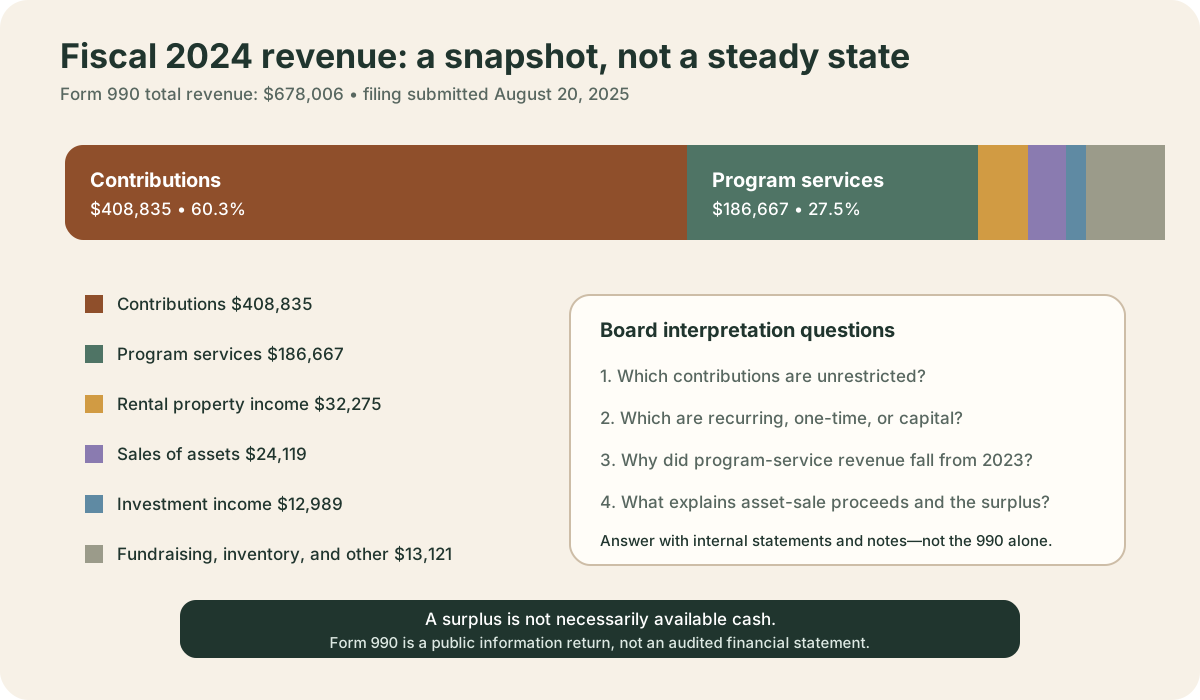
The public filings summarized by ProPublica show 2:
| Item | FY2023 | FY2024 | Change |
|---|---|---|---|
| Total revenue | $497,144 | $678,006 | +$180,862 / +36.4% |
| Total expenses | $471,523 | $504,699 | +$33,176 / +7.0% |
| Change/net income | $25,621 | $173,307 | +$147,686 |
| End net assets | $819,256 | $993,533 | +$174,277 |
| Contributions | $182,050 | $408,835 | +$226,785 / +124.6% |
| Program-service revenue | $247,907 | $186,667 | −$61,240 / −24.7% |
| Rental income | $32,053 | $32,275 | +$222 |
FY2024 details:
- assets: $1,272,717;
- liabilities: $279,184;
- wages: $182,203, 36.1% of total expense;
- investment income: $12,989;
- net rental income reported: $32,275;
- net fundraising-event income reported: $1,411;
- net gain on asset sales: $24,119;
- current filing reports $0 compensation to directors.
Calculate before interpreting
Contributions share
$408,835 / $678,006 = 60.3%
FY2023:
$182,050 / $497,144 = 36.6%
Program-service share
$186,667 / $678,006 = 27.5%
FY2023:
$247,907 / $497,144 = 49.9%
Liability-to-asset snapshot
$279,184 / $1,272,717 = 21.9%
Expense growth
($504,699 − $471,523) / $471,523 = 7.0%
These calculations create questions, not verdicts.
Quick check
Program-service revenue fell from about 50% to 27.5%, which raises questions rather than verdicts.
The board questions
Contribution spike
- What gifts or grants explain the $226,785 increase?
- How much was donor-restricted by purpose or time?
- Was any amount capital, planned, one-time, multiyear, or in-kind?
- Did a campaign or accounting-timing event occur?
- Which portion should not support recurring expense?
- Is donor concentration higher?
Program-service decline
- Which program families changed?
- Is this volume, price, mix, cancellation, scholarship, timing, or classification?
- Did the prior year include an unusual program?
- Did contributed funding intentionally expand access?
- What do current enrollment and forward bookings show?
Surplus and net assets
- How much increased unrestricted liquid resources?
- What portion is restricted or invested in property?
- Did receivables, deferred revenue, debt, or capital assets move?
- What is the recurring operating result excluding one-time/restricted/capital items?
- How does the internal statement reconcile to the return?
Asset sale gain
- What was sold, who authorized it, and was it mission/property related?
- Is the $24,119 gain distinct from cash proceeds?
- Were donor, preservation, or board restrictions involved?
- Is this excluded from operating trend analysis?
Read the whole return
Do not stop at Part I. Inspect:
- Part III: mission and program accomplishments—does narrative communicate public value?
- Part IV: schedules required;
- Part VI: governance, policies, board independence, return review, availability;
- Part VII: officers/directors/key employees and compensation;
- Part VIII: revenue classification;
- Part IX: functional expense;
- Part X: balance sheet;
- Part XI/XII: reconciliation and accounting/reporting;
- Schedules A/B/D/G/L/O when present: public support, contributions, supplemental financial data, fundraising/gaming, interested transactions, explanation.
The public version generally omits donor-identifying Schedule B information.
Board review process
The IRS asks whether a complete copy was provided to governing-body members before filing and requests a description of the review process; federal tax law does not itself require board review 3. Good practice:
- finance/management and preparer reconcile to approved records;
- finance/audit committee reviews numbers, classifications, governance answers, and narrative;
- every director receives the complete board-review copy securely in time;
- questions and corrections go to named owners;
- authorized filer approves/signs;
- final public and confidential copies are stored correctly;
- governance or control gaps become action items.
Focus on:
- mission description and program narrative;
- officer names/terms/time/compensation;
- conflict and related-party answers;
- board-review description;
- fundraising/event/gaming reporting;
- revenue/expense classification;
- significant changes and Schedule O explanations;
- reconciliation to audited/reviewed/internal statements.
Write a board memo
Prepare one page:
Three facts: exact filing figures
Three hypotheses: clearly labeled, not asserted
Five internal documents needed: restriction schedule, recurring bridge, cash forecast, program revenue detail, asset transaction record
Two decisions/monitoring needs: what belongs on a future agenda
The discipline is crucial: public fact → tentative interpretation → internal verification → governance action.
Practice
Form 990 is valuable but cannot answer restriction, recurrence, or liquidity alone.
Practice
Multi-year comparison reveals structural questions, while internal statements provide current answers.
Lesson complete
Nice work.
Sources for this lesson
- 1About Form 990. Internal Revenue Service. verifiedOfficial Form 990 purpose and schedule index. Cited at: purpose.
- 2Shake Rag Alley Inc — IRS Form 990 Filings. ProPublica Nonprofit Explorer. verifiedSearchable presentation of IRS filing data. The course uses the fiscal-2024 filing filed August 20, 2025 and compares prior years. Cited at: 2023 and 2024 filings.
- 3Form 990 Part VI — Board Review of Return. Internal Revenue Service. verifiedOfficial explanation that board review is not federally required but is a reported governance practice. Cited at: board review.
Further reading
- Form 990 Part VI — Governance. Internal Revenue Service. verifiedOfficial explanation of governance questions and the distinction between legal requirements and reported practices.
Previous: Budget, Cash, Restrictions, and Operating Reserves