Capstone: The Two-City Cultural Heritage Lab
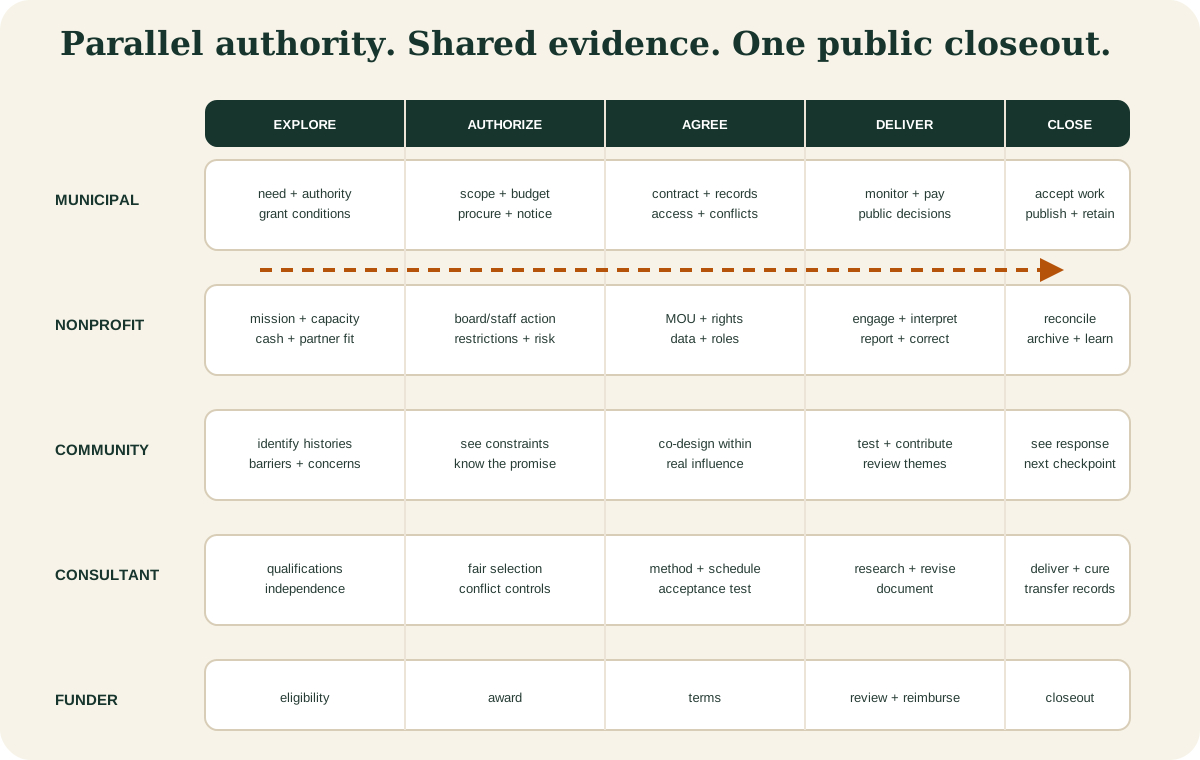
The capstone: designing a two-year heritage partnership around Mineral Point's and Stoughton's 2026 survey grants, with each city running its own survey, nonprofits adding interpretation, sources and uses, conflict handling, agreements, outcomes, guardrails, and motions.
- 8 min
- 13 steps
- 3 questions
- Lesson 36 of 36
In this lesson
- Public resources
- Operating proposal
- Risks and missing facts
- Handle the conflicted bidder
- Consolidated sources
- Nonprofit uses
- Agreement package
- Outputs
- Outcomes
- Nonprofit design-phase motion
- Municipal motion outline
- Capstone standard
Open alongside this lesson
-
Certified Local Government Grants (opens in a new tab)
Confirm current program terms, award amounts, deadlines, procurement, engagement, and eligible work before adapting the fictional scenario.
-
Spectrum of Public Involvement (opens in a new tab)
State which choices the public can actually influence.
Picking up where you left off.
This capstone is fictional, but it uses a real starting point: Wisconsin’s 2026 Certified Local Government awards include historic-resource survey projects for both Mineral Point and Stoughton 1. You will turn those parallel surveys into a carefully governed learning and interpretation initiative without misusing the grant, confusing the cities’ authority, or turning cultural history into marketing inventory.
The proposal
Create a two-year Two-City Cultural Heritage Lab:
- each city completes its own grant-funded survey under its own authority;
- local nonprofits and cultural partners help gather stories, reach participants, and interpret how survey knowledge can support future education;
- artists and historians are paid to develop temporary, accessible public prototypes;
- no prototype implies designation, promises property regulation, or begins rehabilitation;
- each city publishes its own decisions and grant deliverables;
- partners share a methods exchange, not a merged government project;
- final outputs include public learning events, a digital guide, and recommendations for future independently approved work.
The fictional facts
Public resources
- Mineral Point CLG award: up to $34,500 reimbursement.
- Stoughton CLG award: up to $30,000 reimbursement.
- Each city has separately budgeted $8,000 for accessibility, communication, and public engagement outside the survey contract.
- A regional foundation offers $70,000 to a nonprofit consortium for artist/historian interpretation.
- A local bank offers $15,000 sponsorship in return for recognition.
- Donors pledge $25,000, with one requesting permanent naming of the digital archive.
The actual 2026 grant amounts come from the current award page; all other numbers are invented for the exercise.
Quick check
Partners add interpretation and programs without taking over the cities’ grant obligations.
Operating proposal
- 12 oral-history interviews in each city;
- four accessible public history workshops per city;
- two paid artist interpretation prototypes per city;
- shared methods convening;
- digital map using selected survey/public data;
- final public report distinguishing history, community memory, survey findings, and future recommendations.
Risks and missing facts
- survey consultant procurement is not complete;
- one Shake Rag director’s firm may bid in Mineral Point;
- the Stoughton mayor has appeared in a foundation promotional video;
- no oral-history consent or rights framework exists;
- the digital vendor has not passed accessibility/security review;
- grant reimbursement may create a $40,000 combined cash gap;
- the foundation wants participant demographic data;
- one workshop location has no step-free entrance;
- a preservation group wants every identified property recommended for designation;
- property owners fear regulation;
- a candidate requests speaking time at the launch;
- neither city has approved the shared branding;
- long-term archive hosting has no owner or budget.
Phase 1: frame the decisions
Write one sentence for each:
Mineral Point municipal decision
Example:
Authorize the survey procurement and public-engagement plan within the CLG award, city budget, preservation authority, and conflict controls; no rehabilitation or designation is authorized.
Stoughton municipal decision
Same form, under Stoughton’s actual bodies and delegations.
Nonprofit board decision
Accept or decline the foundation award and authorize only a capped design phase until cash, data, rights, access, conflict, partner, and archive conditions are resolved.
Community influence
Residents can identify overlooked histories/resources, shape learning questions, test prototypes, and comment on future recommendations; they cannot select an unqualified consultant, change grant eligibility, guarantee designation, or commit public funds.
Phase 2: authority and conflict map
For each decision, identify:
- legal/governing source;
- accountable body/officer;
- staff owner;
- required recommendation/confirmation;
- conflict or dual-role person;
- advice needed;
- notice/records path;
- evidence of final approval.
Handle the conflicted bidder
The Shake Rag director:
- discloses to the nonprofit and appropriate city channel before scope/selection;
- does not shape the request, criteria, budget, shortlist, references, or vote;
- does not use nonprofit or city relationships to influence;
- follows the stricter applicable process;
- may be excluded from bidding if counsel/process requires.
Disinterested leaders and municipal counsel determine the actual participation rule. The file documents qualification, competition, scoring, conflict controls, and final selection 2.
Phase 3: participation and access plan
Choose levels:
| Workstream | Level | Promise |
|---|---|---|
| explain survey/grant | inform | accurate scope, timeline, limits, contacts |
| identify resources/stories | consult/involve | themes and evidence enter consultant/community research |
| design public prototypes | collaborate | paid group develops and tests options within rights/budget/access |
| municipal designation | separate future legal process | no current promise |
| consultant selection | inform after lawful procurement | criteria and award record published as permitted |
The levels follow the principle that participation must match actual influence 3.
Access minimum:
- accessible venues or an equivalent integrated program solution approved through qualified review;
- captioned hybrid participation;
- accessible registration, documents, maps, and digital prototypes;
- effective communication and reasonable modification;
- plain-language explanation of survey versus designation;
- transportation/schedule alternatives;
- paid participation for sustained expert/lived-experience labor;
- accommodation request process and budget;
- no public disclosure of disability requests.
Title II duties remain with each city for its programs and contracted delivery 4.
Phase 4: money and agreement
Consolidated sources
| Source | Amount | Owner | Key restriction/risk |
|---|---|---|---|
| Mineral Point CLG | $34,500 max | city | survey eligibility, procurement, reimbursement |
| Stoughton CLG | $30,000 max | city | survey eligibility, procurement, reimbursement |
| city engagement budgets | $16,000 | separate cities | public purpose, appropriation, access |
| foundation | $70,000 | nonprofit | interpretation, data/reporting, cash timing |
| sponsor | $15,000 | nonprofit or agreed recipient | recognition/fair value/brand |
| restricted gifts | $25,000 | nonprofit | project use; naming not yet accepted |
| Total | $190,500 | several | not one pot |
Do not deposit city grant awards in the nonprofit account unless a lawful, written arrangement specifically authorizes a payment. Do not count the same workshop against both city and foundation budgets without an allocation method.
Nonprofit uses
| Use | Amount |
|---|---|
| artists/historians/interviewers | $48,000 |
| access and participation | $16,000 |
| project management/payroll burden | $18,000 |
| digital prototype/vendor | $12,000 |
| rights, archive, insurance, evaluation | $8,000 |
| contingency | $8,000 |
| Total | $110,000 |
This matches the $70k + $15k + $25k non-city sources. City survey/engagement spending remains in each city’s ledger.
Agreement package
- separate city-consultant survey contracts;
- foundation-nonprofit grant agreement;
- city-nonprofit engagement/services agreements if public money pays nonprofit work;
- inter-partner MOU for the shared methods exchange;
- artist/historian contracts;
- oral-history consent/license;
- digital vendor/data/accessibility terms;
- venue/facility agreements;
- sponsor and gift/naming decisions.
Phase 5: measurement
Create a dashboard:
Outputs
- properties/resources surveyed under professional method;
- participants and unique contributors;
- workshops, interviews, prototypes;
- artist/historian compensation;
- accessible formats and accommodation response;
- city/nonprofit dollars by source/use.
Quality
- consultant acceptance;
- historical source transparency;
- contributor review/consent;
- prototype accessibility/usability;
- participant experience;
- corrections resolved.
Outcomes
- previously underrepresented histories added;
- resident understanding of survey versus designation;
- future planning questions clarified;
- institutions with usable preservation data;
- continued creative/historical participation.
Guardrails
- no unsupported economic-impact claim;
- no designation promise;
- no campaign platform;
- no private donor control of public findings;
- no publication beyond consent/rights;
- no inaccessible digital product;
- no project expansion without authority.
Phase 6: crisis test
Two weeks before launch:
- a participant withdraws oral-history consent;
- a candidate claims the project is a “secret property-control plan”;
- the website map exposes a private email address;
- one city consultant misses a milestone;
- the inaccessible venue cannot be fixed in time.
Response:
- honor consent and rights process;
- correct the policy claim with plain-language scope and official records;
- remove exposure, preserve evidence, assess breach, notify under plan;
- use contract cure/escalation and protect grant timeline;
- move or redesign the event rather than providing an inferior segregated experience;
- coordinate facts while each institution speaks within authority;
- publish next steps and later after-action changes.
Phase 7: draft motions
Nonprofit design-phase motion
“I move that the board accept the foundation award subject to final written terms and authorize up to $12,000 of project funds for a 90-day design phase; authorize no public launch, permanent naming, city-fund receipt, oral-history publication, or digital production contract; require disinterested conflict handling, a 13-week cash forecast, data/consent/rights plan, accessibility review, partner decision-rights matrix, archive owner and lifecycle cost, and final sources-and-uses; and require management to return by [date] with a go/no-go motion.”
Municipal motion outline
Counsel and the clerk must draft the actual action. The outline should identify:
- grant/appropriation authority;
- procurement and consultant;
- capped amount/fund;
- public-engagement scope;
- conflict handling;
- accessibility;
- reporting and records;
- staff authority and change limits;
- return date.
Do not copy the nonprofit motion into city minutes.
Your final board-and-mayor book
Produce:
- two-institution authority map;
- open meetings/records/nonprofit transparency matrix;
- dual-role/conflict register;
- participation decision-space and access plan;
- sources/uses plus 13-week cash forecast;
- agreement stack and RACI;
- cultural-value measurement brief;
- place/project stage gates;
- coalition network and appointment/recruitment matrix;
- communication/crisis protocol;
- advocacy/campaign role cards;
- draft motions, reporting calendar, and after-action plan.
Capstone standard
You pass when a skeptical resident, nonprofit director, city clerk, participant, and grant monitor can each answer:
- Who decided?
- Under what authority?
- Where did the money go?
- What could the public influence?
- How were conflicts and access handled?
- What did the project produce and change?
- Where are the records?
- What happens next?
Final rule
Public-nonprofit leadership is not the art of getting everyone to say yes. It is the craft of making separate, lawful, evidence-based promises fit into one accountable result.
Practice
The municipality owns the grant and procurement responsibility; partners may help frame community needs without controlling a conflicted selection.
Practice
Stage-gated authorization preserves options and produces decision-grade evidence.
Lesson complete
Nice work.
Sources for this lesson
- 1Certified Local Government Grants. Wisconsin Historical Society. verifiedCurrent eligibility, project types, reimbursement model, procurement expectations, public-engagement requirements, deadlines, and awards, including 2026 survey awards to Mineral Point and Stoughton. Cited at: 2026 awards.
- 2A Citizen's Guide to Wisconsin's Local Governmental Officials Code of Ethics. Wisconsin Ethics Commission. verifiedPlain-language guide to private benefit, financial interests, incompatible action, and public contracts for local officials. Cited at: official-action and contract issues.
- 3Spectrum of Public Involvement. U.S. Environmental Protection Agency. verifiedCurrent framework for matching the public's promised influence to inform, consult, involve, collaborate, or empower. Cited at: participation promises.
- 4State and Local Governments — Title II of the ADA. U.S. Department of Justice. verifiedOfficial overview of program access, effective communication, reasonable modifications, and disability nondiscrimination for public entities. Cited at: public program access.
Further reading
- Historic Preservation Commission. City of Mineral Point, Wisconsin. verifiedCurrent commission mission and responsibilities linking cultural heritage, education, civic identity, tourism, business, and community welfare.
- Boards, Commissions, and Committee Notifications. City of Stoughton, Wisconsin. verifiedCurrent list including the Arts Council, Landmarks Commission, Opera House Board, Plan Commission, Redevelopment Authority, and Common Council.
- Wisconsin Open Meetings Law Compliance Guide. Wisconsin Department of Justice. 2025. verifiedCurrent official guide to governmental-body status, notice, access, closed sessions, electronic participation, walking quorums, and enforcement.
- Wisconsin Public Records Law Compliance Guide. Wisconsin Department of Justice. 2025. verifiedCurrent official guide to authorities, custodians, records, requests, balancing, redaction, electronic records, fees, and enforcement.
- Government-Nonprofit Contracting Reform. National Council of Nonprofits. verifiedPractice and policy issues in government grants and contracts, including full cost, indirect cost, payment timing, and administrative burden.
- Creative Placemaking. National Endowment for the Arts. verifiedFederal framework for integrating arts, culture, and design into community-developed economic, physical, and social outcomes.
- Frequently Asked Questions About the Ban on Political Campaign Intervention. Internal Revenue Service. verifiedOfficial examples and questions about candidate events, voter education, issue positions, and the absolute campaign-intervention ban.
- Wikideas1. Stoughton City Hall. Wikimedia Commons. 2024. verifiedPanoramic photograph dedicated to the public domain under CC0 1.0.
- Wikideas1. Mineral Point, Wisconsin. Wikimedia Commons. 2024. verifiedAerial view released under CC0 1.0.


Previous: Advocacy, Lobbying, Campaigns, and Public Resources