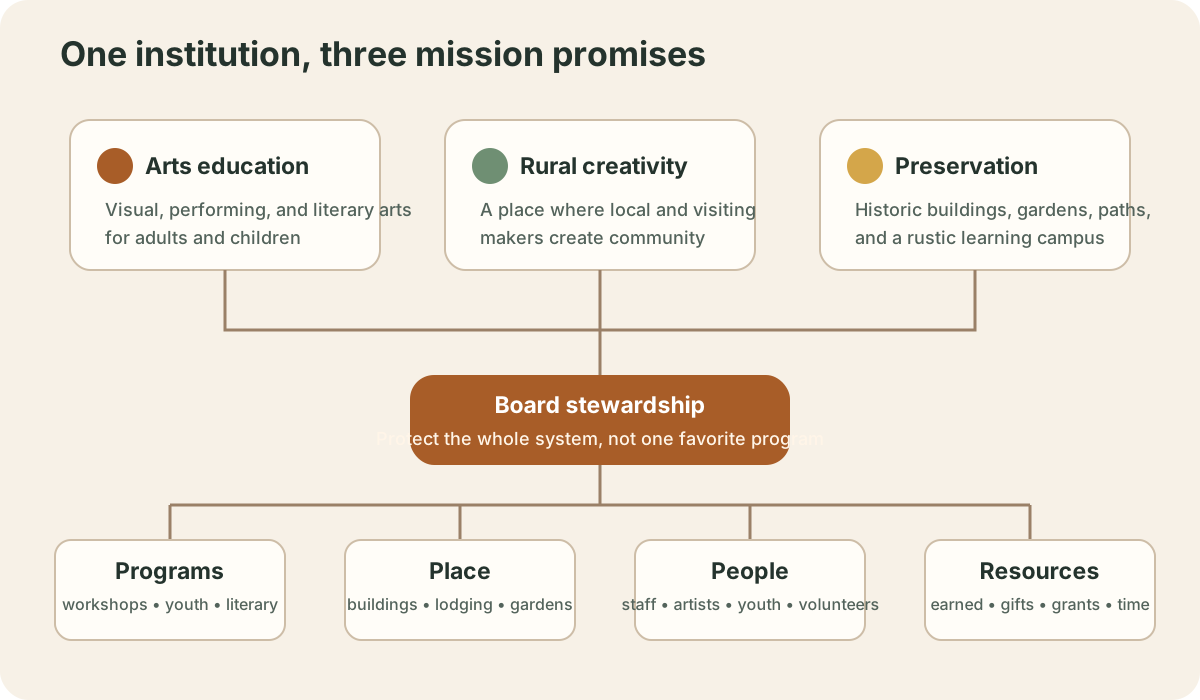
How Shake Rag Alley Actually Works
How Shake Rag Alley turns people, place, and money into mission: the program portfolio, five linked engines (learning, place, hospitality, community, resources), workshop contribution margin, a portfolio matrix, listening through the executive, and a quarterly board dashboard.
- 6 min
- 8 steps
- 3 questions
- Lesson 3 of 36
In this lesson
- The program portfolio
- Five linked engines
- Unit economics without mission amnesia
- Portfolio questions for directors
- Stakeholder listening without bypassing staff
- The board dashboard
- Assignment: draw the flow
Picking up where you left off.
An operating model answers a simple question:
How does this organization repeatedly turn people, place, money, knowledge, and relationships into mission value?
Shake Rag Alley is not only a school, venue, preservation site, lodging operator, youth program, event producer, or volunteer network. It combines all of them. Board decisions fail when one component is analyzed as though the others were free.
The program portfolio
The current public program includes:
- adult workshops from half-day projects to week-long immersion;
- multi-day retreats in fields such as jewelry, writing, fiber, mixed media, and rustic arts;
- K–12 youth programming, including community-supported free arts experiences;
- literary readings, poetry workshops, writing residencies, and Alley Stage events;
- community and fundraising events;
- campus and off-campus lodging;
- site rental and custom retreats;
- gift certificates and shop activity; and
- gardens and historic grounds open for visitation 1 2.
The current instructor page says workshops are often nine or fewer participants and proposal scheduling is developed on an annual cycle 3. Small classes can create exceptional contact and learning. They also create fragile economics: one cancellation, instructor travel change, or empty seat can move a class from contribution to subsidy.
Five linked engines
1. Learning engine
Staff recruit and schedule instructors, shape a catalog, price workshops, manage registrations, coordinate materials and space, communicate with students, host teaching, and evaluate the experience.
Board-level evidence:
- registration pace, fill and cancellation rates;
- new versus returning learners;
- net tuition after refunds and direct expenses;
- instructor recruitment, retention, compensation, and geographic mix;
- participant learning or creative outcomes;
- access, scholarships, and local participation;
- staff hours and space constraints.
2. Place engine
Buildings and grounds create identity and enable specialized, intimate learning. They also require inspection, utilities, insurance, cleaning, repairs, capital planning, accessibility, fire and weather readiness, tools, and neighbor relationships.
Board-level evidence:
- current condition assessment and maintenance backlog;
- near-term and five-year capital forecast;
- occupancy and life-safety requirements;
- deferred maintenance trend;
- restricted capital funds and donor promises;
- property, liability, and business-interruption coverage;
- accessibility barriers and improvement plan.
3. Hospitality engine
Lodging and rentals can deepen a participant’s experience and create earned revenue. Current offerings include campus lodging and the Sardeson property, with mission-supporting public rates and participant discounts 4 5.
Board-level evidence:
- occupancy, average rate, direct costs, cleaning and staff load;
- lodging tax and sales-tax handling;
- capital replacement and reserve assumptions;
- complaints, incidents, cancellations, and accessibility;
- cross-over between lodging guests and programs;
- rental uses that fit or strain mission and reputation.
4. Community engine
Volunteers host events, tend gardens, support fundraisers, and care for place. Shake Rag Alley says volunteers contribute more than 1,000 hours annually 6.
Volunteer time is not “free.” It requires recruitment, scheduling, supervision, training, recognition, safe task design, tools, records, and insurance review. A board should value the contribution while refusing to build essential operations on an untested assumption that volunteers will appear.
5. Resource engine
Revenue comes from program services, gifts and grants, rentals, events, investment income, sales, and sometimes asset transactions. Public Form 990 data show that the mix changes sharply by year. In 2023, program-service revenue was $247,907 and contributions $182,050. In 2024, program-service revenue was $186,667 and contributions $408,835 7.
The public support page says donations are roughly 30 percent of annual operating costs 6. That may describe a typical operating pattern, while Form 990 “contributions” can include grants or unusually large and possibly restricted gifts. Do not call either source wrong. Ask which definition, period, and restrictions each represents.
Quick check
The community engine has real capacity costs that belong on the dashboard.
Unit economics without mission amnesia
For a workshop, calculate:
gross tuition
− instructor compensation and travel
− materials included
− payment and registration fees
− directly attributable hospitality or space cost
= contribution margin before shared overhead
Then ask how much staff time, marketing, building use, insurance, administration, and fixed cost the program requires. “Full cost” assigns a reasonable share of those resources. Contribution margin helps short-term choices; full cost helps long-term pricing and capacity.
Do not cancel a mission-essential program solely because it is subsidized. Name the subsidy and decide intentionally:
“This youth program costs $X, earns $Y, requires $Z in support, reaches these participants, and produces these outcomes. We choose to subsidize it because ______.”
That sentence is much stronger than pretending the program pays for itself or calling overhead waste.
Portfolio questions for directors
Use a matrix:
| Activity | Mission contribution | Net financial contribution | Capacity load | Material risk | Strategic choice |
|---|---|---|---|---|---|
| Adult workshop | learning, artist livelihood | measure | staff + space | cancellation/tool | grow, maintain, redesign |
| Free youth arts | access, learning | likely subsidy | staff + volunteers | safeguarding | fund intentionally |
| Lodging | immersion, revenue | measure | cleaning + capital | guest/property/tax | optimize carefully |
| Site rental | revenue, community | measure | scheduling + wear | use/reputation | define acceptable uses |
| Free event | community | subsidy/sponsorship | intense volunteer load | crowd/weather | design for outcomes |
| Historic grounds | preservation, identity | indirect | year-round | capital/weather | fund lifecycle |
The answer is not to maximize the upper-right cell. A healthy portfolio may include earned-revenue engines, supported mission services, community access, experiments, and long-lived assets. The board should know which is which.
Stakeholder listening without bypassing staff
A director should experience workshops, events, and place. But “secret shopper” behavior can damage trust. Coordinate listening through the executive:
- attend as a learner or disclosed observer;
- use a consistent observation guide;
- never evaluate an employee directly;
- do not promise refunds, program changes, grants, jobs, or exceptions;
- route complaints promptly through the defined channel;
- report patterns, not gossip or personal preference;
- protect participant and donor privacy.
Ask staff what evidence would be useful before collecting more.
The board dashboard
A concise quarterly dashboard could include:
- mission reach: learners, youth, local share, repeat participation;
- program health: fill, cancellation, satisfaction, net contribution;
- people: vacancies, turnover, workload, volunteer capacity, incidents;
- place: maintenance backlog, capital progress, significant failures;
- money: actual versus budget, cash forecast, restrictions, reserve;
- development: donor retention, pipeline, grants, board participation;
- risk: top changes, control tests, insurance or compliance exceptions.
Every metric needs:
- definition;
- source;
- owner;
- target or interpretation band;
- trend;
- decision trigger.
Assignment: draw the flow
On one page, draw:
inputs → recurring work → direct outputs → participant/community outcomes
              ↓                    ↓
          cost/capacity         revenue/obligations
Mark three bottlenecks, two cross-subsidies, one single-person dependency, and one fact the board does not currently know. Bring the unknown as a question—not an accusation.
Course rule
Mission happens through an operating system. Govern the connections, price the real work, and make subsidies, constraints, and dependencies visible.
Practice
The operating model links inputs, activities, outputs, outcomes, economics, and constraints.
Practice
Economics inform portfolio decisions, but mission value still matters.
Lesson complete
Nice work.
Sources for this lesson
- 1About Us. Shake Rag Alley Center for the Arts. verifiedCurrent mission, staff and board roster, programs, campus history, and organization timeline. Cited at: what we do.
- 22026 Workshops, Retreats & Special Events. Shake Rag Alley Center for the Arts. 2026. verifiedCurrent program catalog and mission-facing description of the campus and learning experience. Cited at: program overview.
- 3Instructors — Propose a Workshop. Shake Rag Alley Center for the Arts. verifiedCurrent workshop-development rhythm, class-size assumptions, and instructor proposal information. Cited at: class size and planning.
- 4Shake Rag Alley Lodging. Shake Rag Alley Center for the Arts. verifiedCurrent lodging inventory, rates, guest policies, and earned-revenue context. Cited at: lodging.
- 5Site Rental. Shake Rag Alley Center for the Arts. verifiedCurrent campus rental offerings and facilities used for private events and retreats. Cited at: site rental.
- 6Ways to Support Shake Rag Alley. Shake Rag Alley Center for the Arts. verifiedCurrent volunteer, donation, planned-giving, event, and legal-name information. Cited at: volunteer contribution; donation share.
- 7Shake Rag Alley Inc — IRS Form 990 Filings. ProPublica Nonprofit Explorer. verifiedSearchable presentation of IRS filing data. The course uses the fiscal-2024 filing filed August 20, 2025 and compares prior years. Cited at: 2023 and 2024 extracted revenue.
Further reading
- Shake Rag Alley Center for the Arts. Shake Rag Alley Center for the Arts. verifiedCurrent public program, workshop, retreat, lodging, rental, and event entry points.
- Shake Rag Alley Center for the Arts. TechSoup. 2017. verifiedHistorical case study of organizational growth, bookkeeping, program profitability, facilities, and technology capacity.