Mission, History, and the Board’s Mandate
What a Shake Rag Alley director actually governs: a Wisconsin nonstock corporation and 501(c)(3) with a three-part mission, the campus story from Federal Spring and the 1830 log cabin, three loyalties (purpose, institution, public trust), the current roster as a dated snapshot, and a four-line agenda habit.
- 7 min
- 7 steps
- 3 questions
- Lesson 1 of 36
In this lesson
- The institutional story you inherit
- What the board actually governs
- Your three loyalties
- A current snapshot—and its limits
- Board habit: translate every agenda item
- First assignment: write your governing sentence
Open alongside this lesson
-
About Us (opens in a new tab)
Treat the roster as a dated public snapshot and the mission as the starting point for every board decision.
-
Art and History at Shake Rag Alley (opens in a new tab)
Megan O’Connell’s 2014 lecture connects the campus to Mineral Point’s mining, preservation, and artisan history. Current operations must be checked separately.
Picking up where you left off.
You are not joining an advisory fan club. You are becoming one of the people collectively responsible for a Wisconsin nonstock corporation and a federal 501(c)(3) public charity. Your job is to preserve mission, legality, assets, leadership capacity, and public trust while helping the institution remain useful.
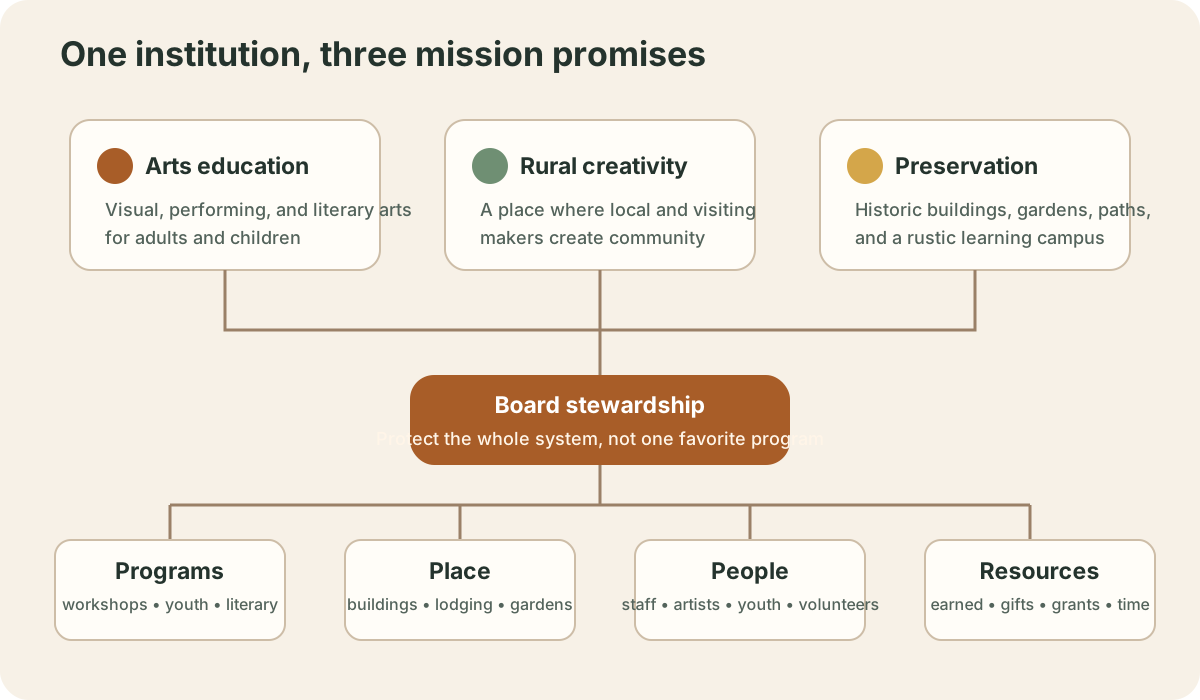
Shake Rag Alley’s published mission contains three promises:
- provide educational experiences in visual, performing, and literary arts for adults and children;
- cultivate creativity in a rural community; and
- rehabilitate and preserve historic buildings and a rustic campus 1.
Each promise competes for money and attention while reinforcing the others. A historic room becomes a classroom. A visiting instructor generates tuition and creative exchange. Lodging supports immersion and earned revenue. A free youth program builds access but needs subsidy. Gardens create place identity while demanding volunteer and maintenance capacity.
The institutional story you inherit
The official history begins with the spring-fed valley around Federal Spring, used by Native people before lead miners arrived in the late 1820s. Cabins in the area became known as “Shake Rag Under the Hill.” The campus includes an 1830 log cabin described as a possible Territorial Wisconsin schoolhouse and stone structures dating to roughly 1840–50 1.
Around 1970, Madison florist Al Felly bought the little homesteads around the spring, created gardens, rehabilitated and built structures, and made room for working artisans. After later owners and uses, local artists and community members led by Jim Kackley, Sandy Scott, and Judy Sutcliffe purchased the property on October 14, 2004. The organizing group raised the required $100,000 contingency-sale down payment and launched a nonprofit arts education center 1.
Today the organization says it occupies nine buildings on 2.5 acres and has grown from an after-school youth program and a handful of workshops into a nationally known arts and crafts school supported by students, instructors, donors, and volunteers 1.
This is not trivia. It reveals enduring governance tensions:
- Preserve versus adapt. Old structures carry meaning but must safely support contemporary education, accessibility, utilities, tools, and occupancy.
- Local versus national. The institution is rooted in Mineral Point but draws instructors and students from beyond the region.
- Earned versus contributed revenue. Workshops, lodging, rentals, gifts, grants, events, and volunteer labor each behave differently.
- Magic versus systems. A visitor experiences spontaneity; staff must produce schedules, registrations, contracts, maintenance, bookkeeping, safety, and service.
- Founder energy versus durable governance. The 2004 rescue depended on urgency and relationships. A mature institution also needs repeatable policy, succession, controls, and reserves.
What the board actually governs
The board governs Shake Rag Alley, Inc., not individual events or staff tasks. The public website identifies the legal name and EIN 26-0094618, and IRS-derived filings show tax-exempt status since January 2005 2 3.
The board’s collective responsibilities include:
- protect the charitable mission and ensure activities remain aligned with it;
- select, support, evaluate, and—when necessary—replace the executive director;
- approve strategy, major policy, the annual budget, and decisions reserved to the board;
- monitor financial condition, restricted resources, internal controls, and material risks;
- ensure the organization has adequate resources, including participation in development;
- preserve appropriate independence and handle conflicts;
- govern board composition, officer and committee succession, and its own performance;
- ensure filings, records, insurance, contracts, and professional advice are appropriate; and
- act as credible ambassadors without making unauthorized promises.
The National Council of Nonprofits summarizes the distinction as foresight, oversight, and insight rather than daily management 4.
No director can order staff, spend corporate money, promise a naming right, waive policy, commit the organization to a grant, or speak for the full board merely because that person is a director. The board normally acts together through properly authorized decisions. Officers and committees receive only the authority granted by law, bylaws, policy, or board resolution.
Your three loyalties
A useful way to enter the role is to name three loyalties:
To purpose
Ask whether the institution is producing the charitable value it exists to create. “We have always done it” and “people love it” are inputs, not complete answers. You need evidence about who participates, what they experience or learn, what access barriers exist, what each activity truly costs, and how it serves the mission portfolio.
To institution
Protect the organization’s long-term ability to act. That includes cash, buildings, staff capacity, data, reputation, policies, relationships, and leadership succession. Mission impact purchased by exhausting staff, deferring every roof, or accepting impossible grant terms is not sustainable stewardship.
To public trust
A charity holds resources for public and charitable purposes rather than insider benefit. Donors expect honest use and reporting. Participants expect safe, respectful programs. Staff expect a board that governs through a clear executive relationship. The community expects the institution’s heritage and future to be treated carefully.
A current snapshot—and its limits
As checked July 29, 2026, Shake Rag Alley’s website lists Mike Christensen as president, David Southward as vice president, Deb Donaghue as treasurer, and Steve Leger as secretary, with five additional directors. It lists Christina Kubasta as executive director and a small staff covering administration, registration/bookkeeping, youth, facilities/grounds, and marketing 1.
That snapshot is useful for orientation, not as a permanent fact. Board rosters, titles, committee assignments, employment, and delegated authority can change. Your controlling sources are the current corporate records: articles, bylaws, board resolutions, minutes, position descriptions, committee charters, and policy manual.
Board habit: translate every agenda item
Before discussing an item, write four lines:
| Lens | Question |
|---|---|
| Mission | Which promise does this advance, and for whom? |
| Authority | Is this a board decision, staff decision, or shared recommendation? |
| Evidence | What do we know, what is assumed, and what remains unknown? |
| Stewardship | What does this choice commit in money, people, place, risk, and future flexibility? |
If the item cannot survive those four lines, it is not decision-ready.
Quick check
Which promise it serves, who decides, what’s known, and what it commits.
First assignment: write your governing sentence
Complete this sentence in fewer than 60 words:
“As a Shake Rag Alley director, I help the board collectively __ so that _, while protecting ___.”
Then name:
- one mission promise you understand well;
- one promise you might overlook;
- one stakeholder whose experience you need to learn directly;
- one asset that could be depleted invisibly; and
- one question you need answered by a governing document rather than memory.
Do not pledge to “help wherever needed.” That language invites operational drift. Pledge to become informed, prepare, deliberate, disclose conflicts, support collective decisions, help secure resources, and follow through on explicit board work.
Course rule
Love the institution enough to govern the whole of it. Affection is valuable; stewardship adds evidence, boundaries, difficult choices, and continuity.
Practice
Directors steward the corporation and its complete mission, not a constituency or favorite program.
Practice
Source date and purpose determine what a source can support.
Lesson complete
Nice work.
Sources for this lesson
- 1About Us. Shake Rag Alley Center for the Arts. verifiedCurrent mission, staff and board roster, programs, campus history, and organization timeline. Cited at: mission; timeline; 2004 acquisition; history; current staff and board.
- 2Ways to Support Shake Rag Alley. Shake Rag Alley Center for the Arts. verifiedCurrent volunteer, donation, planned-giving, event, and legal-name information. Cited at: legal name and EIN.
- 3Shake Rag Alley Inc — IRS Form 990 Filings. ProPublica Nonprofit Explorer. verifiedSearchable presentation of IRS filing data. The course uses the fiscal-2024 filing filed August 20, 2025 and compares prior years. Cited at: organization summary.
- 4Board Roles and Responsibilities. National Council of Nonprofits. verifiedGovernance practice on fiduciary stewardship, executive oversight, resources, fundraising, and advocacy. Cited at: board and executive roles.
Further reading
- Megan O'Connell. Art and History at Shake Rag Alley. PBS Wisconsin. 2014. verifiedAn 18-minute historical lecture with a full transcript; use as a 2014 institutional-history source, not a current operations source.