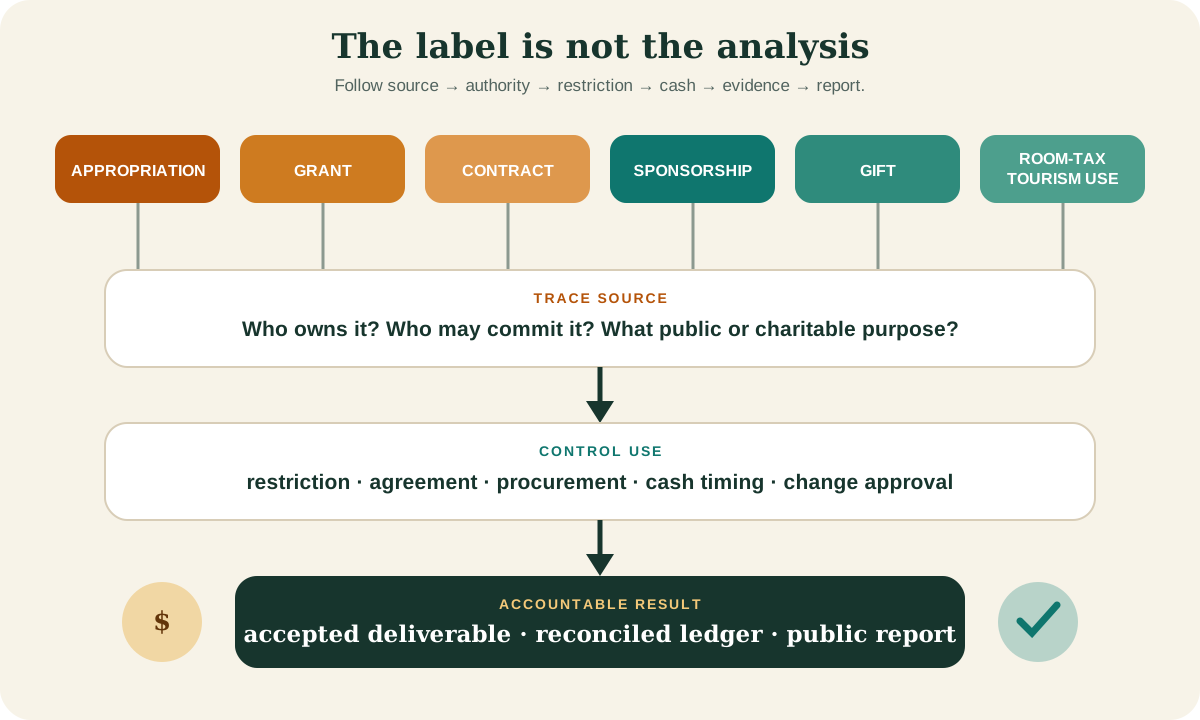
Follow the Money: Grant, Contract, Gift, Sponsorship, or Tax
Following public and charitable money from source to evidence: telling grants, contracts, gifts, sponsorships, and appropriations apart, tracing the source, reconciling two ledgers, full cost, reimbursement-grant cash flow, restricted funds, and a sources-and-uses sheet.
- 7 min
- 9 steps
- 3 questions
- Lesson 29 of 36
In this lesson
- Classify the transaction
- The S-O-U-R-C-E trace
- Build two ledgers, then reconcile
- Full cost is more than visible activity
- Reimbursement-grant cash lab
- Restricted money is a promise
- Public-value and tax-exemption checks
- Build a sources-and-uses sheet
- Working rule
Open alongside this lesson
-
Government-Nonprofit Contracting Reform (opens in a new tab)
Focus on full cost, indirect cost, reimbursement timing, audit, reporting, and administrative burden.
-
Wisconsin Municipal Room Tax (opens in a new tab)
Recheck the current state guide, municipal ordinance, local rate, and tourism arrangement before making a local claim.
Picking up where you left off.
Cross-sector money becomes dangerous when leaders discuss only the amount. A sound analysis follows the money from legal source to final evidence.
Classify the transaction
The everyday words grant, contract, donation, sponsorship, appropriation, and partnership are often used loosely. Build from substance.
Public appropriation
The city’s adopted budget or later authorized action supplies spending authority for a public purpose. An appropriation is not, by itself, the complete relationship with a recipient. Selection, agreement, conditions, and payment authorization still matter.
Grant
The funder supports a defined public or charitable purpose and imposes eligibility, allowable-cost, match, procurement, reporting, audit, record, and repayment conditions. Some grants are paid in advance; others reimburse accepted expenses. “Grant” does not mean “unrestricted.”
Purchase-of-service contract
The city buys specified services or deliverables: workshops, visitor information, facility operation, planning assistance, or another defined output. Procurement, performance standards, invoicing, insurance, records, ownership, remedies, and renewal need attention.
Sponsorship
Money may purchase recognition, audience connection, event presence, tickets, hospitality, or another benefit. For a city, ask about public purpose and authority. For a nonprofit, analyze fair value and whether the payment is a contribution, exchange transaction, or mixed arrangement for accounting and tax purposes.
Charitable gift
A donor transfers value for charitable use without receiving equivalent goods or services. A donor can restrict purpose, but cannot direct the nonprofit to violate law, surrender board control, create impermissible private benefit, or use funds outside mission.
Room-tax-supported tourism expenditure
Wisconsin law and local arrangements can direct municipal room-tax revenue toward tourism promotion and development through defined municipal and tourism structures 1. This is neither generic city money nor a blank check for any visitor-facing activity. Verify the current law, local ordinance, reports, tourism entity, rate, and eligible use.
Shake Rag operates lodging, which makes room tax and tourism policy operationally relevant, but the current local obligations and rate must be verified rather than inferred from the existence of lodging 2.
Quick check
An appropriation supplies spending authority; the relationship is built afterward.
The S-O-U-R-C-E trace
For every dollar:
- Source: tax, fee, room tax, state/federal award, donor, sponsor, ticket, reserve, loan.
- Owner and authority: who controls it and who may commit it?
- Use restriction: program, geography, population, period, capital, match, procurement, or prohibition.
- Recipient obligation: service, output, access, report, acknowledgment, record, or repayment.
- Cash timing: advance, reimbursement, milestone, retainage, pledge, receivable.
- Evidence: invoice, payroll, attendance, procurement file, work product, outcome, audit trail.
Add an exception path: who approves a budget revision, scope change, deadline extension, or reallocation?
Build two ledgers, then reconcile
The city and nonprofit should each maintain their own accounting.
City view
- legal/budget authority;
- fund and account;
- encumbrance and payment approval;
- vendor/subrecipient classification as applicable;
- contract/grant monitor;
- deliverable acceptance;
- public records and audit trail;
- results reported to the body and public.
Nonprofit view
- contribution or exchange classification;
- restriction and release;
- grant/contract receivable;
- allowable direct and indirect cost;
- staff time and procurement support;
- cash requirement;
- program and facility allocation;
- reporting and return-of-funds exposure;
- board dashboard.
Then reconcile agreement amount, approved budget, invoices, payments, deliverables, and ending balance. Do not “wash” public money through the nonprofit’s general bank balance and reconstruct the story at year-end.
Full cost is more than visible activity
A $40,000 public arts contract may require:
- $20,000 artist/instructor compensation;
- $5,000 materials;
- $3,000 accessible communication and participation;
- $2,000 insurance, permits, and safety;
- $4,000 project management and payroll burden;
- $3,000 finance, reporting, technology, and occupancy;
- $3,000 evaluation and closeout.
The sum is $20k + $5k + $3k + $2k + $4k + $3k + $3k = $40k.
Calling only the first $28,000 “program” does not make the remaining work disappear. Government-nonprofit contracting frequently creates problems when agreements omit reasonable indirect cost, pay late, change requirements, or shift administrative burden without resources 3.
The board should ask:
- What would the organization stop doing to absorb an underpriced contract?
- Are restricted donations unintentionally subsidizing a public purchase?
- Is staff capacity treated as free?
- Does reimbursement require a working-capital bridge?
- Who bears cost overrun and demand risk?
Reimbursement-grant cash lab
Assume:
- $100,000 total award;
- quarterly reimbursement;
- $25,000 eligible expense per quarter;
- 30 days to prepare/submit;
- 45 days for review/payment;
- $20,000 monthly unrestricted operating cash need outside the grant.
Even if the grant eventually pays 100%, the nonprofit may carry approximately one quarter’s project cost for 75 days. A simple planning bridge might be at least $25,000, plus any next-quarter spending that begins before payment and a safety margin. The exact peak requires a weekly or 13-week cash forecast.
Model:
| Week | Project payment | Reimbursement | Cumulative project cash |
|---|---|---|---|
| 1–13 | (25,000) | 0 | (25,000) |
| 14–17 | (8,000) next quarter | 0 | (33,000) |
| 18–24 | (7,000) | 25,000 | (15,000) |
An award can be profitable on accrual statements and destabilizing in cash.
Restricted money is a promise
For each public award or donor gift:
- preserve the original terms;
- code the restriction and grant period;
- train spenders before they incur cost;
- require documentation at the point of purchase;
- review budget-to-actual and upcoming commitments;
- obtain written approval for changes;
- release restrictions only when conditions are met;
- keep closeout and retention evidence.
The board’s financial-literacy role includes budgets, cash, restrictions, reserves, controls, and intelligible reporting—not merely approving an annual total 4. Basic internal controls separate custody, authorization, recording, and review as staffing permits 5.
Public-value and tax-exemption checks
The city asks:
- What public purpose and authority support this expenditure?
- Are selection and terms consistent and defensible?
- What does the city receive, and how will the public know?
- What constitutional, procurement, ethics, accessibility, or records rules apply?
The nonprofit asks:
- Does the activity advance exempt purpose?
- Is private benefit incidental and justified?
- Are payments, benefits, and related-party terms reasonable?
- What Form 990, public-disclosure, or tax reporting follows 6?
Neither side should treat the other’s approval as a substitute for its own.
Build a sources-and-uses sheet
For a shared project, create:
| Source | Amount | Restriction | Cash date | Approval owner | Evidence |
|---|---|---|---|---|---|
| city contract | $40,000 | deliverables/period | quarterly after acceptance | council/authorized officer | invoice + output report |
| foundation grant | $25,000 | artist fees/access | 50% advance | foundation + nonprofit | grant report |
| donor gifts | $15,000 | project only | pledge schedule | donors/board acceptance | acknowledgment + ledger |
| earned fees | $10,000 | unrestricted unless promised | registration | nonprofit | sales/attendance |
Uses must match timing as well as total. Add contingency and show who owns it.
Working rule
Every dollar needs a legal source, an authorized decision, a timed cash path, a permitted use, and evidence of what it accomplished.
If leaders cannot name all five, the partnership is not financially ready.
Practice
Public money needs a lawful, documented route; the casual label does not control the transaction.
Practice
Reimbursement timing can create a liquidity crisis even when the project budget balances.
Lesson complete
Nice work.
Sources for this lesson
- 1Wisconsin Municipal Room Tax. Wisconsin Department of Revenue. verifiedCurrent official overview of municipal room tax, tourism entities and commissions, permitted uses, and reporting. Confirm local ordinances and current legal advice before acting. Cited at: state framework.
- 2Shake Rag Alley Lodging. Shake Rag Alley Center for the Arts. verifiedCurrent lodging inventory, rates, guest policies, and earned-revenue context. Cited at: lodging context.
- 3Government-Nonprofit Contracting Reform. National Council of Nonprofits. verifiedPractice and policy issues in government grants and contracts, including full cost, indirect cost, payment timing, and administrative burden. Cited at: full cost and payment.
- 4Financial Literacy for Nonprofit Boards. National Council of Nonprofits. verifiedBoard-level guidance on budgets, reports, controls, restrictions, reserves, dashboards, and whistleblowing. Cited at: board financial oversight.
- 5Internal Controls for Nonprofits. National Council of Nonprofits. verifiedPractical checks and balances for cash, banks, spending authority, vendors, and segregation of duties. Cited at: checks and balances.
- 6Exempt Organization Public Disclosure and Availability Requirements. Internal Revenue Service. verifiedOfficial public-inspection and copying rules for annual returns and exemption applications. Cited at: public filings.
Further reading
- City Budget. City of Stoughton, Wisconsin. verifiedOfficial archive of adopted budgets and related capital-planning documents; verify that the selected document covers the intended fiscal year.
- Exemption Requirements — 501(c)(3) Organizations. Internal Revenue Service. verifiedOfficial rules on exempt purposes, private benefit, lobbying limits, and political campaign intervention.
- Wisconsin Room Tax Reporting. Wisconsin Department of Revenue. verifiedCurrent state reporting guidance and public annual-report system for municipalities and tourism entities.
Previous: Participation, Stakeholders, and the Honest Promise