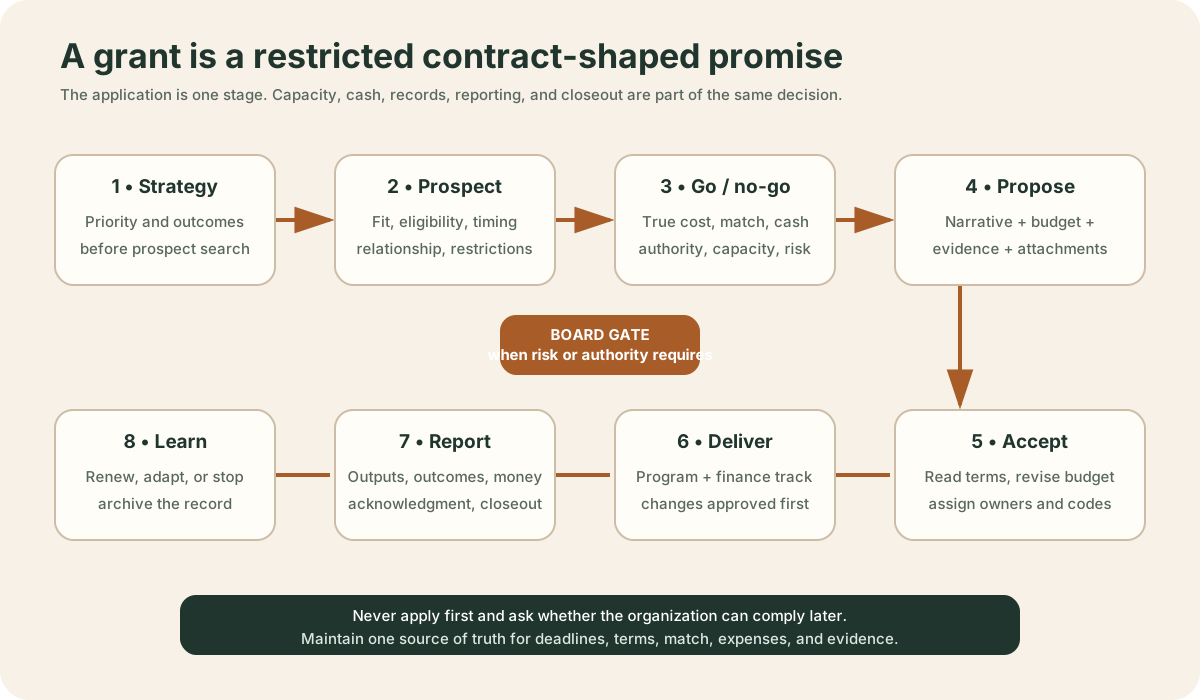
Grant Readiness, Prospecting, and the Go/No-Go Decision
Deciding whether to apply before writing: a readiness file, prospect research cards, a go/no-go scorecard, the Wisconsin Arts Board's Creative Communities grants and NEA Grants for Arts Projects as real examples, contacting funders, and what the board approves.
- 5 min
- 9 steps
- 3 questions
- Lesson 21 of 36
In this lesson
- Readiness file
- Prospect research card
- Go/no-go scorecard
- Real opportunity: Wisconsin Arts Board
- Real opportunity: NEA Grants for Arts Projects
- Funder contact
- Board role
- One-page recommendation
Open alongside this lesson
-
The Grant Lifecycle (opens in a new tab)
Use it to understand pre-award, award, and post-award responsibilities.
-
Creative Communities Program (opens in a new tab)
Verify the current cycle, phase, eligibility, match, and deadline before planning.
Picking up where you left off.
Grant writing begins before writing. The first question is not “Can we win?” It is “Should this organization undertake this work under these terms?”
Readiness file
Maintain current, approved versions of:
- legal name, address, EIN, Wisconsin entity status;
- IRS determination letter and public-charity classification;
- UEI and SAM.gov registration/renewal where federal systems require;
- Grants.gov workspace roles;
- articles, bylaws, board roster and demographics requested lawfully;
- mission, history, programs, outcomes, strategic plan;
- current budget, financials, latest Form 990, audit/review if applicable;
- indirect-cost method/rate if used;
- nondiscrimination, accessibility, conflict, whistleblower, youth-safety, procurement, records, and other required policies;
- insurance and authorized signers;
- bank/payment enrollment handled securely;
- staff résumés/bios and partner commitments;
- evaluation measures/data definitions;
- standard organization and program budgets;
- prior grants, reports, findings, and closeouts;
- image/story permissions.
Federal applications commonly require a UEI and active SAM.gov registration, whose processing/renewal should begin well before a deadline 1.
Assign owners and dates. “In the old executive director’s email” is not readiness.
Prospect research card
For every prospect capture:
funder/program · official URL · purpose/priorities · eligible applicant · geographic/population fit · eligible/ineligible cost · amount/range · project period · match · indirect cost · deadline/time zone · preapplication/contact rules · review criteria · attachments · award terms · reporting · competition/prior awards · relationship · next action
Use the official guidelines as controlling source. A foundation directory or prior application can help discover; it cannot override the current request for proposals.
Go/no-go scorecard
Score 0–2:
| Factor | 0 | 1 | 2 |
|---|---|---|---|
| strategy | unrelated | adjacent | approved priority |
| eligibility | no/unknown | conditionally | clearly eligible |
| fit | weak | partial | direct |
| readiness | idea only | gaps with plan | program ready |
| outcomes/data | no measure | developing | credible |
| budget | hidden deficit | manageable questions | fully costed |
| match/cash | unavailable | plausible | committed plan |
| capacity | displaces critical work | stretch | assigned |
| compliance | unacceptable | needs mitigation | feasible |
| probability/relationship | speculative | some evidence | strong evidence |
Set a minimum and automatic stops:
- ineligible;
- outside mission;
- board/staff cannot accept terms;
- match or reimbursement float unavailable;
- deadline prevents responsible approval;
- required outcomes cannot be delivered/verified;
- restricted award creates an unfunded recurring liability;
- known conflict or prior finding unresolved.
Real opportunity: Wisconsin Arts Board
The FY2027 Creative Communities Program public page describes grants of $1,500–$6,000, a 1:1 match with at least half of match in cash, a UEI, and support for new/expanded activity distinct from regular operations 2. Phase 1 guidelines emphasize community need, partnership, planning, and criteria 3.
A plausible exploration—not an assumed eligible project:
A new or substantially expanded Mineral Point community craft-story initiative co-designed with residents and artists, with public learning, documented community need, partners, access plan, and a clearly distinct project budget.
Go/no-go questions:
- Is it genuinely new/expanded rather than relabeled core work?
- Did community members shape it before application?
- Which cash and in-kind sources meet match rules?
- Can the project operate within the award period?
- Are outcomes more than attendance?
- Does staff have capacity for a small grant’s full administration?
Small grants can have high cost per dollar. Mission and relationship value may still justify them.
Quick check
Grants run $1,500 to $6,000 for new or expanded activity, not regular operations.
Real opportunity: NEA Grants for Arts Projects
The current NEA page describes 501(c)(3) eligibility requirements including a programming history and minimum operating-expense test, request amounts generally $10,000–$100,000, and a 1:1 cost share/match, subject to current category rules and calendars 4.
Board questions:
- Which project category and review criteria truly fit?
- Does Shake Rag meet every eligibility lookback?
- Is the match raised, probable, or merely hoped for?
- Are federal requirements proportionate to staff systems?
- Will federal timing align with catalog, artists, construction, and cash?
- Who is authorized to submit/certify?
Never build from this lesson’s snapshot. Recheck the live notice.
Funder contact
If permitted, prepare three concise questions not answered in guidelines:
“We are considering [specific project]. Our uncertainty is whether [specific element] fits [quoted priority/eligibility]. We have [brief facts]. Would you clarify how applicants should treat this?”
Do not ask “Would you fund us?” or request a pre-review the funder does not offer. Record the answer, speaker/date, and remember oral advice does not supersede written terms.
Board role
The board should approve:
- grant strategy and risk appetite;
- applications requiring material match, debt/cash exposure, new recurring activity, capital/property commitments, or obligations beyond delegation;
- authorized signers when required;
- policies and systems;
- corrective action for material findings.
The board should monitor:
- pipeline and weighted revenue;
- match/float;
- award restrictions and reporting;
- outcomes;
- capacity;
- findings/late reports;
- renewal/concentration.
It should not line-edit every application.
One-page recommendation
Before a consequential submission, require:
strategic fit · eligibility · project/outcomes · total budget and request · match sources/status · cash timing · staff/partner capacity · terms/risks · sustainability after grant · approvals · recommendation
The best grant discipline is the ability to say no before winning the wrong work.
Practice
Grants should fund strategy and feasible delivery, not pull the organization off mission.
Practice
A grant is a conditional agreement with real capacity and compliance costs.
Lesson complete
Nice work.
Sources for this lesson
- 1Applicant Registration. Grants.gov. verifiedCurrent organization-registration, UEI, SAM.gov, renewal, and Grants.gov role requirements. Cited at: registration.
- 2Creative Communities Program. Wisconsin Arts Board. verifiedCurrent Wisconsin arts-project eligibility, matching requirement, amount range, phases, criteria, and reporting resources. Cited at: FY2027 overview.
- 3FY27 Creative Communities Phase 1 Guidelines. Wisconsin Arts Board. 2026. verifiedApplication criteria emphasizing alignment, artistic or educational value, participation, accessibility, and innovation. Cited at: guidelines.
- 4Grants for Arts Projects. National Endowment for the Arts. verifiedCurrent federal arts-grant eligibility, cost share, request range, and application calendar. Cited at: current program.
Further reading
- The Grant Lifecycle. Grants.gov. verifiedOfficial federal pre-award, award, implementation, reporting, and closeout lifecycle.
- About Us. Shake Rag Alley Center for the Arts. verifiedCurrent mission, staff and board roster, programs, campus history, and organization timeline.
Previous: Events, Sponsorships, In-Kind Gifts, and Gift Acceptance