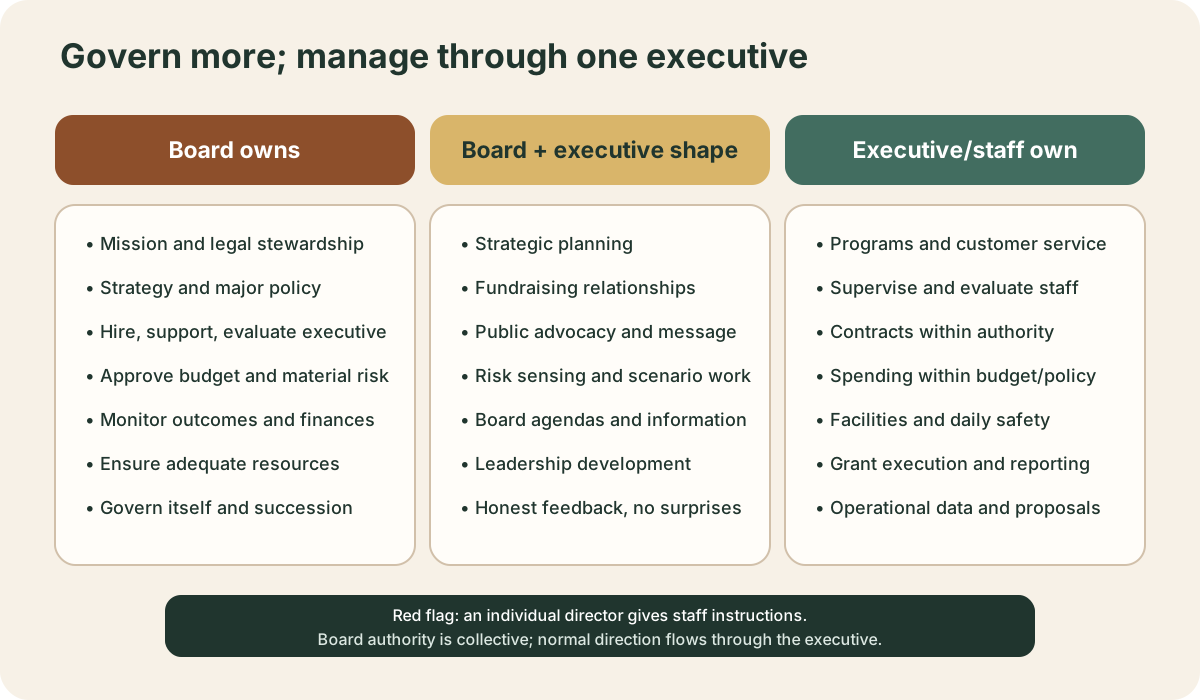
Board, Executive Director, and Staff: One Organization, Different Work
Who does what: the board's single relationship with the executive director, naming which hat you're wearing, mutual accountabilities, a decision-rights matrix, oversight questions versus operational directives, one voice after a vote, the chair-executive rhythm, evaluation, and succession.
- 5 min
- 11 steps
- 3 questions
- Lesson 6 of 36
In this lesson
- Name the hat
- Mutual accountabilities
- Draft decision-rights matrix
- Questions are not micromanagement
- One voice, many minds
- Chair–executive rhythm
- Handling concerns
- Executive evaluation
- Succession
- Boundary scripts
Picking up where you left off.
The board’s central staffing relationship is with the executive director as a whole board. Individual directors are not roaming supervisors.
If ten directors direct staff, staff have ten bosses, the executive retains accountability without authority, and directors receive context-free fragments.
Name the hat
| Hat | Typical work | Authority |
|---|---|---|
| Board | mission, strategy, executive, budget, policy, risk | collective vote or valid written action |
| Officer/committee | work defined by bylaws, charter, or delegation | only delegated scope |
| Executive director | implements strategy; manages staff, programs, contracts | delegated executive authority |
| Individual director | prepares, questions, votes, advocates, gives, opens doors | no unilateral operational authority |
| Program volunteer | hosts, gardens, assists an event | follows staff volunteer lead |
| Professional volunteer | legal, design, finance, facilities help | written scope; management remains owner |
Say which hat you wear. A director volunteering at an event follows staff. Professional expertise does not automatically confer decision authority.
Mutual accountabilities
The board:
- agrees on executive outcomes and constraints;
- approves strategy and a realistic budget;
- gives authority commensurate with accountability;
- supports the executive without creating a shadow CEO;
- evaluates performance and sets compensation through a disinterested process;
- plans emergency and long-term succession;
- intervenes when performance, ethics, safety, or legality requires.
The executive:
- translates strategy into plans, staffing, systems, and programs;
- provides timely, candid monitoring information;
- surfaces material failures and risks;
- follows policy and delegated authority;
- recommends changes when policy or resources no longer fit;
- manages staff performance and culture;
- tells the board what help is useful.
Draft decision-rights matrix
Adapt this to current bylaws and policies:
| Matter | Board | Executive | Staff/committee |
|---|---|---|---|
| Mission/bylaws | decides | advises | consulted |
| Strategic plan | approves/monitors | recommends/implements | develops/implements |
| Annual budget | approves | proposes/manages | supplies plans/data |
| Unbudgeted spend | above threshold | within threshold | follows authorization |
| Program calendar/design | monitors portfolio/outcomes | accountable | designs/delivers |
| Hire/fire staff | no role | decides | managers recommend |
| Hire/evaluate executive | decides | participates | structured input if requested |
| Executive compensation | disinterested board | factual context | no role |
| Crisis position | major policy/mission stance | coordinates | designated spokesperson |
| Building emergency | policy/capital oversight | directs | follows incident command |
Define verbs: decides, recommends, consulted, informed. Two people cannot both be final owner.
Questions are not micromanagement
Legitimate questions:
- Are youth safe and included?
- Are program outcomes consistent with strategy?
- Does the facilities plan protect people and historic assets?
- Are unrestricted cash and staff capacity sufficient?
- What threshold returns this to the board?
Operational directives:
- Use this instructor.
- Change that employee’s hours.
- Price this workshop at $X.
- Send donors these words today.
- Buy this tool brand.
The board may shape those choices through policy, strategy, budget, and executive accountability. It does not casually make them.
One voice, many minds
Before action, disagree constructively. After lawful action:
- authorized people communicate it;
- directors do not privately ask staff to ignore it;
- reconsideration uses proper process;
- nobody must defend illegality or misstate facts.
This is not false unanimity. It lets the organization act.
Quick check
One voice isn’t false unanimity; nobody has to defend illegality or misstate facts.
Chair–executive rhythm
A weekly or biweekly check-in can cover:
- What changed materially?
- What decision approaches?
- Where is board help needed?
- What board behavior creates friction?
- What people, money, stakeholder, or risk issue cannot wait?
- What belongs in the next packet?
The chair cannot privately approve what the board must decide.
Handling concerns
For another employee, bring concrete observations to the executive unless the executive is implicated or policy specifies another channel. Do not investigate or supervise.
For an executive concern, use the chair, authorized committee, or whistleblower route. The board should define the allegation or gap, protect due process and evidence, assign fact gathering, obtain HR/legal/safeguarding advice when appropriate, act collectively, and document follow-up.
Imminent safety threats use emergency and safeguarding procedures first.
Executive evaluation
Set weighted goals at the start:
| Domain | Evidence |
|---|---|
| Mission/program | outcomes, quality, participation, access |
| Finance | variance, cash, controls, sustainability |
| People | retention, culture, compliance, capacity |
| Development | contributed income and donor system |
| Campus/risk | plan milestones, incidents, maintenance |
| Board partnership | accurate packets, early escalation |
Use evidence, not a popularity vote. The chair consolidates board input. The disinterested board sets compensation using comparability data and contemporaneous documentation 1.
Succession
Maintain:
- emergency succession and interim authority;
- bank, contract, password, grant, calendar, and relationship continuity;
- planned-transition procedure;
- leadership development and cross-training;
- a communications plan.
Succession planning is standing stewardship, not a prediction that the executive will leave 2.
Boundary scripts
When staff asks you to approve something:
“I want to help without creating a second reporting line. Is this within management authority, or is there a specific board decision needed?”
When you see a problem:
“I observed . The possible mission/risk/financial effect is . Is this already owned, and what—if anything—should the board monitor or decide?”
Good boundaries make help usable.
Practice
Directors surface evidence and govern outcomes without creating a second management chain.
Practice
The board supervises the executive, not individual employees.
Lesson complete
Nice work.
Sources for this lesson
- 1Executive Compensation. National Council of Nonprofits. verifiedBoard process for annual review, reasonable compensation, comparability, independence, and minutes. Cited at: compensation process.
- 2Succession Planning for Nonprofits. National Council of Nonprofits. verifiedPractice guidance for planned and emergency executive and board leadership transitions. Cited at: succession planning.
Further reading
- Board Roles and Responsibilities. National Council of Nonprofits. verifiedGovernance practice on fiduciary stewardship, executive oversight, resources, fundraising, and advocacy.
- Recommended Board Practices. BoardSource. verifiedCurrent recommendations on board composition, meetings, assessment, executive partnership, strategy, and personal giving.