The Case for Support and the Development System
Development as a system: a seven-part case for support in public-value language, audience segments, scoring prospects, moves management, plan math for a $420,000 contributed-income goal, a development dashboard, and turning the Donor Bill of Rights into operating standards.
- 5 min
- 9 steps
- 3 questions
- Lesson 18 of 36
In this lesson
- Write the case in seven parts
- From institution-centered to public-value language
- Segment the audience by relationship
- Prospect qualification
- Moves management
- Development plan math
- Dashboard
- Donor rights
Picking up where you left off.
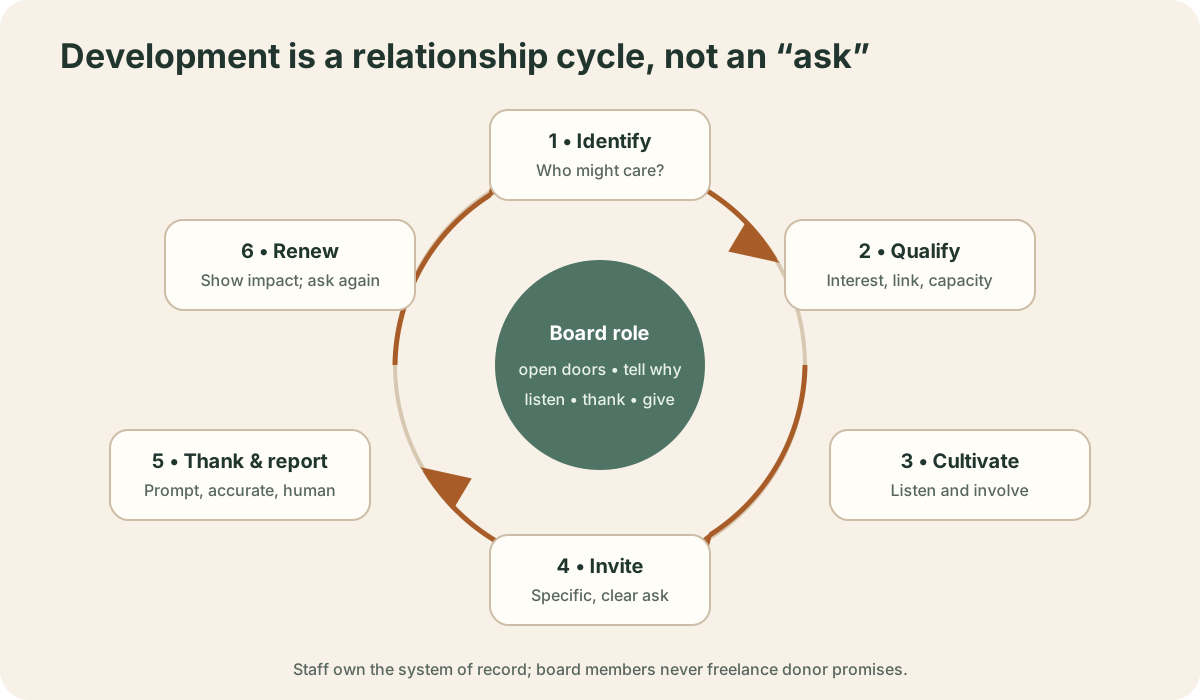
Development is the disciplined creation of relationships and resources for mission. Fundraising is the request within that system.
Write the case in seven parts
- Need/opportunity: What matters for people, artists, place, and community?
- Distinctive response: Why is Shake Rag suited to act?
- Evidence: What is delivered and what changes?
- Plan: What exactly will happen?
- Economics: What does it cost, what is earned, and why is philanthropy needed?
- Urgency: Why now—not manufactured crisis?
- Invitation: What can this donor make possible?
A Shake Rag core case might connect:
- learning directly with artists;
- a rural campus where creative practice and place reinforce one another;
- access for children and adults;
- preservation of buildings that make the experience possible;
- a mixed model of fees, rentals/lodging, gifts, grants, volunteers, and partnerships.
Verify every claim against current data. Replace “transformative” with an observable change.
From institution-centered to public-value language
Weak:
“Our historic buildings need money.”
Stronger:
“The campus is part of the classroom. Stabilizing water entry protects safe, year-round learning and prevents a repair from becoming an emergency closure. The project costs $; committed sources are $; unrestricted support closes $___ and funds contingency.”
Weak:
“Please support youth programs.”
Stronger:
“A gift of $___ underwrites ___ local youth places, including materials and trained supervision. We will report participation, completion, and one defined learning/belonging measure while protecting children’s privacy.”
Segment the audience by relationship
Potential constituencies:
- participants/alumni and families;
- artists/instructors;
- Mineral Point residents and businesses;
- visitors and cultural travelers;
- preservation and craft communities;
- arts education and youth supporters;
- foundations and government agencies;
- vendors and corporate partners;
- volunteers and former leaders;
- planned-gift prospects.
Do not assume the same case motivates all. Maintain one truthful institutional case, then emphasize relevant evidence.
Prospect qualification
Score collaboratively:
| Factor | Question |
|---|---|
| Alignment | Is mission/program/place genuinely relevant? |
| Relationship | Who knows them and with what trust? |
| Interest | What have they attended, asked, or supported? |
| Capacity | Is a gift range plausible—not treated as entitlement? |
| Access | Is there an ethical warm path? |
| Timing | What event, decision, or cycle matters? |
| Restrictions/risk | Could the likely interest create mission or cost problems? |
Use A/B/C:
- A: qualified, named next move/date/owner;
- B: promising but missing relationship or interest evidence;
- C: broad community communication, no expensive moves.
Avoid invasive research, protected-class profiling, gossip, and data that the organization should not store.
Moves management
Each qualified relationship has:
relationship owner · staff strategy owner · current stage · interests · last meaningful contact · next move/date · likely ask purpose/range/timing · restrictions/conflicts · stewardship promise
A “move” changes understanding or commitment:
- campus tour around the donor’s interest;
- artist conversation;
- sharing an outcome report and asking for reaction;
- volunteer experience;
- proposal discussion;
- introduction to another leader.
“Sent newsletter” is touch activity, not necessarily a move.
Quick check
Each qualified relationship has an owner, a stage, a next move, and a likely ask.
Development plan math
Suppose the contributed-income goal is $420,000:
| Source | Goal | Renewals expected | New/upgraded needed |
|---|---|---|---|
| individuals | $190,000 | $135,000 | $55,000 |
| foundations/government | $140,000 | $80,000 | $60,000 |
| sponsorship | $35,000 | $20,000 | $15,000 |
| appeal/monthly | $40,000 | $25,000 | $15,000 |
| net events | $15,000 | $10,000 | $5,000 |
Build a gift table larger than the goal because not every request closes:
| Gifts | Amount | Subtotal | Qualified prospects needed at 3:1 |
|---|---|---|---|
| 1 | $50,000 | $50,000 | 3 |
| 3 | $25,000 | $75,000 | 9 |
| 10 | $5,000 | $50,000 | 30 |
| 30 | $500 | $15,000 | broad pipeline |
This is planning, not pressure. Probability should reflect relationship evidence.
Dashboard
Track leading and lagging measures:
- donor retention/reactivation;
- first-to-second gift conversion;
- recurring donors and upgrades;
- qualified pipeline by stage and ask month;
- proposals submitted/awarded and weighted value;
- meaningful visits/moves completed;
- acknowledgments within service standard;
- stewardship promises due/completed;
- unrestricted/restricted mix;
- concentration;
- event gross, direct cost, net, staff/volunteer hours, new qualified relationships;
- board commitments completed.
Revenue is lagging. Pipeline health and stewardship predict it.
Donor rights
AFP’s Donor Bill of Rights emphasizes truthful information, appropriate stewardship, recognition, confidentiality, and professional treatment 1. Put rights into operating standards:
- acknowledge promptly and accurately;
- honor purpose;
- report setbacks honestly;
- use authorized access to donor records;
- respect communication preferences;
- disclose material benefits/conflicts;
- provide an accountable contact;
- never sell or repurpose a relationship casually.
The development system is successful when supporters understand the mission, choose freely, receive what was promised, and want to remain in relationship.
Practice
A case is donor-centered but evidence-based and specific.
Practice
Qualification protects time and relationships by testing fit, not merely capacity.
Lesson complete
Nice work.
Sources for this lesson
- 1The Donor Bill of Rights. Association of Fundraising Professionals. verifiedWidely used ethical expectations for mission information, board stewardship, use of gifts, acknowledgment, privacy, and access to financial information. Cited at: donor rights.
Further reading
- About Us. Shake Rag Alley Center for the Arts. verifiedCurrent mission, staff and board roster, programs, campus history, and organization timeline.
- Ways to Support Shake Rag Alley. Shake Rag Alley Center for the Arts. verifiedCurrent volunteer, donation, planned-giving, event, and legal-name information.
- 2026 Workshops, Retreats & Special Events. Shake Rag Alley Center for the Arts. 2026. verifiedCurrent program catalog and mission-facing description of the campus and learning experience.
- Nonprofit Fundraising and the Board’s Role. BoardSource. verifiedBoard and staff roles in contributed-income strategy, donor portfolios, cultivation, solicitation, and stewardship.