Budget, Cash, Restrictions, and Operating Reserves
The budget as quantified strategy: revenue, expense, and staff capacity together, workshop contribution margins, a monthly cash plan and 13-week forecast, who can change each kind of restriction, operating reserves sized to the organization, and preapproved scenario triggers.
- 4 min
- 7 steps
- 3 questions
- Lesson 14 of 36
In this lesson
- Build an integrated budget
- Program contribution
- Cash plan
- Restriction taxonomy
- Operating reserve
- Scenario triggers
- Budget approval questions
Picking up where you left off.
A budget is the board’s quantified strategy and delegation. If it is merely last year plus a percentage, it hides choices.
Build an integrated budget
Revenue
By program and source:
- registrations and fees;
- lodging and rentals;
- individual gifts;
- foundations/government grants;
- sponsorships;
- events and auctions;
- investment and other income;
- in-kind support where accounting requires.
For each, identify:
volume × price/average gift × probability/timing × restriction
Do not plug an unexplained “fundraising gap.”
Expense
By natural type and program/function:
- compensation, benefits, contractor/instructor costs;
- supplies/materials;
- occupancy, utilities, maintenance;
- insurance and professional services;
- marketing, payment/registration fees;
- technology;
- scholarships/subsidy;
- development expense;
- depreciation and capital.
Separate:
- fixed/variable;
- committed/discretionary;
- cash/noncash;
- operating/capital;
- restricted/unrestricted.
Capacity
Budget hours as well as dollars:
- instructors and program administration;
- development and grant reporting;
- finance/control workload;
- building maintenance;
- volunteer coordination;
- board participation.
A grant can be fully funded and still overload the organization.
Program contribution
For a workshop:
gross earned revenue = paid participants × fee
direct contribution = earned revenue − instructor − materials − direct processing/travel
fuller contribution = direct contribution − reasonable shared staff/facility allocation
Example:
12 × $425 = $5,100 revenue
direct costs: $1,800 instructor + $900 materials + $180 fees + $420 travel = $3,300
direct contribution = $1,800; direct margin = 35.3%
If shared staff/facility load is $1,350, fuller contribution is $450. That does not prove the workshop should run. Add mission outcome, access, instructor relationship, donor appeal, and campus load.
Break-even seats:
fixed direct costs / (fee − variable cost per participant)
If fixed direct cost is $2,220, fee $425, and variable cost $90:
$2,220 / $335 = 6.63 → 7 paid seats
Define cancellation and subsidy rules before pressure arrives.
Quick check
$5,100 revenue minus $3,300 direct is $1,800; minus $1,350 shared load leaves $450. That alone doesn’t decide whether it runs.
Cash plan
Create a monthly cash budget and a rolling 13-week forecast:
beginning cash + expected receipts − expected payments = ending cash
Show:
- usable unrestricted cash;
- restricted cash;
- reserve/designated funds;
- credit availability and terms;
- low point;
- payroll/tax/debt deadlines;
- grant reimbursements;
- major capital draws.
Probability-weight uncertain gifts; do not spend a verbal pledge.
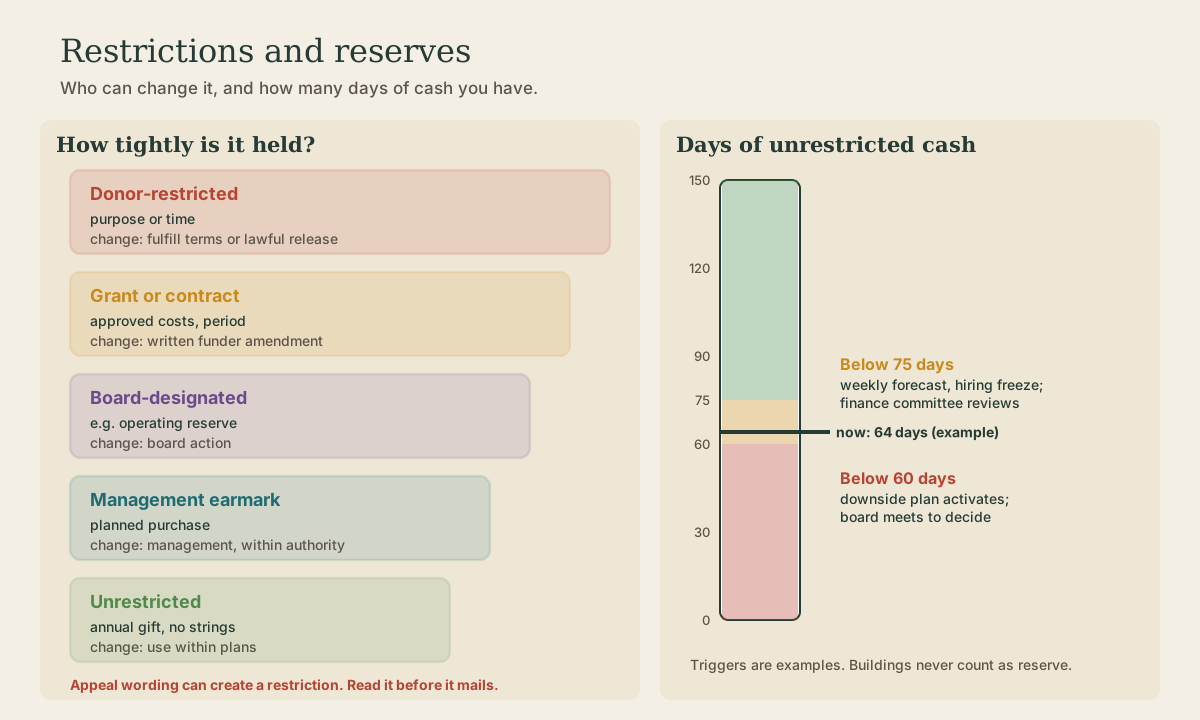
Restriction taxonomy
| Category | Who constrains it? | Example | Change path |
|---|---|---|---|
| donor-restricted purpose/time | donor gift instrument | roof, scholarship, future period | fulfill terms or obtain lawful donor/court release as advised |
| grant/contract restriction | funder agreement | approved project costs/period | written funder amendment |
| board-designated | board | operating reserve | proper board action |
| management earmark | management | planned equipment purchase | management within authority |
| unrestricted | no external purpose/time constraint | annual gift without restriction | use for charitable purposes within plans |
Marketing language can create restriction. Review appeal wording. Track restrictions from acceptance through release/report.
Operating reserve
An operating reserve is not “extra money.” It provides time to respond to unexpected revenue loss or expense without harming mission. National Council of Nonprofits emphasizes that no universal reserve ratio fits every organization 1.
Policy should define:
- purpose;
- target and floor;
- how target reflects seasonality, concentration, property, debt, and risk;
- where funds are held/invested;
- who authorizes use;
- permitted uses;
- notification/documentation;
- replenishment plan;
- reporting and annual review.
Possible target method:
baseline months of unrestricted operating cash
+ revenue-concentration adjustment
+ historic-property/seasonality adjustment
− reliable committed credit or highly liquid unrestricted resources
Do not count illiquid buildings as operating reserve.
Scenario triggers
Preapprove management actions within authority:
| Trigger | Management response | Board response |
|---|---|---|
| unrestricted cash below 75 days | weekly forecast; freeze nonessential hiring | finance review |
| below 60 days | activate downside plan | board meeting/decision |
| forecast covenant/obligation breach | notify chair immediately | counsel/lender/funder path |
| high-priority building failure | incident/capital protocol | reserve/capital decision |
Use numbers suited to actual circumstances; these are examples.
Budget approval questions
- Does it fund the stated strategy?
- What revenue is uncommitted, one-time, or restricted?
- Where is seasonality?
- What has been excluded—maintenance, benefits, systems, evaluation?
- What are downside actions and protected priorities?
- What grant match and reimbursement float are required?
- Which assumptions need board help?
- At what variance does authority return to the board?
Approve the assumptions, cash story, capital plan, and monitoring—not just a surplus of $1.
Practice
Board designation is an internal governance decision, distinct from external donor restriction.
Practice
A board needs the operating model and cash timing, not only a balanced column.
Lesson complete
Nice work.
Sources for this lesson
- 1Operating Reserves for Nonprofits. National Council of Nonprofits. verifiedBoard policy considerations and the warning that no universal reserve target fits every nonprofit. Cited at: operating reserves.
Further reading
- Financial Policy Guidelines and Example. Propel Nonprofits. verifiedPolicy framework for authority, conflicts, spending, contracts, records, reporting, restrictions, and reserves.
- Internal Controls for Nonprofits. National Council of Nonprofits. verifiedPractical checks and balances for cash, banks, spending authority, vendors, and segregation of duties.