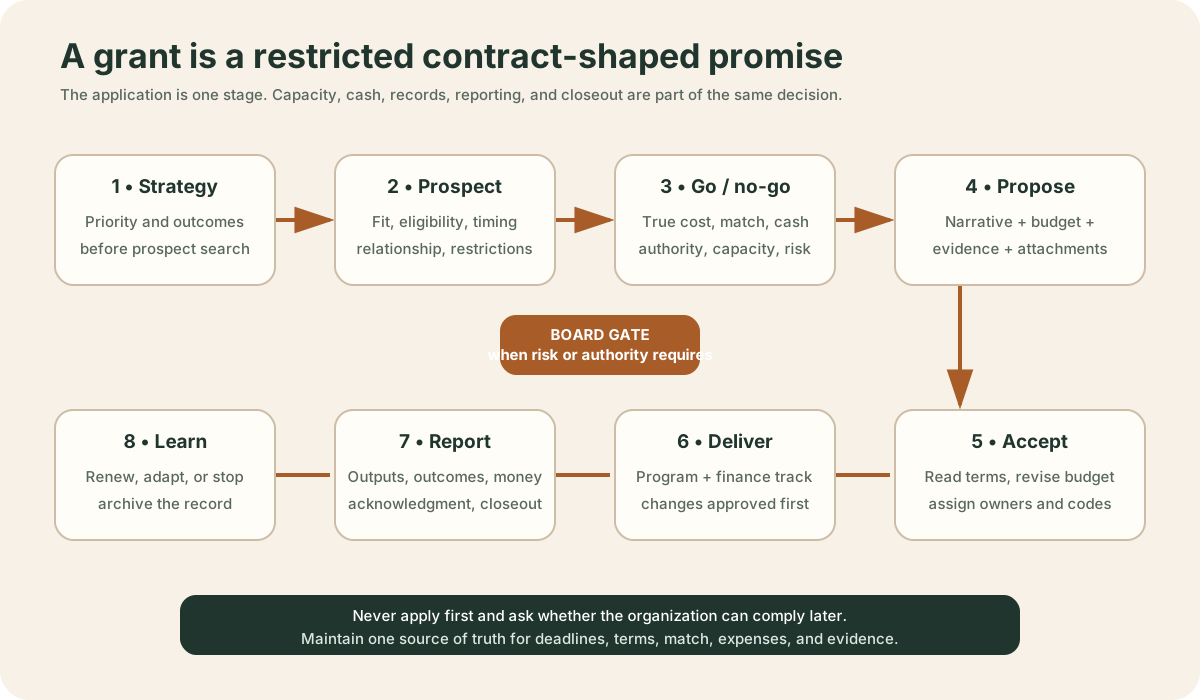
Grant Budgets, Match, Award Setup, Reporting, and Closeout
Grant money from budget to closeout: building costs from units times rates, direct and indirect costs, 1:1 match, the reimbursement cash-flow gap, reading an award before accepting it, kickoff, monthly reconciliation, strong reports, and closeout.
- 5 min
- 9 steps
- 3 questions
- Lesson 23 of 36
In this lesson
- Build from work
- Direct and indirect cost
- Match
- Cash-flow test
- Award acceptance
- Award kickoff
- Monthly reconciliation
- Reports
- Closeout and board learning
Picking up where you left off.
A proposal budget is another version of the project narrative. If a promised artist, evaluation step, accommodation, or report has no resources, the plan is not credible.
Build from work
For each activity:
unit × quantity × rate = cost
Example:
| Cost | Calculation | Amount |
|---|---|---|
| artist fees | 4 artists × 40 hours × $55 | $8,800 |
| artist travel | 4 × 220 miles × current approved rate | calculate |
| materials | 72 participants × $48 | $3,456 |
| access | interpretation/transport/assistants | $3,200 |
| staff | 0.18 FTE loaded compensation | $11,700 |
| evaluation | 60 hours × $50 | $3,000 |
| facility | documented allocable project cost | $2,400 |
| communications | design/printing/ads | $1,800 |
| contingency | only if funder permits | $1,200 |
Verify rates, math, allowability, and indirect treatment. Do not use contingency if prohibited.
Direct and indirect cost
- Direct: identifiable with the project—artist fee, materials, project coordinator time.
- Indirect/common: organization-wide administration, accounting, IT, occupancy, governance.
Use the funder’s current rules and a consistent allocation method. Never charge the same cost twice or shift a grant-disallowed cost into another award without basis.
If a funder caps administration, the cost does not disappear. Show how unrestricted resources or other lawful sources support it and decide whether the project remains worthwhile.
Match
Suppose a $30,000 award requires 1:1 match:
total project ≥ $60,000
grant = $30,000
eligible non-federal/other match = $30,000, under actual rules
The Wisconsin Arts Board FY2027 overview says CCP uses 1:1 match with at least half of match in cash 1. For a $6,000 request, a simplified plan would need $6,000 match, at least $3,000 cash—then verify which sources and in-kind values qualify.
The NEA Grants for Arts Projects page describes a 1:1 cost share/match for current awards 2. Federal sources generally cannot be assumed eligible as match to another federal award.
Maintain a match ledger:
| Source | Cash/in-kind | Amount | Eligible? | Committed? | Documentation | Used elsewhere? |
|---|---|---|---|---|---|---|
| participant fees | cash | $8,000 | verify | forecast | registration ledger | no |
| donor gift | cash | $10,000 | verify restriction | yes | gift record | no |
| volunteer service | in-kind | $4,000 | verify role/rate | forecast | signed logs | no |
| facility | in-kind/direct | $3,000 | verify method | yes | allocation | no |
Never count the same match twice.
Cash-flow test
Reimbursement grant:
- project spends $18,000 in months 1–3;
- report submitted day 90;
- payment arrives day 135;
- other receipts do not cover the gap.
The project needs at least $18,000 plus operating cushion before reimbursement. A balanced grant budget can cause a cash crisis.
Require:
- draw/reimbursement schedule;
- documentation lead time;
- receivable risk;
- bridge source and authority;
- restriction on using other donor funds temporarily;
- downside if payment is delayed.
Quick check
A balanced grant budget can still cause a cash crisis.
Award acceptance
Do not assume application approval equals authority to accept every term.
- compare notice/contract with submitted scope and budget;
- identify changed amount, conditions, match, period, reporting, publicity, IP/data, records, procurement, audit, termination, repayment;
- obtain legal/CPA/insurance review where needed;
- document authorized acceptance;
- preserve signed award and approved application/budget;
- avoid starting before allowability/start date is confirmed.
Award kickoff
Bring program, finance, development, executive, communications, evaluation, and partner owners together.
Create:
- project/grant code;
- budget by approved category;
- allowable/unallowable guide;
- time and procurement documentation;
- restriction and cash schedule;
- match ledger;
- deliverable/outcome calendar;
- reporting and board dates;
- modification authority;
- partner/subrecipient/vendor responsibilities;
- records retention;
- public credit/brand rules;
- risk and incident escalation.
Every owner should answer: What evidence will I produce, where, and by when?
Monthly reconciliation
Compare:
- general ledger to grant budget;
- program outputs to narrative;
- payroll/time to charged effort;
- procurement/contract evidence;
- match ledger;
- cash received/receivable;
- restricted balance;
- milestones/outcomes;
- forecast and needed amendment.
Flag:
- category variance;
- late start or scope change;
- lower participation;
- staff vacancy;
- match shortfall;
- disallowed/unsupported cost;
- partner delay;
- overspending before approval;
- duplicated cost.
Obtain written funder approval before changes when required. A friendly program officer conversation is not always an amendment.
Reports
Strong report:
- restates approved purpose;
- gives outputs with denominators;
- reports outcomes and method;
- explains variance/setbacks;
- reconciles budget and match;
- shares participant/partner evidence ethically;
- describes adaptations and remaining work;
- supplies required attachments;
- submits through authorized process;
- stores acceptance/feedback.
Never adjust numbers to match the proposal. Explain reality.
Closeout and board learning
Close only after:
- final program and financial reports accepted;
- receivable collected;
- match documented;
- equipment/property obligations recorded;
- restrictions released correctly or balance plan approved;
- partner obligations complete;
- records retained;
- final accounting reconciliation;
- sustainability decision;
- findings corrected.
Board closeout memo:
promised · delivered · outcome · total cost and unrestricted subsidy · compliance issues · assets/liabilities continuing · funder relationship · lessons · renew/stop/redesign
Winning is not the finish. A well-administered award builds trust and institutional memory.
Practice
Match eligibility and valuation depend on the actual award terms.
Practice
Formal award setup translates obligations into operating controls.
Lesson complete
Nice work.
Sources for this lesson
- 1Creative Communities Program. Wisconsin Arts Board. verifiedCurrent Wisconsin arts-project eligibility, matching requirement, amount range, phases, criteria, and reporting resources. Cited at: match.
- 2Grants for Arts Projects. National Endowment for the Arts. verifiedCurrent federal arts-grant eligibility, cost share, request range, and application calendar. Cited at: cost share.
Further reading
- The Grant Lifecycle. Grants.gov. verifiedOfficial federal pre-award, award, implementation, reporting, and closeout lifecycle.
- Applicant Registration. Grants.gov. verifiedCurrent organization-registration, UEI, SAM.gov, renewal, and Grants.gov role requirements.
- FY27 Creative Communities Phase 1 Guidelines. Wisconsin Arts Board. 2026. verifiedApplication criteria emphasizing alignment, artistic or educational value, participation, accessibility, and innovation.
Previous: Writing the Proposal: Need, Design, Outcomes, and Review Criteria