Controls, Assurance, and the Compliance Calendar
Internal control for a small staff: separating authorization, custody, recording, reconciliation, and review, walking donations, registrations, purchases, and payroll, compensating controls, compilation versus review versus audit, the Wisconsin and federal compliance calendar, and fraud response.
- 5 min
- 9 steps
- 3 questions
- Lesson 16 of 36
In this lesson
- Five control functions
- Walk the transactions
- Small-staff compensating controls
- Assurance levels
- Compliance is a matrix, not one deadline
- Wisconsin distinctions
- Federal watch items
- Fraud-response plan
- Quarterly finance assurance
Open alongside this lesson
-
Charitable and Professional Organization Forms (opens in a new tab)
Recheck current forms, thresholds, exemptions, and due dates each filing year.
-
Sales Tax Exemptions for Nonprofit Organizations (opens in a new tab)
Nonprofit status does not make every sale or purchase tax-free.
Picking up where you left off.
Internal control is not mistrust. It is a system that protects people from error, temptation, accusation, and impossible concentration of authority.
Five control functions
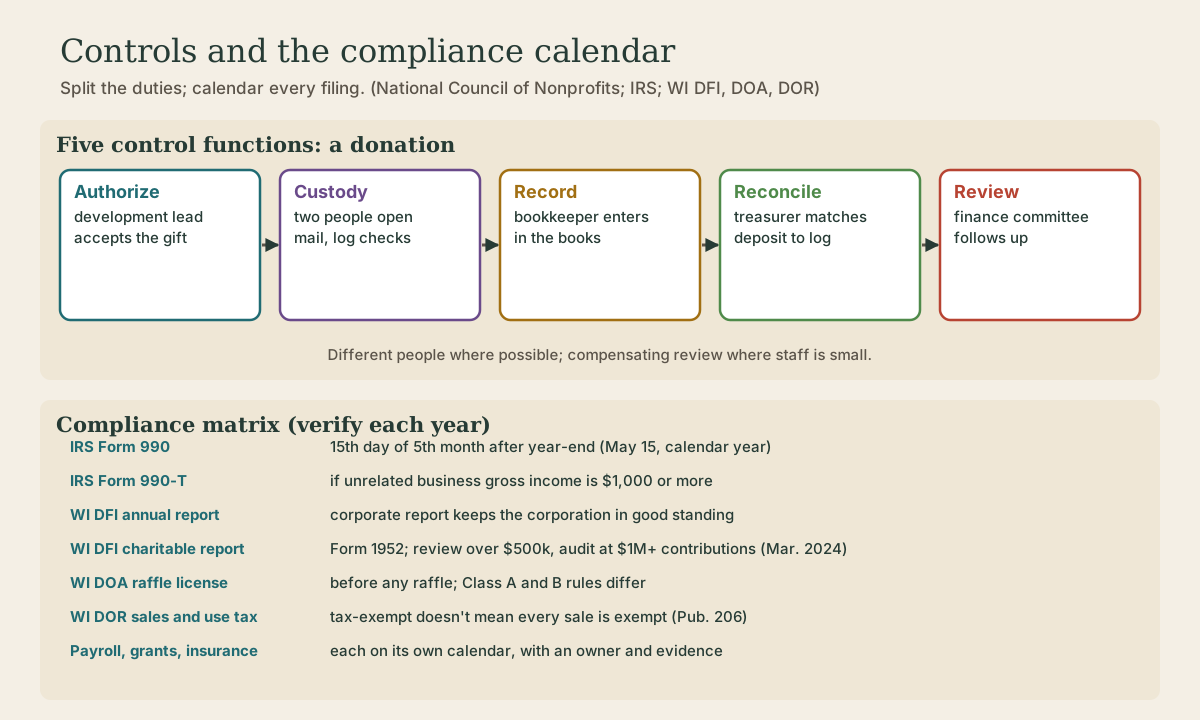
For each money flow separate where feasible:
- authorization — permission;
- custody — access to cash/assets;
- recording — accounting entry;
- reconciliation — comparison to independent source;
- review — investigation and follow-up.
National Council of Nonprofits emphasizes clear authority, segregation, documentation, and monitoring 1.
Walk the transactions
Donation
mail/portal receipt → gift/restriction record → deposit → accounting → donor acknowledgment → bank reconciliation → development/accounting reconciliation → board reporting
Check:
- two-person mail/cash process;
- payment platform access and MFA;
- donor restriction captured exactly;
- donor database equals ledger;
- acknowledgments do not overstate deductibility;
- refund/reversal authority;
- no donor payment instructions changed from email alone.
Registration/refund
enrollment → payment/deferred revenue → roster → attendance → earned revenue → refund/cancellation → reconciliation
Check approval for complimentary seats, scholarships, refunds, transfers, chargebacks, and instructor payment.
Purchase/payment
need → budget/authority → conflict/procurement → receipt of goods → invoice approval → payment → recording → bank reconciliation
No person should independently create a vendor, approve the purchase, change bank details, release payment, record it, and reconcile.
Payroll
Separate hire/pay authorization, time/changes, payroll processing, bank release, reconciliation, and tax filing review. Directors should receive exception evidence, not employee detail without need.
Small-staff compensating controls
When full segregation is impossible:
- unopened bank statements/read-only bank access to an independent reviewer;
- monthly review of bank reconciliations, cleared images, new vendors, payroll changes, refunds, journals, and card detail;
- dual approval above thresholds;
- automated audit logs;
- mandatory vacation/cross-training;
- direct complaint route;
- rotating spot checks;
- finance committee exception reporting.
Signatures without review are theater.
Assurance levels
Understand the engagement:
- internal management statements: prepared by organization;
- compilation: accountant presents information, generally no assurance;
- review: limited assurance through inquiry/analytics;
- audit: reasonable—not absolute—assurance that statements lack material misstatement;
- agreed-upon procedures: findings on specified procedures.
Ask the CPA what was in scope, materiality, adjustments, control deficiencies, estimates, going-concern issues, restrictions/grants, and management letter. An audit does not guarantee no fraud.
Quick check
A compilation generally gives no assurance and a review gives limited assurance.
Compliance is a matrix, not one deadline
Maintain:
| Obligation | Regulator/funder | Due rule | Owner | Reviewer | Evidence | Escalation |
|---|---|---|---|---|---|---|
| Form 990 | IRS | current federal due/extension | finance | committee/board process | accepted filing | |
| corporate annual report | WI DFI corporate | current entity due | secretary/executive | governance | confirmation | |
| charitable report/renewal | WI DFI charity | current form/due | finance | committee | confirmation | |
| payroll/tax | federal/state | filing calendar | processor/finance | independent review | receipts | |
| grants | each award | agreement dates | grant owner | finance/program | accepted reports | |
| raffle | WI DOA | license/report terms | event owner | finance | license/report | |
| sales/use tax | WI DOR | activity-specific | finance | CPA | returns/workpapers | |
| insurance | carriers | renewal/claim deadlines | executive | board/risk | binder |
Verify current requirements every year.
Wisconsin distinctions
- Corporate annual report: maintains corporation information through Wisconsin DFI 2.
- Charitable solicitation registration/reporting: separate DFI charitable-organization stream 3.
- Financial statement attachment: current Form 1952 instructions use contribution thresholds for reviewed/audited statements and a waiver process; the March 2024 form identifies review above $500,000 through $999,999 and audit at $1,000,000 or more in contributions 4. Recheck the form in the filing year and obtain accounting advice.
- Raffles: Wisconsin requires a raffle license; Class A and B rules differ 5. An auction, door prize, sweepstakes, and raffle are not interchangeable labels.
- Sales/use tax: exemption from income tax does not make every purchase or sale exempt; Publication 206 explains Wisconsin nonprofit rules 6.
Federal watch items
- Form 990 is generally due the 15th day of the fifth month after year-end, subject to current rules/extensions 7.
- Unrelated business income generally has three elements: trade/business, regularly carried on, and not substantially related to exempt purpose; exceptions and modifications apply. Form 990-T filing is generally triggered when gross unrelated business income is $1,000 or more 8.
- Public support, payroll, contractor reporting, donor acknowledgments, lobbying/election rules, and grant conditions have separate tests.
For Shake Rag, assess—not assume—the treatment of rentals, lodging, merchandise, food, sponsorship benefits, advertising, raffles, and asset use with a nonprofit CPA or counsel.
Fraud-response plan
Before suspicion:
- reporting channels and non-retaliation;
- authorized response team;
- insurer/counsel/forensic contacts;
- evidence preservation;
- limits on access changes and interviews;
- authority to notify bank, processor, law enforcement, funder;
- communications and recovery.
If concern arises, do not confront casually, alter files, promise outcomes, or let a potentially implicated person control the inquiry.
Quarterly finance assurance
The board receives:
- statements and forecast;
- restriction/grant compliance;
- bank/reconciliation confirmation;
- control exceptions and corrective actions;
- filing calendar status;
- suspected fraud/material error incidents;
- external accountant findings;
- decisions required.
The useful question is not “Did someone file everything?” It is: What evidence shows each obligation and control is owned, reviewed, and corrected?
Practice
Control functions should be separated or independently reviewed.
Practice
Corporate existence and charitable-solicitation reporting use different requirements and forms.
Lesson complete
Nice work.
Sources for this lesson
- 1Internal Controls for Nonprofits. National Council of Nonprofits. verifiedPractical checks and balances for cash, banks, spending authority, vendors, and segregation of duties. Cited at: internal controls.
- 2Annual Report Instructions for Nonstock Corporations. Wisconsin Department of Financial Institutions. verifiedCurrent business-entity annual-report requirement, separate from charitable solicitation reporting. Cited at: corporate report.
- 3Charitable and Professional Organization Forms. Wisconsin Department of Financial Institutions. verifiedCurrent Wisconsin charitable registration and annual financial-report forms. Cited at: charity forms.
- 4Wisconsin Supplement to Financial Report — Form 1952. Wisconsin Department of Financial Institutions. verifiedState charitable-report form showing current review and audit triggers; always recheck the current form before filing. Cited at: threshold instructions.
- 5Applying for a New Raffle License. Wisconsin Department of Administration. verifiedCurrent Wisconsin raffle-license eligibility and Class A/Class B overview. Cited at: raffle licensing.
- 6Sales Tax Exemptions for Nonprofit Organizations. Wisconsin Department of Revenue. verifiedOfficial state guidance on nonprofit purchases, sales, occasional sales, admissions, and fundraising events. Cited at: Publication 206.
- 7About Form 990. Internal Revenue Service. verifiedOfficial Form 990 purpose and schedule index. Cited at: filing.
- 8Unrelated Business Income Tax. Internal Revenue Service. verifiedOfficial three-part UBIT concept and Form 990-T gross-income filing threshold. Cited at: UBIT.