Participation, Stakeholders, and the Honest Promise
Public participation that doesn't mislead: matching the promise to real influence on the inform-consult-involve-collaborate-empower spectrum, drawing the decision-space box, access and representation as legitimacy, and reporting what was heard, done, and not done.
- 6 min
- 9 steps
- 3 questions
- Lesson 28 of 36
In this lesson
- Separate four groups
- Draw the decision-space box
- Access is part of legitimacy
- Representation is evidence, not decoration
- Mineral Point planning lab
- The “we heard / we did / we could not” report
- Board and mayor roles
- Working rule
Open alongside this lesson
-
Spectrum of Public Involvement (opens in a new tab)
Use the spectrum to state how much influence participants will actually have.
-
State and Local Governments — Title II of the ADA (opens in a new tab)
Accessibility is part of participation design, not a last-minute accommodation box.
Picking up where you left off.
Public participation fails when leaders invite people to influence a decision that is already fixed—or ask for “ideas” without explaining money, law, time, ownership, and who decides. The repair is an honest promise.
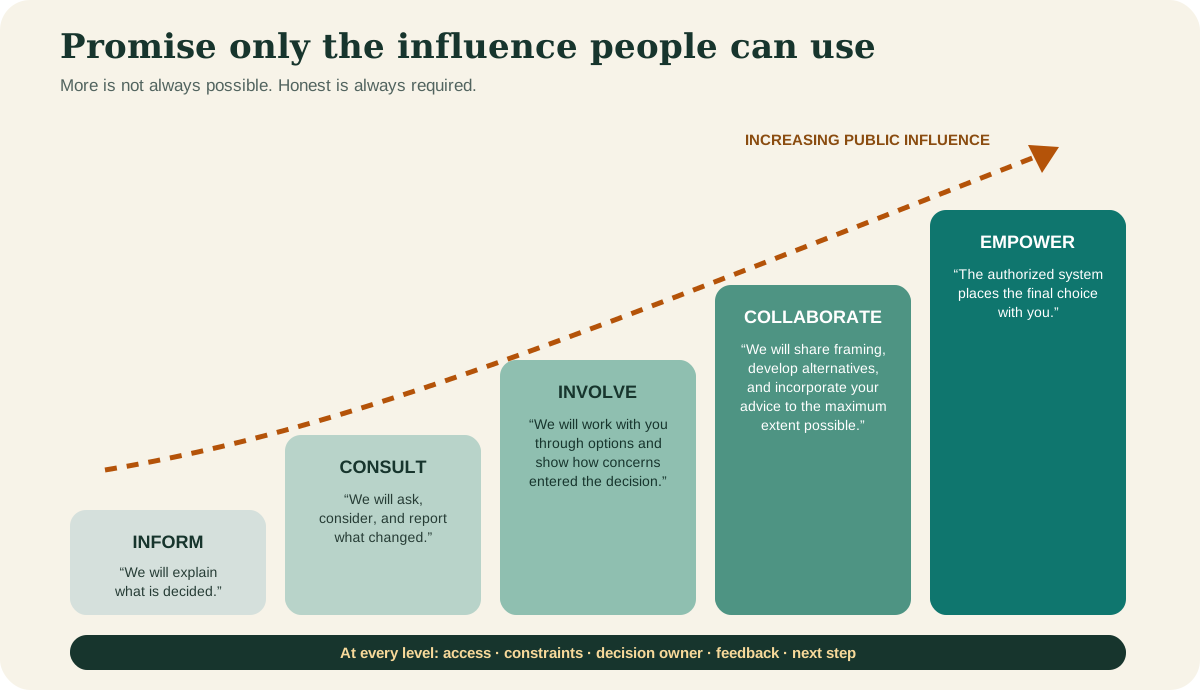
The EPA spectrum distinguishes levels commonly described as inform, consult, involve, collaborate, and empower. The level should match the amount of influence the public can actually have 1. “Inform” is not an insult when a decision is final or legally constrained. “Collaborate” is not a compliment if leaders will ignore the result.
Separate four groups
The legal public
Residents and others may have rights to notice, access, testimony, records, hearings, petitions, voting, or appeal depending on the matter. A public hearing has a defined legal function; it is not automatically a co-design workshop.
Affected people
These are people who receive benefit or bear cost, inconvenience, exclusion, traffic, noise, risk, taxes, changed access, or displacement. They may include people who rarely attend formal meetings.
Stakeholders and partners
Artists, youth, instructors, businesses, preservation groups, accessibility advocates, neighbors, donors, visitors, schools, and community organizations may supply knowledge, resources, implementation, or legitimacy. They do not all have identical authority.
Decision-makers
The council, board, commission, staff officer, executive, or funder retains a specified decision. Participation informs or shares that decision only to the degree law and the institution allow.
Draw the decision-space box
Before inviting participation, publish:
- Decision: the exact question.
- Owner: who has final authority.
- Fixed constraints: law, grant terms, safety, historic standards, budget ceiling, property rights, deadline.
- Open choices: scope, priorities, design, schedule, access, evaluation, mitigation, partner role.
- Evidence: what participants will receive.
- Method: workshop, survey, interview, hearing, advisory group, prototype, participatory allocation.
- Promise: how input will affect the decision.
- Feedback: when people will see what was heard, chosen, and why.
Example:
“The City will select one qualified consultant through the required grant and procurement process. Residents cannot select an unqualified bidder. They can help identify overlooked historic resources, underrepresented histories, research questions, accessibility needs, and priorities for the final public product. The Commission will publish a themes report, selection record, and response explaining which ideas entered the scope.”
Quick check
‘Inform’ isn’t an insult when the decision space is closed; a false promise is.
Access is part of legitimacy
Title II of the ADA applies to state and local governments regardless of size and requires nondiscrimination, program access, effective communication, and reasonable modifications 2. Digital access is also governed by the current Title II web/mobile rule, with compliance dates and technical requirements that should be rechecked for the municipality’s size and the specific content 3.
A nonprofit partner also has its own obligations and should treat access as mission infrastructure. If the nonprofit delivers a city program under contract, the city’s public responsibilities do not simply disappear.
Participation design should consider:
- step-free and transit/parking access;
- captioning, sign-language interpretation, assistive listening, and readable microphones;
- screen-reader-compatible documents, contrast, headings, alt text, and keyboard access;
- plain language and translated or interpreted communication where needed;
- multiple times and asynchronous routes;
- childcare, caregiver realities, device/data limits, and compensation for deep advisory labor;
- sensory environment and remote participation;
- privacy and safety for people sharing lived experience.
“Contact us if you need anything” places the whole burden on the participant. Plan known access from the start and offer a clear request channel for individual needs.
Representation is evidence, not decoration
One person cannot “represent” every artist, disabled resident, downtown business, Indigenous community, learner, or young person. Ask:
- Who selected this person?
- What experience or constituency do they actually speak from?
- How will they consult others?
- What views within the group may differ?
- Is the institution expecting unpaid emotional or cultural labor?
- Is dissent documented or flattened into consensus?
Use several evidence channels:
| Channel | Strength | Blind spot |
|---|---|---|
| open meeting | public, recorded, shared | time, confidence, access, dominance |
| survey | reach and comparable items | self-selection, shallow answers |
| targeted interview | depth and trust | small sample, interpreter effect |
| site walk | concrete place knowledge | mobility/weather/schedule limits |
| advisory group | continuity and iteration | membership legitimacy |
| prototype/pilot | behavior and usability | cost, may exclude nonusers |
| administrative data | patterns over time | only measures what systems captured |
Triangulate rather than allowing the loudest channel to become “the community.”
Mineral Point planning lab
Mineral Point’s planning system provides a concrete context. Its Planning and Development hub links current strategic and comprehensive plans 4, while the Plan Commission includes mayoral, council, and citizen participation in physical, social, and economic planning 5.
Choose a potential cultural-place issue:
- pedestrian connections among historic sites;
- wayfinding and interpretation;
- housing pressure and visitor economy;
- public art in a historic district;
- adaptive reuse;
- campus-neighborhood traffic;
- a survey of historic resources;
- accessible cultural tourism.
Create three participation plans:
Minimum legal process
Only what the governing law, ordinance, or grant requires. Name it accurately.
Good consult/involve process
Accessible information, targeted outreach, multiple channels, visible themes, response memo, and repeated check-ins.
Collaboration
A representative working group helps frame questions, test options, interpret evidence, and recommend a package within published constraints. Final legal authority remains explicit unless it has truly been delegated.
Then decide which level the project can support. More participation is not automatically better; underfunded collaboration can exploit people and delay action.
The “we heard / we did / we could not” report
After a decision, publish:
| We heard | We did | We could not | Why | Next checkpoint |
|---|---|---|---|---|
| preserve local craft stories | added oral-history workstream | interview every family in phase 1 | time and consent capacity | phase-2 archive plan |
| meetings need captions | budgeted live captioning | translate every historical record immediately | scope and rights | priority-language plan |
This closes the loop without pretending every request was accepted.
Board and mayor roles
A mayor can:
- insist that city participation promises are accurate;
- ask who is absent and whether barriers are removable;
- connect commissions, staff, council, and community without privately predetermining decisions;
- protect staff from being ordered to manufacture consensus.
A nonprofit board can:
- require stakeholder and accessibility evidence in strategy;
- authorize staff time and resources for genuine engagement;
- use relationships to reach people the city may miss;
- avoid claiming it speaks for the whole community;
- protect participant information and compensate specialized labor.
Working rule
Never ask people to spend trust on a decision they cannot influence.
If the institution can only explain, explain well. If it can consult, show what changed. If it promises collaboration, share the framing work—not only the microphone.
Practice
Meaningful participation can exist within constraints, but the remaining decision space must be explicit.
Practice
Volume alone can hide exclusion and does not show influence or feedback.
Lesson complete
Nice work.
Sources for this lesson
- 1Spectrum of Public Involvement. U.S. Environmental Protection Agency. verifiedCurrent framework for matching the public's promised influence to inform, consult, involve, collaborate, or empower. Cited at: levels and promises; @cc-epa-select-participation|selecting a level.
- 2State and Local Governments — Title II of the ADA. U.S. Department of Justice. verifiedOfficial overview of program access, effective communication, reasonable modifications, and disability nondiscrimination for public entities. Cited at: public-entity duties.
- 3Fact Sheet — New Rule on the Accessibility of Web Content and Mobile Apps. U.S. Department of Justice. verifiedCurrent Title II web and mobile-app accessibility rule, scope, exceptions, technical standard, and compliance dates. Cited at: web and mobile rule.
- 4Planning and Development. City of Mineral Point, Wisconsin. verifiedCurrent city hub for the comprehensive plan, strategic plan, development information, zoning, and planning resources. Cited at: current plans.
- 5Plan Commission. City of Mineral Point, Wisconsin. verifiedCurrent description of the mayor, council, and citizen commission charged with physical, social, and economic planning work. Cited at: commission role.
Further reading
- Selecting the Right Level of Public Participation. U.S. Environmental Protection Agency. verifiedGuidance for choosing a participation level based on the decision, constraints, stakeholder interest, and actual room for influence.
- About Us. Shake Rag Alley Center for the Arts. verifiedCurrent mission, staff and board roster, programs, campus history, and organization timeline.
Previous: Ethics, Conflicts, Gifts, and the Dual-Role Problem