Coalitions, Appointments, and Relationship Infrastructure
Building civic networks that outlast individuals: mapping public authority, governance, and affected communities, five kinds of power, coalitions with charters, appointments recruited by skills and perspectives, relationship maintenance, and a coalition health dashboard.
- 6 min
- 11 steps
- 3 questions
- Lesson 33 of 36
In this lesson
- Map the system before convening it
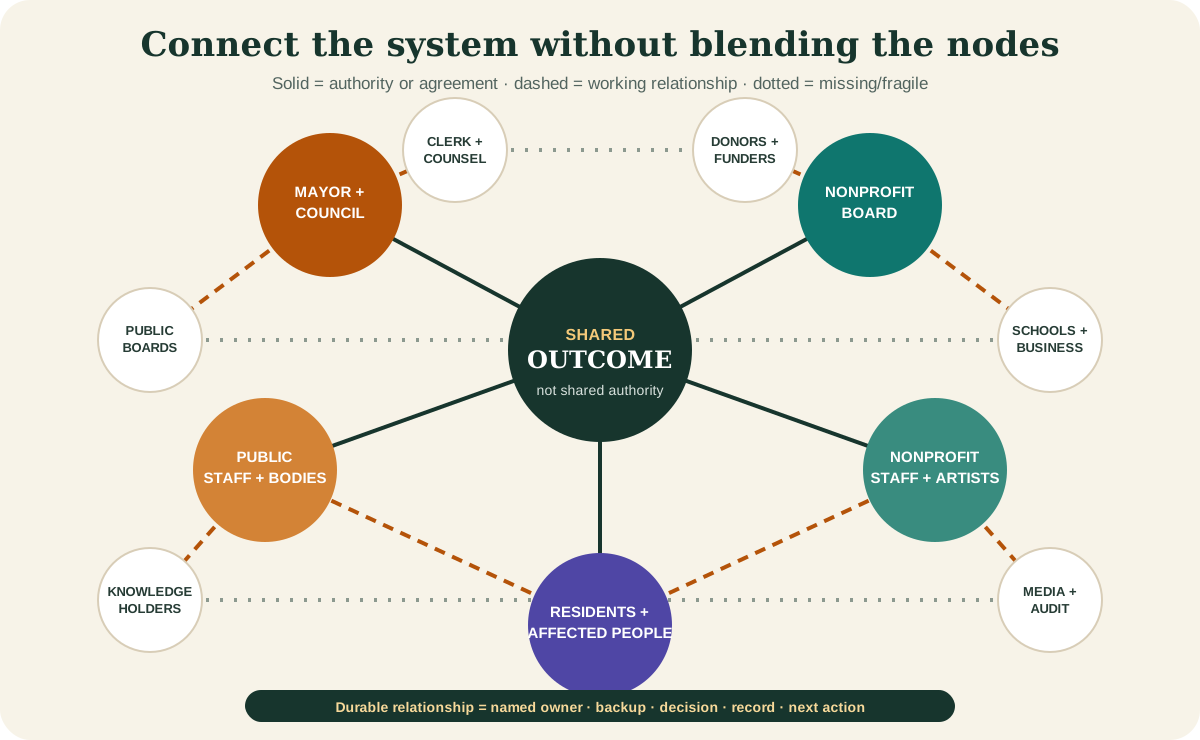
- Five kinds of power
- Coalition is a structure, not a mood
- The coalition charter
- Appointments are infrastructure
- Nonprofit board recruitment faces parallel issues
- Relationship maintenance system
- Convening agenda that produces action
- Coalition health dashboard
- Field lab
Open alongside this lesson
-
Boards, Commissions, and Committee Notifications (opens in a new tab)
Use current rosters, ordinances, and agendas—not the notification list alone—to verify authority and vacancies.
-
City Committees, Boards, and Commissions (opens in a new tab)
Compare formal bodies with informal coalitions and nonprofit committees.
Picking up where you left off.
Community leadership is relational, but “knowing everyone” is not the same as building a durable civic network. Personal relationships open doors. Institutional relationships keep work alive when a mayor, director, alderperson, donor, volunteer, or executive leaves.
Map the system before convening it
For a cultural-development issue, identify:
- public authority: council, mayor, staff, clerk, attorney, plan commission, landmarks/historic-preservation body, arts council, redevelopment authority, tourism structure;
- nonprofit governance: board, executive, program/facility/development staff, committees;
- affected communities: residents, neighbors, property owners, renters, youth, disabled people, artists, cultural knowledge holders;
- delivery partners: schools, libraries, businesses, contractors, visitor organizations, emergency services;
- resource partners: donors, foundations, state/federal agencies, lenders, sponsors;
- accountability actors: voters, members if any, regulators, auditors, insurers, media, grant monitors.
Stoughton publicly lists cultural and place-related bodies including its Arts Council, Landmarks Commission, Opera House Board, Plan Commission, and Redevelopment Authority 1. Mineral Point’s public directory similarly distinguishes committees, commissions, and boards 2.
Five kinds of power
Do not map only titles.
- Formal power: vote, veto, appointment, permit, appropriation, contract, policy.
- Implementation power: staff, time, systems, property, technical knowledge.
- Resource power: money, volunteers, venue, data, equipment, audience.
- Knowledge power: lived experience, history, craft, law, access, local conditions.
- Trust power: ability to convene people who will not respond to an official notice.
A resident without formal office may hold decisive knowledge and trust. A mayor with formal visibility may lack legal power over a commission matter. A nonprofit board may control unrestricted resources but not the permit. A staff planner may know what is feasible but not make the final political decision.
Coalition is a structure, not a mood
Choose a form that matches the work:
Information network
Partners share calendars, facts, referrals, and alerts. Low decision integration.
Coordinating table
Partners align separate programs, avoid collisions, and identify gaps.
Project coalition
A time-limited group delivers a defined output under agreements and named governance.
Advisory body
Members study and recommend to a decision-maker. The promise and selection process must be explicit.
Formal public body
Created by legal authority with public duties, membership, powers, and open-government obligations.
Backbone arrangement
One organization supplies convening, data, coordination, and administration while partners retain their own authority. Fund the backbone work; it is not free.
Do not create a formal-looking “task force” without determining whether it is a governmental body or whose authority created it.
Quick check
Charters, appointments, and shared records turn goodwill into durable structure.
The coalition charter
Write one page:
- problem and bounded outcome;
- sponsor and authority;
- members and selection;
- voices still missing;
- participation promise;
- decisions the group can and cannot make;
- meeting/records/access rules;
- conflict and confidentiality;
- staff/administrative owner;
- deliverables and dates;
- public reporting;
- end date and disposition of work.
If the group can only recommend, use that word.
Appointments are infrastructure
Stoughton’s mayor makes many committee, board, and commission appointments under local and state rules, often with confirmation requirements 3. Appointment power should build legitimate capacity, not a personal loyalty network.
Use a matrix:
| Need | Evidence to look for | Risk to avoid |
|---|---|---|
| statutory qualification | residence, profession, office, term | ineligible appointment |
| role knowledge | planning, finance, arts, preservation, utilities | titles without working competence |
| lived perspective | renter, youth/family, disability, neighborhood | tokenism |
| public deliberation | listening, reasons, disagreement | campaign surrogate behavior |
| independence | conflict disclosure, judgment | captured body |
| work capacity | packet reading, attendance, follow-through | honorary appointment |
| succession | future chair/mentor potential | one-person dependency |
Publish an accessible expression-of-interest process where permitted. Explain duties, meeting load, term, legal status, training, financial disclosure if any, and public-record implications before recruiting.
A fair appointment interview
Ask every candidate the same core questions:
- What does this body actually decide or recommend?
- Tell us about changing your view after evidence or testimony.
- How would you handle a matter involving your employer, client, donor, or organization?
- What voices does this body miss, and how would you listen without claiming to represent everyone?
- Can you meet the preparation, attendance, and public-service expectations?
- What support or accommodation would enable service?
Document the lawful appointment and confirmation process. Do not promise the seat privately.
Nonprofit board recruitment faces parallel issues
The nonprofit board needs fiduciary judgment, mission connection, finance, executive oversight, development, risk, access, place knowledge, and diverse relationships 4. A famous name or large gift does not supply every competency.
The matrix should distinguish:
- skills the board needs collectively;
- perspectives and community relationships;
- identity and lived experience without tokenization;
- fundraising willingness;
- conflicts and independence;
- meeting and committee capacity;
- future officer succession.
Do not recruit a city official primarily to “get city money.” That framing harms both roles and may create conflicts or public distrust.
Relationship maintenance system
Keep an institutional relationship ledger:
| Partner | Shared outcome | Current owner | Last substantive contact | Next decision | Promise outstanding | Continuity risk |
|---|---|---|---|---|---|---|
Rules:
- record decisions and commitments, not gossip;
- identify an organizational owner and backup;
- respect consent and privacy;
- transfer records on role change;
- schedule listening when no ask is pending;
- close the loop after advice;
- do not turn every relationship into fundraising or politics.
Convening agenda that produces action
- decision/outcome for this meeting;
- facts and fixed constraints;
- short reports from affected/implementing people;
- choices and tradeoffs;
- decision rights;
- commitments: owner, date, evidence;
- unresolved issues and escalation;
- public/partner communication;
- next gate or deliberate ending.
Do not spend 80% of a coalition meeting on institutional updates that could have been written.
Coalition health dashboard
Track:
- member/affected-group gaps;
- attendance and preparation;
- commitments delivered on time;
- decisions waiting for unclear authority;
- resources contributed and burden distribution;
- conflicts disclosed;
- participation/access barriers;
- partner trust pulse;
- outcomes and unintended effects;
- single-person dependencies;
- renewal or sunset decision.
Field lab
Choose one Stoughton cultural-place objective or one Shake Rag/Mineral Point objective. Draw the network, then annotate:
- solid line = formal authority or contract;
- dashed line = working relationship;
- dotted line = missing or fragile relationship;
- red marker = conflict or concentrated dependency;
- star = people most affected but least connected to decision-makers.
Write three next actions. At least one must strengthen an institutional connection, not simply arrange a meeting with a friend.
Working rule
Use relationships to connect institutions; do not make institutions dependent on private relationships.
The coalition should become more capable and accountable than any one connector.
Practice
A matrix improves intentionality; it does not override appointment law, bylaws, vetting, or confirmation.
Practice
Single-person dependency creates continuity, equity, and accountability risk.
Lesson complete
Nice work.
Sources for this lesson
- 1Boards, Commissions, and Committee Notifications. City of Stoughton, Wisconsin. verifiedCurrent list including the Arts Council, Landmarks Commission, Opera House Board, Plan Commission, Redevelopment Authority, and Common Council. Cited at: boards and commissions.
- 2City Committees, Boards, and Commissions. City of Mineral Point, Wisconsin. verifiedCurrent list and basic explanation of Mineral Point's public decision and advisory bodies. Cited at: public bodies.
- 3Mayor. City of Stoughton, Wisconsin. verifiedOfficial description of the mayor's local responsibilities, current officeholder, and contact information. Cited at: appointments.
- 4Board Roles and Responsibilities. National Council of Nonprofits. verifiedGovernance practice on fiduciary stewardship, executive oversight, resources, fundraising, and advocacy. Cited at: board responsibilities.
Further reading
- City Council. City of Stoughton, Wisconsin. verifiedOfficial council roster and description of the 12 alderpersons, four districts, staggered terms, agendas, and meeting video.
- Plan Commission. City of Mineral Point, Wisconsin. verifiedCurrent description of the mayor, council, and citizen commission charged with physical, social, and economic planning work.
- Selecting the Right Level of Public Participation. U.S. Environmental Protection Agency. verifiedGuidance for choosing a participation level based on the decision, constraints, stakeholder interest, and actual room for influence.