Writing the Proposal: Need, Design, Outcomes, and Review Criteria
Writing a proposal reviewers can score: a compliance matrix from the rubric, a need statement that avoids deficit stories, project design, a logic model, measurable outcomes, an evaluation plan, capacity and sustainability sections, editing in passes, and the board's review question.
- 5 min
- 11 steps
- 3 questions
- Lesson 22 of 36
In this lesson
- Start with the scoring rubric
- Need statement
- Project design
- Logic model
- Write measurable outcomes
- Evaluation plan
- Organizational capacity
- Sustainability
- Editing in passes
- Board review question
Picking up where you left off.
A grant proposal is an evidence-based implementation argument:
a defined need/opportunity + a credible response + capable people/partners + measurable outcomes + a complete budget + feasible administration
Beautiful prose cannot cure a weak program. Strong programs can lose when the proposal makes reviewers infer the logic.
Start with the scoring rubric
Create a compliance matrix:
| Requirement/criterion | Points | Evidence needed | Section | Owner | Status |
|---|---|---|---|---|---|
| community need | 20 | data, listening, partner evidence | need | program | amber |
| project quality | 25 | design, artists, timeline | methods | lead | green |
| access | 15 | barrier analysis/accommodations | access | program | amber |
| management | 20 | roles, history, systems | capacity | executive | green |
| outcomes | 20 | measures/targets/use | evaluation | evaluator | red |
Use the funder’s exact current language without parroting unsupported claims.
Need statement
Structure:
- who/where;
- specific condition or opportunity;
- evidence and source/date;
- barriers/assets;
- why now;
- how the project addresses—not solves everything.
Avoid deficit stories that portray Mineral Point residents, youth, or artists as props. Include community assets and voices. The Wisconsin Arts Board’s Phase 1 guidance emphasizes community involvement and planning, not an organization deciding what a community needs by itself 1.
Weak:
Rural communities lack culture.
Better pattern:
Listening with [partners/groups] identified [specific access or opportunity]. Current [data/observation] shows . Mineral Point already has [artists, institutions, traditions, spaces]; the remaining barrier is . This project co-designs ___.
Project design
Answer:
- participants and selection/recruitment;
- activities, sequence, intensity, location;
- artists/instructors and selection;
- partners and exact commitments;
- access/accommodations;
- youth/safety/risk controls;
- timeline and milestones;
- who owns each element;
- contingency;
- connection to existing work without double charging.
Use a work plan:
| Month | Activity | Owner | Output | Decision/dependency |
|---|---|---|---|---|
| 1 | community design sessions | partner + program | 3 sessions/30 voices | final scope |
| 2–3 | artist selection/curriculum | artistic lead | contracts/curriculum | checks/access |
| 4–7 | learning series | instructors | 8 sessions | attendance threshold |
| 8 | public sharing/reflection | program | event/archive | consent |
| 9 | analysis/report | evaluator/finance | report/closeout | board learning |
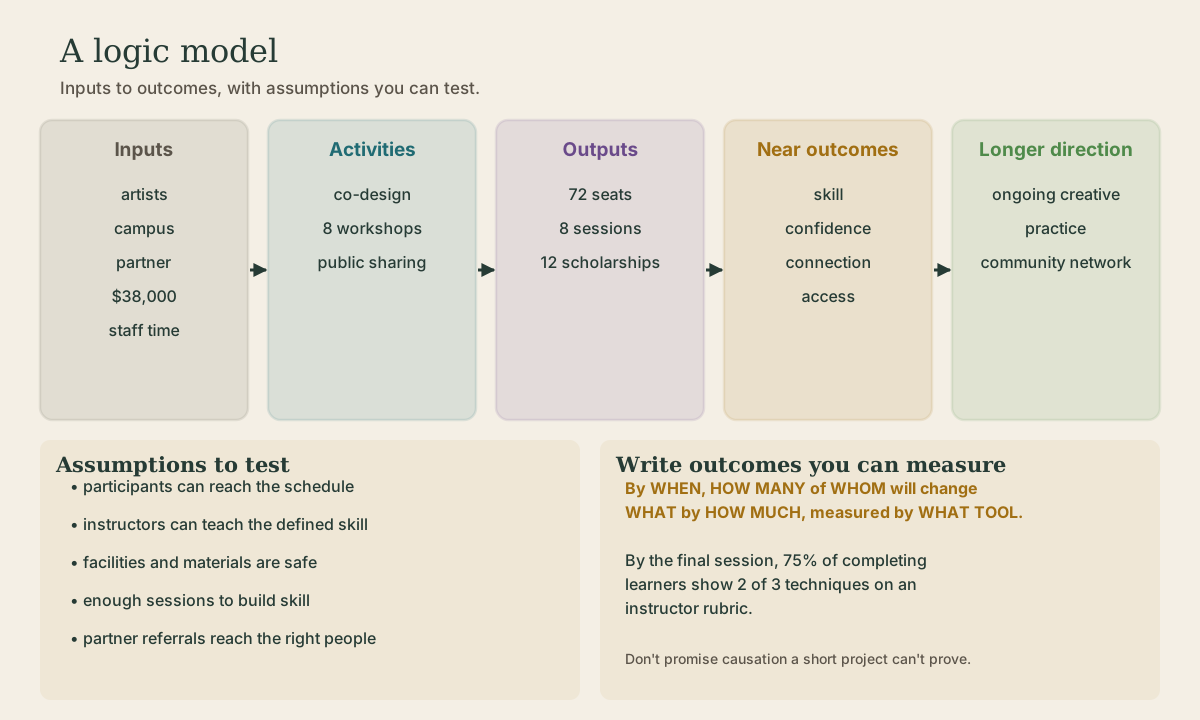
Logic model
Example:
| Inputs | Activities | Outputs | Near outcomes | Longer direction |
|---|---|---|---|---|
| artists, campus, partner, $38k, staff | co-design + 8 workshops + sharing | 72 seats; 8 sessions; 12 scholarships | skill, confidence, connection, access | ongoing creative practice/community network |
State assumptions:
- targeted participants can access schedule/transport;
- selected instructors can teach the defined skill;
- safe facilities and materials are available;
- dosage is sufficient;
- partner referrals reach intended participants.
Then design mitigations.
Write measurable outcomes
Formula:
By time, number/percentage of whom will change what by how much, measured by tool/source, reviewed by which groups/use.
Examples:
- By final session, 75% of completing learners demonstrate at least two of three defined techniques on an instructor rubric.
- At least 60% of first-time participants report intent and a specific plan to continue creative practice at 60-day follow-up.
- The project reaches 30 participants from defined priority groups, with completion gaps no greater than X percentage points; barriers and adaptations are reviewed monthly.
- Two partner organizations adopt a specific continuation action by closeout.
Do not promise causation a short project cannot prove.
Evaluation plan
For each outcome:
| Measure | Source | Baseline | Target | Timing | Owner | Use |
|---|---|---|---|---|---|---|
| technique rubric | work sample | first session | 75% threshold | first/final | instructor | adapt teaching |
| belonging | 3-item survey | start | +0.5 average | start/end | program | access design |
| continuation | follow-up | n/a | 60% plan | 60 days | partner | next phase |
Protect privacy, obtain consent, minimize child data, define denominators, and plan for missing responses.
Add qualitative evidence:
- structured interviews/focus groups;
- artist reflection;
- partner observation;
- participant-created work with permission;
- outcome stories that include context and do not overclaim.
Organizational capacity
Do not paste a history chronology. Connect capability:
- mission and relevant program history 2;
- named staff/artist/partner roles;
- financial/control systems;
- facilities and risk;
- prior results and learning;
- governance/board oversight;
- what capacity the grant funds rather than assumes.
If there is a gap, name the mitigation. Honest risk management is more credible than perfection.
Sustainability
Avoid “we will seek other grants.” Explain:
- what ends at grant close;
- what becomes part of core operations and at what annual cost;
- earned/contributed/partner sources;
- which assets/curriculum/relationships persist;
- what evidence controls continuation;
- no promise of permanence before evaluation.
Quick check
Say what ends, what continues, at what cost, and who pays.
Editing in passes
- compliance: every prompt, limit, attachment, file type;
- logic: need → activity → outcome → budget;
- evidence: source/date and no unsupported adjectives;
- specificity: people, counts, roles, dates;
- equity/access: who shaped, benefits, barriers, data;
- plain language: short sentences, defined acronyms;
- cross-document: narrative, budget, timeline, letters match;
- cold review: someone scores only against rubric.
Cut organizational praise before cutting project mechanics.
Board review question
The board does not need to edit prose. For a material grant it asks:
Is the proposal truthful, within mission/authority, completely costed, operationally feasible, ethically designed, and acceptable under the award terms?
Practice
It identifies population, change, measure, target, time, and an access/equity lens.
Practice
A fundable proposal explicitly answers the live criteria with current evidence.
Lesson complete
Nice work.
Sources for this lesson
- 1FY27 Creative Communities Phase 1 Guidelines. Wisconsin Arts Board. 2026. verifiedApplication criteria emphasizing alignment, artistic or educational value, participation, accessibility, and innovation. Cited at: community involvement.
- 2About Us. Shake Rag Alley Center for the Arts. verifiedCurrent mission, staff and board roster, programs, campus history, and organization timeline. Cited at: mission/history.
Further reading
- The Grant Lifecycle. Grants.gov. verifiedOfficial federal pre-award, award, implementation, reporting, and closeout lifecycle.
- Grants for Arts Projects. National Endowment for the Arts. verifiedCurrent federal arts-grant eligibility, cost share, request range, and application calendar.
Previous: Grant Readiness, Prospecting, and the Go/No-Go Decision