Public Communication, Media, and Crisis
Communicating in public and in a crisis: four lanes from action instructions to accountability, a five-line decision explanation, preparing before an incident, first-hour discipline, an accuracy ladder, privacy and accessibility, joint-project messaging, and after-action review.
- 6 min
- 13 steps
- 3 questions
- Lesson 34 of 36
In this lesson
- Four communication lanes
- The five-line decision explanation
- Before the incident: prepare the system
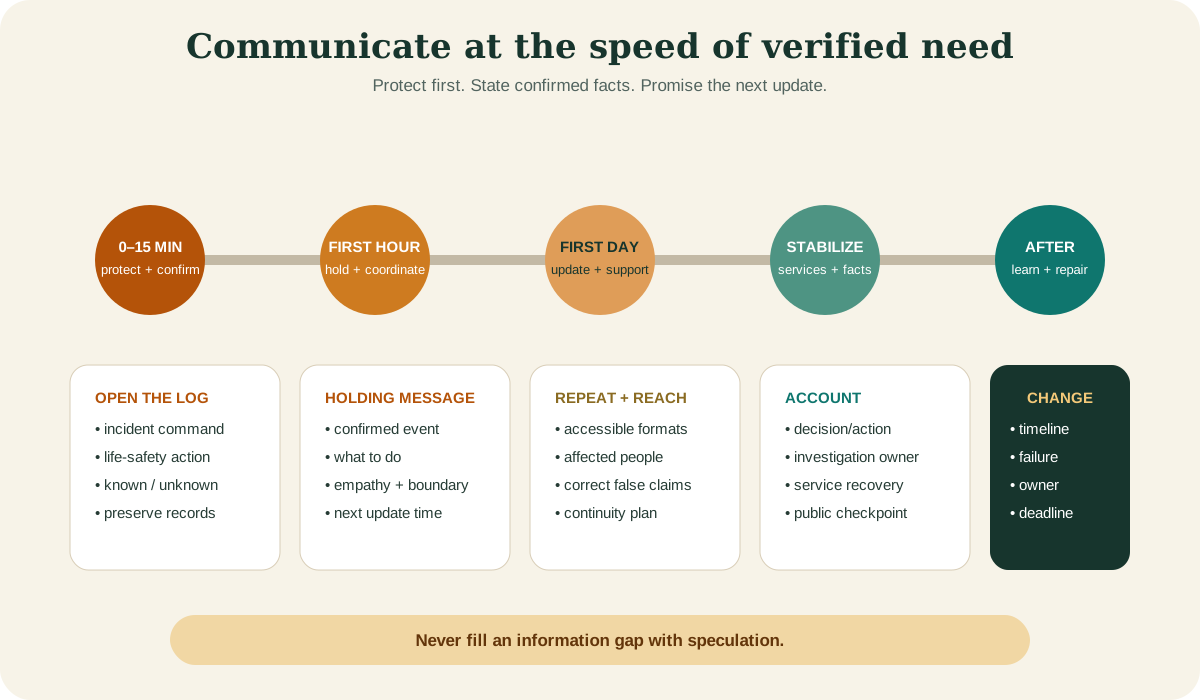
- The first-hour discipline
- Accuracy ladder
- Public records and private data
- Accessibility under pressure
- Media interview bridge
- Joint-project message protocol
- Crisis scenario: fire alarm during youth demonstration
- After-action review
- Working rule
Open alongside this lesson
-
Ready for Anything — A Guide to Crisis Communications (opens in a new tab)
Adapt the planning tools to local authority, staff structure, and actual emergency plans.
-
Wisconsin Public Records Law Compliance Guide (opens in a new tab)
Messages, notes, texts, photographs, and drafts may create records; follow custodian and retention guidance.
Picking up where you left off.
Public leadership is partly the work of reducing uncertainty without manufacturing certainty. In ordinary times, good communication explains decisions. In crisis, it also helps people act safely, locate services, understand what is known, and trust the next update.
Four communication lanes
Operational instruction
What people need to do now: leave an area, use another entrance, postpone travel, retrieve a child, avoid a hazard, contact a service.
Decision explanation
What was decided, by whom, under what authority, after considering which evidence, with what dissent, condition, or next step.
Institutional accountability
What the city or nonprofit owns: funding, failure, investigation, corrective action, records, report, or restitution.
Community meaning
Recognition of loss, history, identity, fear, celebration, or disagreement. This is important, but must not replace operational truth.
A mayor may be the city’s executive and ceremonial voice in defined circumstances 1. A nonprofit board chair may speak for governance while the executive director speaks for operations. Establish the lanes before a crisis.
The five-line decision explanation
Use:
- Decision: “The Council approved…”
- Authority/process: “After the noticed hearing and recommendation from…”
- Evidence and tradeoff: “The decisive factors were…; the principal cost/risk is…”
- Implementation: “Staff/nonprofit partner will… by…”
- Accountability: “The agreement, vote, report, and next review are available at…”
Do not say “the community decided” when a public body decided after hearing mixed views.
Before the incident: prepare the system
Create:
- crisis team and alternates;
- incident-command relationship;
- 24/7 contact tree;
- thresholds for notifying board, mayor, council, insurer, counsel, law enforcement, funder, family, regulator, and media;
- authorized spokespeople by subject;
- accessible emergency channels and message templates;
- participant, staff, artist, tenant, volunteer, neighbor, donor, and public contact routes;
- protected-information rules;
- social monitoring and correction process;
- website/status-page access;
- records and decision log;
- after-action owner.
FEMA’s crisis-communication guide emphasizes advance plans, audiences, roles, messages, channels, and post-event learning 2.
The first-hour discipline
Confirm
What happened, where, when, and from which authoritative operational source? Separate witnessed fact from report and inference.
Protect
What immediate action should people take? Is the message accessible across audio, visual, digital, and language needs?
Coordinate
Who is incident lead? Who speaks for city operations, public safety, nonprofit operations, board governance, property, and participants? Which facts can be shared?
Hold
Issue a holding statement when public need exists:
“At approximately [time], [confirmed event] occurred at [general location]. Emergency personnel are responding, and [protective instruction]. We are coordinating with [authorities/partner]. We do not yet know [material unknown]. We will provide the next update at [time/channel].”
Preserve
Open an incident log. Preserve relevant messages, photographs, access logs, contracts, training, maintenance, and decisions. Do not clean up the record.
Quick check
Reduce uncertainty without manufacturing certainty.
Accuracy ladder
Label information internally:
- confirmed: verified by responsible source;
- probable: supported but awaiting confirmation;
- reported: attributed to a source;
- unknown: not established;
- incorrect: disproven and ready for correction;
- protected: known but not releasable because of privacy, safety, investigation, privilege, or law.
“We cannot release that yet” is different from “we do not know.”
Public records and private data
Public communication creates records. Drafts, texts, notes, photographs, direct messages, and corrections may be relevant under Wisconsin public-records analysis when created or held in public business 3. Use public systems and route requests to the custodian.
At the same time, do not release:
- unnotified identities;
- medical or disability details;
- youth/learner information;
- security vulnerabilities;
- unverified allegations;
- privileged legal analysis;
- donor or employee information without authority.
The correct process may include balancing and redaction, not improvised secrecy or full disclosure.
Accessibility under pressure
Emergency communication should include:
- captions and visual equivalents for spoken alerts;
- screen-reader-compatible updates;
- plain-language action first;
- relay/interpreter routes;
- multiple channels;
- information about accessible shelter, transportation, entrances, or services;
- repeated updates when conditions change.
Title II’s effective-communication duty is part of public crisis planning 4.
Media interview bridge
Prepare:
- fact: what is confirmed;
- meaning: why it matters;
- action: what the institution is doing;
- boundary: what cannot yet be stated;
- next: when and where more information will come.
Example:
“The confirmed fact is that a water leak closed two campus buildings before today’s workshop. No injuries are reported. Participant safety and preservation of collections are our immediate priorities. Inspectors are assessing cause and damage, so I will not speculate. Registered learners are receiving relocation/refund information, and the next public update will be posted at 4 p.m.”
Do not repeat a false premise simply to deny it. Correct it with the verified fact.
Joint-project message protocol
Write before launch:
| Topic | Lead voice | Required consultation |
|---|---|---|
| city authority/vote/public money | authorized city spokesperson | clerk/attorney/project owner |
| nonprofit program/staff/participants | executive director | board chair/counsel as needed |
| emergency operations | incident commander/agency | both institutions |
| board governance action | board chair | executive/counsel |
| investigation | designated authority | counsel/insurer/agency |
| shared outcomes | agreed spokesperson | data owners and approvers |
No partner should announce the other’s commitment.
Crisis scenario: fire alarm during youth demonstration
Facts:
- alarm and smoke reported in a historic teaching building;
- youth group evacuates;
- one participant is missing from the initial roster check;
- a volunteer posts “everyone is safe”;
- a parent posts a photograph and claim of an electrical fire;
- the city fire department is in command;
- the building is part of a city-supported project.
First actions:
- incident command and life safety;
- reconcile participant roster; follow youth/family plan;
- correct the volunteer’s unauthorized certainty;
- preserve records and do not amplify the parent’s unverified cause;
- coordinate a holding statement with fire/public-safety authority;
- notify required leaders, insurer, counsel, and funder;
- provide accessible family and public updates;
- avoid discussing cause, blame, or identity;
- plan program continuity and property assessment;
- schedule operational and governance after-action reviews.
After-action review
Within a defined period:
- timeline from logs;
- what protected people/property;
- failures and near misses;
- communication reach/access;
- decision/authority problems;
- policy, training, facility, technology, or agreement changes;
- owners and deadlines;
- public summary and protected annex;
- board/council follow-up;
- confirmation that changes were completed.
Do not use “lessons learned” when no owner or deadline follows.
Working rule
Say what is known, what people should do, what you own, what remains unknown, and when the next truth will arrive.
That pattern works in a fire, funding shortfall, leadership transition, preservation controversy, or ordinary public disagreement.
Practice
A holding statement can be prompt and useful without speculation or privacy violations.
Practice
Coordination should prevent contradiction while preserving institutional authority and subject-matter ownership.
Lesson complete
Nice work.
Sources for this lesson
- 1Mayor. City of Stoughton, Wisconsin. verifiedOfficial description of the mayor's local responsibilities, current officeholder, and contact information. Cited at: responsibilities.
- 2Ready for Anything — A Guide to Crisis Communications. Federal Emergency Management Agency. verifiedPractical public-sector crisis-communication guide covering plans, audiences, message discipline, roles, channels, and post-event learning. Cited at: planning framework.
- 3Wisconsin Public Records Law Compliance Guide. Wisconsin Department of Justice. 2025. verifiedCurrent official guide to authorities, custodians, records, requests, balancing, redaction, electronic records, fees, and enforcement. Cited at: electronic records and custody.
- 4State and Local Governments — Title II of the ADA. U.S. Department of Justice. verifiedOfficial overview of program access, effective communication, reasonable modifications, and disability nondiscrimination for public entities. Cited at: effective communication.
Further reading
- Wisconsin Open Meetings Law. Wisconsin Department of Justice. verifiedOfficial compliance resources and current DOJ guide for public notice, open sessions, and walking quorums.
- About Us. Shake Rag Alley Center for the Arts. verifiedCurrent mission, staff and board roster, programs, campus history, and organization timeline.
Previous: Coalitions, Appointments, and Relationship Infrastructure