Financial Statements Without Fear
Reading nonprofit finances: the statement of financial position, statement of activities, cash forecast, budget-to-actual, and restriction schedule, each with its question; why cash, revenue, and margin differ; functional versus natural expenses; and ten questions with a worked liquidity example.
- 5 min
- 7 steps
- 3 questions
- Lesson 13 of 36
In this lesson
- Five reports, five questions
- Cash is not revenue; revenue is not margin
- Functional versus natural expense
- Board packet format
- Ten questions
- Practice
Picking up where you left off.
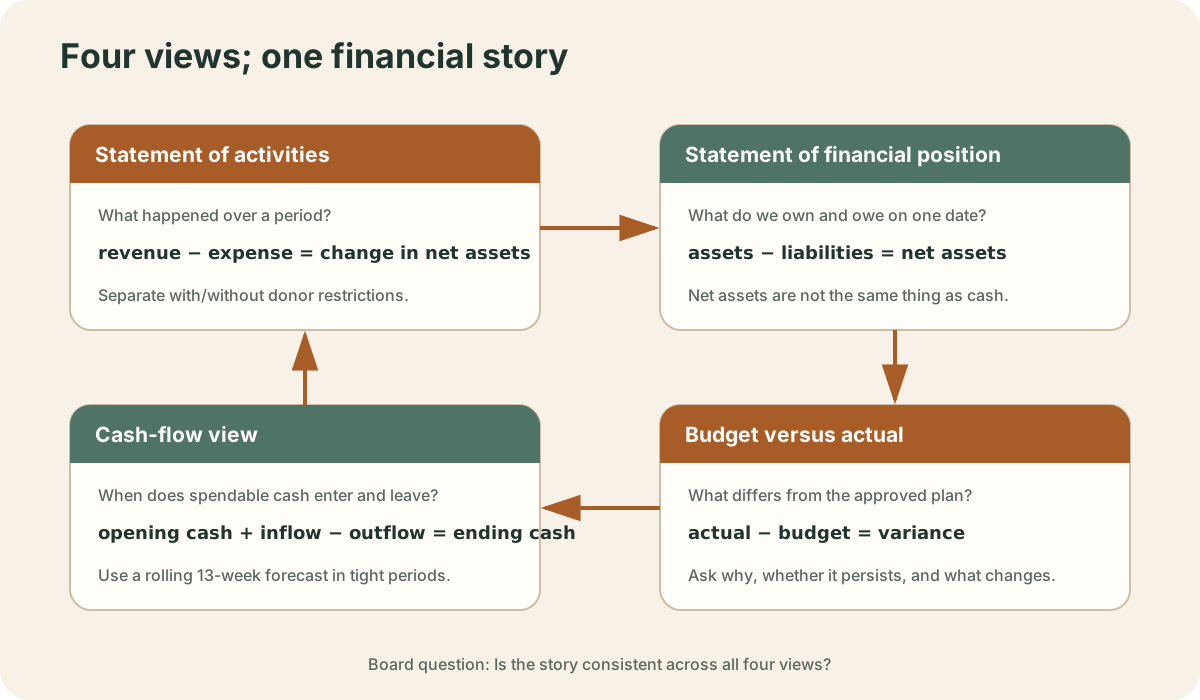
Every director needs enough financial literacy to ask good questions. The treasurer and finance committee deepen the work; they do not carry the duty for everyone 1.
Five reports, five questions
Statement of financial position
A balance-sheet snapshot:
assets = liabilities + net assets
Read:
- cash/cash equivalents: how much exists now;
- receivables/pledges/grants: expected collection and risk;
- prepaids: value paid in advance, not cash;
- property/equipment: accounting value, not necessarily sale or replacement value;
- payables/accruals: bills/services owed;
- deferred revenue: cash received before earning it;
- debt: principal, terms, covenants, current portion;
- net assets without donor restrictions;
- net assets with donor restrictions.
Board question: What can we actually use, and what obligations attach?
Statement of activities
Shows revenue, expense, releases of restrictions, and change in net assets over a period.
Board question: Did the operating and restricted story perform as intended?
Do not read total change alone. A capital gift can produce a large surplus while recurring operations deteriorate.
Cash-flow statement/forecast
Accounting statement classifies operating, investing, and financing cash. A management cash forecast shows timing forward.
Board question: When could cash run short, even if the annual budget balances?
For a seasonal arts program, a rolling 13-week forecast can expose registration deposits, instructor payments, event costs, payroll, grant reimbursements, and repairs.
Budget-to-actual
Shows plan, actual, variance, revised forecast, and explanation.
Calculate:
dollar variance = actual − budget
percentage variance = (actual − budget) / budget
Use sign conventions carefully: an expense above budget is operationally unfavorable even if shown as a positive arithmetic variance.
Board question: Is the variance timing, permanent, restricted, or a changed assumption—and what action follows?
Restrictions and grant schedule
Track beginning balance, new restricted revenue, qualified spending/releases, ending balance, cash location, grant period, reporting dates, match, and obligations.
Board question: Can we prove each restricted dollar was used for its purpose and are we financing any reimbursement gap?
Cash is not revenue; revenue is not margin
Examples:
- A donor pays $50,000 restricted to a future roof: cash rises now; current operating availability does not.
- A participant pays a deposit for next year: cash rises; some may be deferred revenue.
- A reimbursement grant covers costs after proof: revenue recognition and cash receipt may differ.
- Depreciation reduces reported results without current cash outflow, while roof replacement requires future cash not captured by current depreciation.
- An in-kind contribution may be reported as revenue and expense but creates no cash.
Ask for a bridge:
reported change in net assets → noncash/timing items → restrictions → working-capital changes → actual unrestricted cash movement
Functional versus natural expense
Natural classification says what was bought: wages, occupancy, supplies, insurance, professional fees, depreciation.
Functional classification says why: program services, management/general, fundraising.
Allocation is judgment. The board should understand methodology and consistency, but should not equate low administration with virtue. Finance, HR, IT, safety, data, development, and maintenance make mission possible. Underinvesting can create hidden liability.
Board packet format
Monthly or quarterly:
- one-page finance dashboard;
- statement of financial position with comparison;
- activities versus budget and prior year;
- forecast to year-end;
- 13-week cash forecast when useful;
- restrictions/grants schedule;
- fundraising and program revenue detail;
- capital/debt/reserve schedule;
- written variance/risk narrative;
- decisions requested.
Use consistent definitions and dates. Label preliminary numbers.
Ten questions
- How many days of available unrestricted cash do we have?
- What receipts/payments create the next low point?
- Which revenue is one-time, restricted, uncertain, or concentrated?
- Which costs are fixed, variable, deferrable, or already committed?
- Are payroll taxes, debt, restricted obligations, and payables current?
- Which variances change the full-year forecast?
- What maintenance/capital need is absent from the operating result?
- Are receivables and pledges aging?
- Do program economics include staff and facility load?
- What decision or threshold requires the board?
Practice
Suppose:
- cash: $220,000;
- donor-restricted cash: $90,000;
- board-designated reserve: $60,000;
- minimum operating cash: $40,000;
- average monthly cash expenses: $45,000.
One useful conservative availability view:
$220,000 − $90,000 − $60,000 − $40,000 = $30,000 above protected categories
Unrestricted cash days before minimum, if all designations remain intact:
($220,000 − $90,000 − $60,000 − $40,000) / ($45,000 / 30) = 20 days
But confirm whether restricted funds are held separately, whether reserve can be undesignated by the board, what liabilities fall due, and whether average expense hides a seasonal spike. The formula starts inquiry; it does not finish it.
Financial literacy means translating numbers into mission choices without pretending numbers are the choices.
Quick check
At $45,000 a month in expenses, that’s less than three weeks of cushion.
Practice
Accrual timing, restrictions, receivables, and payment schedules separate reported performance from usable cash.
Practice
Donor restrictions are external obligations; board designations are internal and conceptually different.
Lesson complete
Nice work.
Sources for this lesson
- 1Financial Literacy for Nonprofit Boards. National Council of Nonprofits. verifiedBoard-level guidance on budgets, reports, controls, restrictions, reserves, dashboards, and whistleblowing. Cited at: board financial literacy.
Further reading
- Shake Rag Alley Inc — IRS Form 990 Filings. ProPublica Nonprofit Explorer. verifiedSearchable presentation of IRS filing data. The course uses the fiscal-2024 filing filed August 20, 2025 and compares prior years.