Fuse Boxes, Old Panels, and Service Upgrades
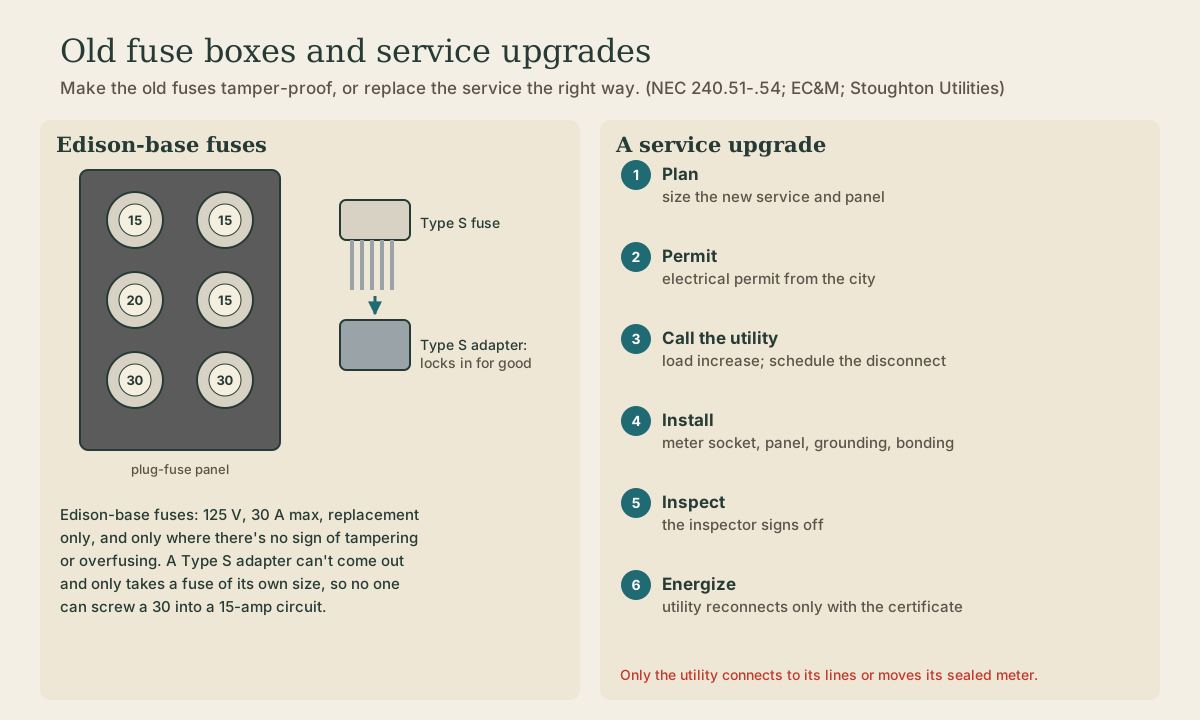
A screw-in fuse panel isn't illegal, but it's easy to abuse: anyone can screw a 30-amp fuse into a 15-amp circuit. Type S adapters lock each socket to the right size for good. When it's time for more power, a service upgrade is new work from the meter in: a permit, a call to Stoughton Utilities, a new panel and grounding to today's code, an inspection, and only then reconnection.
- 4 min
- 5 steps
- 3 questions
- Lesson 81 of 111
In this lesson
- Plug fuses and Type S adapters
- A service upgrade, step by step
- What a new panel doesn’t fix
- Try it
Picking up where you left off.
Old houses often still have a screw-in fuse panel somewhere, sometimes alongside a newer breaker panel. Here’s what the code says about the old equipment, and how a service upgrade works.
Plug fuses and Type S adapters
The round screw-in fuses in an old panel are Edison-base fuses, the same thread as a light bulb. They’re rated for no more than 125 volts and 30 amps, and the code permits them only as replacements in existing installations, and only where there’s no evidence of tampering or overfusing 1.
Overfusing is the danger. Every Edison-base socket accepts every Edison-base fuse, so when a 15-amp circuit keeps blowing its fuse, it’s tempting to screw in a 20 or a 30. Then the fuse no longer protects the wire, and the wire can overheat inside the wall long before the fuse blows.
The fix is a Type S adapter. It screws into the Edison-base socket and can’t be removed once installed. It accepts only a Type S fuse of its own amp rating, and Type S fuses and adapters are designed so tampering would be difficult 1. With a 15-amp adapter on a 14-gauge circuit, the usual wire for 15 amps 2, nobody can ever put a 30-amp fuse there again. Check each circuit’s wire size before choosing its adapter.
A fuse panel that’s sound and properly fused is existing work that may stay 3. One that’s overfused is a hazard the inspector can order corrected 3.
Quick check
Once installed, it can’t be removed, which stops overfusing.
A service upgrade, step by step
Adding electric heat, a heat pump, a car charger, or just a modern kitchen often means more power than a small old service can deliver. Replacing the service is new work, held to the current code 3.
- Plan. Size the new service and panel for the loads you have and expect.
- Permit. Get the electrical permit before work begins. Stoughton’s building inspector issues electrical permits under Chapter 10 4; state rules require a permit before a new or added service for some building types and describe how inspections work 5.
- Call the utility. Stoughton Utilities asks for reasonable notice of any substantial load increase that needs a larger transformer, service, or meter 6. The utility makes all connections to its distribution system, and its meters are sealed; only utility employees may remove or relocate a meter 6. Schedule the disconnect with them.
- Install. New meter socket, service entrance conductors, panel, and the grounding and bonding system, all to the current code. In an old house this is usually where the grounding gets brought up to date: the service is where the neutral is bonded to earth and the equipment grounds start 7.
- Inspect. The inspector reviews the work.
- Energize. State law requires the utility to have the electrical inspector’s certificate of approval before it furnishes service 6.
Quick check
The utility makes all connections to its system and seals its meters.
Quick check
State law requires it, according to Stoughton Utilities’ service rules.
What a new panel doesn’t fix
A new panel doesn’t upgrade the branch circuits behind it. Old two-wire circuits are still ungrounded, a switch loop is still a switch loop, and knob-and-tube is still knob-and-tube, all allowed to stay if they’re sound 3. The new breakers protect the old wire only if each breaker matches the size of the wire it feeds.
Try it
Open your panel’s door (not its cover) and make a circuit list: each fuse or breaker, its rating, and what it feeds. If you have plug fuses, note any 20- or 30-amp fuses on circuits that seem to be ordinary lights and outlets; those are the first candidates for a look at the wire size and a Type S adapter.
Lesson complete
Nice work.
Sources for this lesson
- 1Mike Holt. Code Q&A: Edison-Base Fuses and Type S Adapters. EC&M (Electrical Construction & Maintenance). 2013. verifiedFebruary 7, 2013. Edison-base fuses are rated not more than 125V and 30A and are permitted only for replacement in existing installations where there is no evidence of tampering or overfusing [240.51]. Edison-base fuseholders must accept Type S fuses by use of adapters [240.52]. Type S adapters fit Edison-base fuseholders, take Type S fuses only, and can't be removed once installed; Type S fuses, fuseholders, and adapters are designed so tampering or shunting would be difficult [240.54].
- 2Electrical Tech Note 330: Wiring Circuits, Basic Rules. Michigan State University, Biosystems & Agricultural Engineering. verifiedEach hot wire is about 120 V to earth and 240 V hot to hot; voltages above about 15 V can be dangerous; NM-B cable for dwellings is commonly 14 AWG for 15 A circuits (white jacket), 12 AWG for 20 A (yellow), and 10 AWG for 30 A (orange); NM cable is for dry locations only; keep the equipment grounding conductor continuous; one wire per device screw terminal.
- 3Wis. Admin. Code SPS 316.003, 316.021, 316.210, and 316.406. Wisconsin Legislature. 2026. verifiedRegister September 2026. SPS 316.003(1): the chapter applies to all new installations, reconstructions, alterations, and extensions. (3) Existing installations shall conform to the electrical code that applied when they were installed; where a hazard exists or is created, the authority having jurisdiction may require compliance with current code. (4) Repairs conform to the code that applied when installed, with the same hazard provision. (6) Additions and alterations comply with the chapter at the time of permit application or, with no permit, the beginning of the project. SPS 316.021: installations known to be defective so as to endanger life or property shall be promptly repaired, disconnected, or isolated. SPS 316.210(2): NEC 210.12(E) (AFCI for branch-circuit extensions, modifications, or replacements) is not included. SPS 316.406(1): NEC 406.4(D)(4) (AFCI for replacement receptacles) is not included.
- 4Ordinance O-11-2025: Building permit fees, permit lapses, and revocation (Stoughton Municipal Code Ch. 10). City of Stoughton, Wisconsin. 2025. verifiedAdopted April 8, 2025. Permit fees paid to the Planning and Development Department before a permit issues. Permits for one- and two-family dwelling construction, remodeling, and additions are valid 24 months; other permits lapse after one year. The building inspector may revoke or suspend building, plumbing, or electrical permits for noncompliance, danger, or misrepresentation.
- 5Wis. Admin. Code SPS 316.012-.013, Electrical permits and inspections. Wisconsin Legislature. 2026. verifiedRegister September 2026. A permit from the designated inspection agency is required before a project installing a new or added service, feeder, or branch circuit serving a farm, public building, place of employment, campground, manufactured home community, public marina or dock, or RV park, and (effective 9-1-26) vacant land or any structure without a prior SPS 316 or SPS 320 permit; emergency work may begin if an application is filed by the next business day; applications name the master electrician unless exempt under Wis. Stat. 101.862(4); permits expire 12 months after issue if work hasn't begun. Installations are subject to inspection; the owner notifies the agency when ready; wiring stays accessible and unenergized, but may be concealed or energized (other than a service) if not inspected within 2 business days; final inspection when fixtures, outlets, and faceplates are installed and energized; noncompliant work gets orders to correct. New one- and two-family dwellings are inspected under SPS 320.10.
- 6Electric Service Rules and Information. Stoughton Utilities. 2023. verifiedFebruary 3, 2023. State law requires the utility to receive an authorized electrical inspector's certificate of approval, or where there is no local inspector the wireman's affidavit, before furnishing electric service. Meters and meter equipment are sealed by the utility; only utility employees may remove or relocate meters. Customers must give reasonable notice of a substantial load increase that requires a larger transformer, service, or meter. The utility makes all connections to its distribution system. Contact (608) 873-3379.
- 7Electrical Tech Note 228: Grounding, Bonding, and Equipotential Grids. Michigan State University, Biosystems & Agricultural Engineering. verifiedSystem grounding ties the neutral to earth at the service to limit voltage from lightning, surges, or contact with higher-voltage lines and to stabilize voltage to earth; the equipment grounding conductor (bare or green) carries fault current back so the breaker trips and limits touch voltage; the neutral is the grounded conductor and carries current; the equipment grounding wire and neutral terminate together in the service panel; bonding joins metal parts into one continuous path; current returns to its source, not into the earth for its own sake; electrodes should be under 25 ohms if possible; 0.14 A into a 25-ohm rod gives about 3.5 V neutral-to-earth voltage; GFCI receptacles trip at 5 mA; equipotential grids in livestock and pool areas.