AC and the 120/240-Volt Split-Phase Service
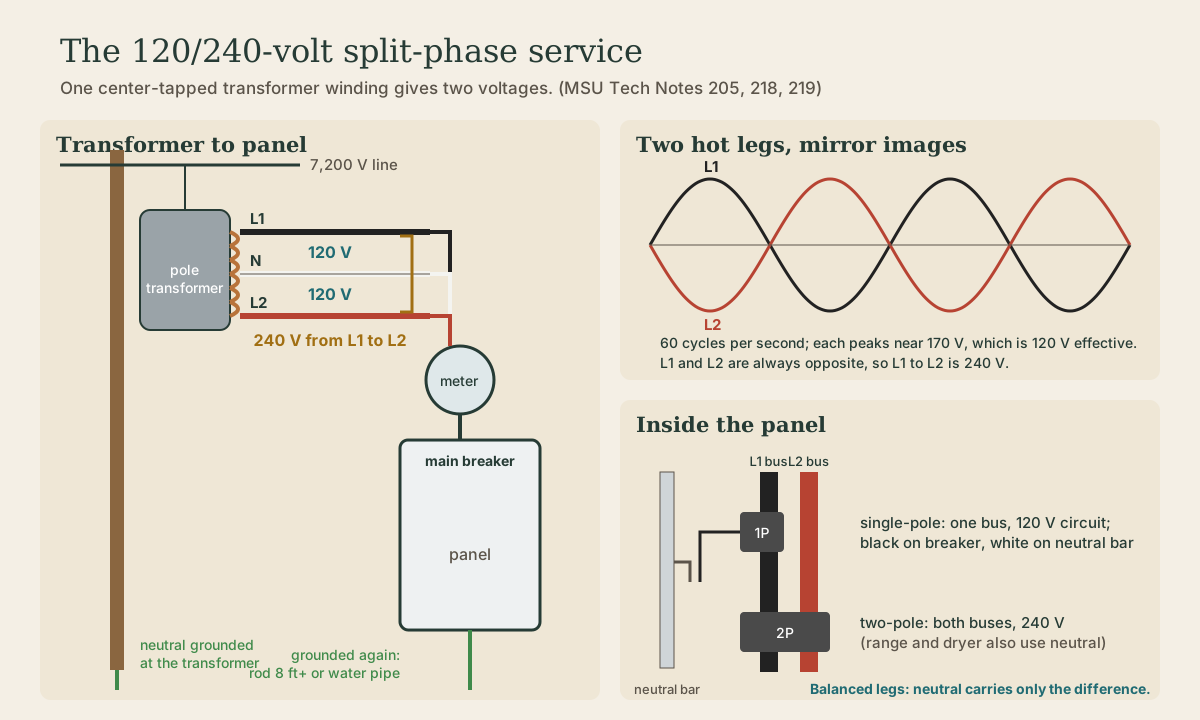
How power reaches a house: 60-hertz alternating current, stepped down from a 7,200-volt distribution line by a pole transformer whose secondary is tapped in the middle. The center tap is the grounded neutral; the two ends are the hot legs, 120 volts to neutral and 240 volts to each other. How that becomes two bus bars, single-pole and two-pole breakers, and a neutral that carries only the imbalance.
- 5 min
- 6 steps
- 3 questions
- Lesson 46 of 111
In this lesson
- Alternating current
- Down the line
- The center-tapped transformer
- The panel
- Balanced loads and the neutral
- What to take from this
Picking up where you left off.
Alternating current
Power plants make alternating current by spinning a magnetic field inside coils of wire. Each half turn, the voltage induced in the coils reverses, so over time it traces a smooth sine wave. US power runs at 60 hertz, 60 cycles per second; a two-pole generator does it by spinning at 3,600 rpm 1.
A sine wave is always changing, so which number is “the voltage”? The useful one is the effective or rms value, the one that does the same work as steady DC in Ohm’s law and power calculations. For a sine wave it’s the peak divided by 1.414. Household voltage peaks at about 170 volts, and 170 ÷ 1.414 = 120 volts 1.
Quick check
The effective value is what you use in Ohm’s law and power calculations.
Down the line
Power travels long distances at very high voltage, then substation transformers lower it to distribution voltage. A common single-phase distribution line in the country runs at 7,200 volts. A transformer on a pole in the yard, or a green box on a pad in town, lowers that to the 120 and 240 volts a house uses 2.
The center-tapped transformer
The trick that gives a house two voltages is in that transformer’s secondary winding. Its two ends make 240 volts. A third wire is attached to the exact middle of the winding, the center tap. From the center tap to either end is 120 volts 3.
So three wires come into the house 3 2:
- Two hot legs, called L1 and L2 (or leg A and leg B): the ungrounded conductors.
- The neutral: the center tap, grounded to the earth.
From either hot to neutral is 120 volts; from hot to hot is 240 volts. The two hot legs’ waves are mirror images, one rising while the other falls, which is why they’re 240 volts apart. Each hot is also about 120 volts to the earth itself 4.
The neutral is grounded for protection against lightning: codes require it bonded to earth at the transformer and again where the service enters the building, usually to a metal water pipe or a ground rod driven at least 8 feet 3.
Quick check
Each end is 120 volts from the center tap, and the two ends are always opposite, so they’re 240 volts apart.
The panel
At the house, the two hots go through the meter to the main breaker, the main service disconnect required by code, and the neutral goes to a neutral terminal bar 3.
Past the main, each hot leg energizes a bus bar, and breakers snap onto the buses:
- A single-pole breaker touches one bus. It feeds a 120-volt circuit: the black (hot) wire on the breaker, the white (neutral) wire on the neutral bar.
- A two-pole breaker touches both buses. Between its two terminals there’s 240 volts, for water heaters, wells, and baseboard heat, usually with no neutral needed. Electric ranges and dryers are exceptions: they use both hots and the neutral, because their timers, lights, and controls run on 120 3.
Every circuit also has a bare or green equipment grounding wire, which carries no current in normal use 3.
Balanced loads and the neutral
Because the two hot legs are opposite, 120-volt loads on opposite legs partly cancel on the shared neutral. If two identical 120-volt loads sit one on each leg, the neutral carries zero current; in general, it carries the difference between the two legs 3. Panels alternate legs from slot to slot so loads spread across both.
The flip side: two circuits sharing one neutral must be on opposite legs. Put both on the same leg and their currents add on the neutral instead of canceling, overloading a wire that has no breaker of its own.
Playback is optional. If the player is unavailable, open the video at its source.
Quick check
That’s why a shared neutral must be on opposite legs, never on the same leg.
What to take from this
House power is 60 Hz AC whose 170-volt peak is 120 volts effective. A pole or pad transformer drops the 7,200-volt line to a center-tapped winding: the grounded center is the neutral, the ends are the hot legs, giving 120 volts hot to neutral and 240 volts hot to hot. In the panel, each hot energizes a bus bar; single-pole breakers make 120-volt circuits and two-pole breakers make 240. The neutral carries only the imbalance between legs, so shared neutrals belong on opposite legs.
Lesson complete
Nice work.
Sources for this lesson
- 1Electrical Tech Note 205: Alternating Current. Michigan State University, Biosystems & Agricultural Engineering. verifiedAC is made by spinning a magnetic field inside coils; US power is 60 Hz (a two-pole generator at 3,600 rpm); voltage traces a sine wave; the effective (rms) value is the peak divided by 1.414, so a 170 V peak is 120 V rms.
- 2Electrical Tech Note 218: Transformers. Michigan State University, Biosystems & Agricultural Engineering. verifiedSubstation transformers lower transmission voltage to distribution levels; a common single-phase distribution line runs at 7,200 V; a transformer on a yard pole lowers that to 120 and 240 V; its secondary has three wires, the grounded center wire being the neutral.
- 3Electrical Tech Note 219: Single-Phase, 120/240 Volt, 3-Wire Electrical System. Michigan State University, Biosystems & Agricultural Engineering. verifiedA center-tapped transformer secondary gives 120 V from the center (neutral) to either end and 240 V end to end; codes require the neutral to be grounded, at the transformer and again at the service (water pipe or ground rod at least 8 ft); balanced 120 V loads leave the neutral carrying only the difference; the panel has two bus bars; single-pole breakers make 120 V circuits (black to breaker, white to neutral bar), two-pole breakers make 240 V circuits; ranges and dryers also use the neutral.
- 4Electrical Tech Note 330: Wiring Circuits, Basic Rules. Michigan State University, Biosystems & Agricultural Engineering. verifiedEach hot wire is about 120 V to earth and 240 V hot to hot; voltages above about 15 V can be dangerous; NM-B cable for dwellings is commonly 14 AWG for 15 A circuits (white jacket), 12 AWG for 20 A (yellow), and 10 AWG for 30 A (orange); NM cable is for dry locations only; keep the equipment grounding conductor continuous; one wire per device screw terminal.