Fishing New Cable Through Plaster Walls
The cleanest way to rewire an old house is often without opening the walls at all. In a balloon-framed house, the studs run in one piece from the sill to the roof, so each stud bay can be an open chute from the basement to the attic. How to find an empty bay, get a cable up from the basement or down from the attic, get past blocking, cut a box into fragile plaster and lath without wrecking it, and patch the holes.
- 4 min
- 6 steps
- 2 questions
- Lesson 66 of 111
In this lesson
- Why balloon frames help
- Plan the route
- Cutting into plaster
- Pulling the cable
- Try it
Picking up where you left off.
Rewiring an old house doesn’t have to mean gutting it. With patience, a few tools, and access from the basement and attic, you can run new cable to many outlets and switches through holes the size of the box you’re installing. The secret is understanding how your house is framed.
Why balloon frames help
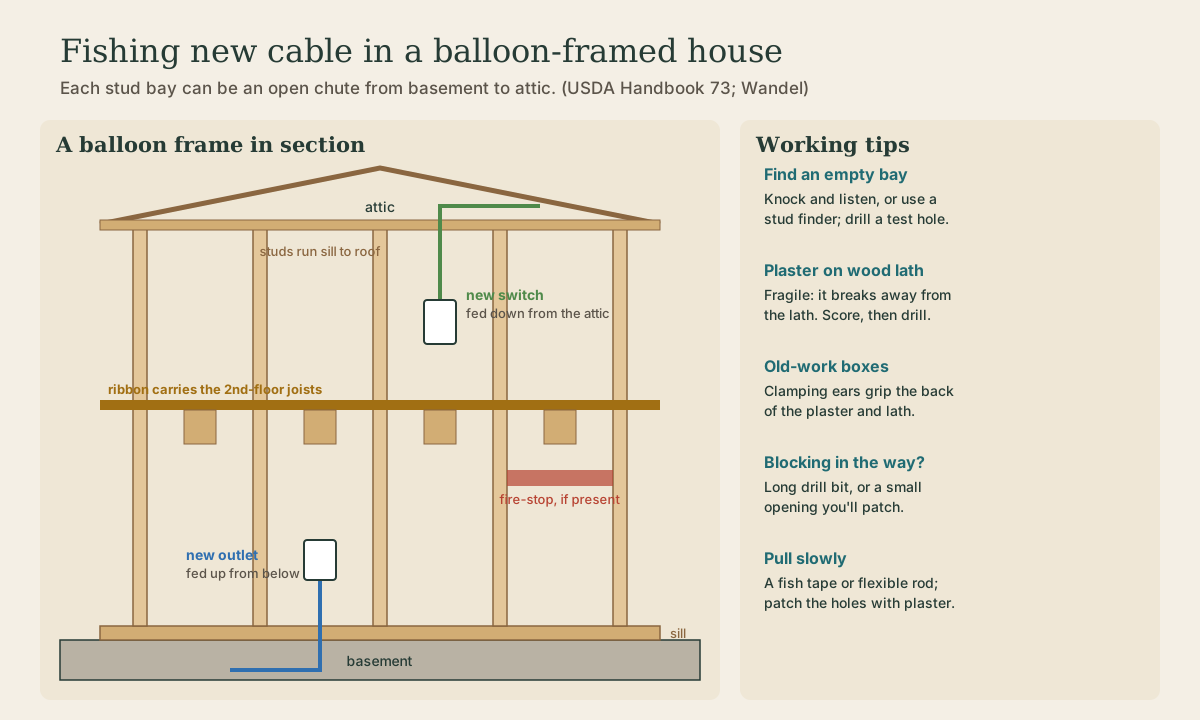
Many houses built around 1900 were balloon framed. In a balloon frame, the wall studs run in one piece from the sill on the foundation all the way up past the second floor, and the second-floor joists rest on a 1-by-4 ribbon let into the studs rather than on top of a first-floor wall 1. The result is that each space between studs, each stud bay, can be an open channel from the basement to the attic.
That’s a fire hazard, which is why building codes later required fire stops: 2-by-4 blocks nailed between the studs to close those passages 1. Your house may have them in some bays and not others, or at the second-floor line where the joists come in. When you’re fishing cable, a blocked bay means drilling through the block or opening the plaster to get past it.
(Platform-framed houses build each floor as a separate box with plates at every level, so fishing there means drilling through plates from above or below.)
Quick check
The second-floor joists hang on a ribbon let into the studs rather than sitting on a wall plate.
Plan the route
- Outlets on the first floor: come up from the basement. Find the bay from below, drill up through the sill or bottom plate, and push a fish tape or flexible rod up to the outlet hole.
- Switches and ceiling lights on the second floor: come down from the attic, drilling through the top plate.
- Across a room: run through the basement or attic, never diagonally through a finished wall.
Measure carefully from a fixed reference both inside and below (a window, a pipe, a corner) to match the hole in the basement to the bay you want. A small test hole behind where the box will go confirms it.
Cutting into plaster
Plaster is not drywall. On thick plaster, stud finders often fail; knocking along the wall and listening for the hollow sound works surprisingly well, and a small test hole that will be hidden by the box settles it 2. To cut the opening, trace the box, then drill a row of closely spaced holes around the outline and chip out between them rather than hammering or sawing hard 2.
Houses with wood lath, generally the older ones, need the most care: the plaster is fragile and tends to break away from the lath when you work on it. Matthias Wandel, who has rewired an older house himself, suggests that in wood-lath houses a box mounted near a joist or stud may be the better choice 2. Use old-work boxes, whose ears or clamps grip the back of the wall, or screw the box to a stud 2.
Quick check
Score the outline and drill closely spaced holes rather than hammering; use old-work boxes or mount to a stud.
Pulling the cable
- Use a steel fish tape or fiberglass fish rods, and pull slowly; cable insulation scrapes easily on rough lath and old nails.
- Leave plenty of extra length at each box.
- Keep standard practices: the right cable gauge for the breaker, one wire per terminal, and a continuous ground 3.
- Mark every cable at both ends before you pull.
When you’re done, fill the drilled test holes and chipped edges with plaster patch and paint 2. And for every abandoned old circuit, make sure it’s dead and disconnected at its source.
Playback is optional. If the player is unavailable, open the video at its source.
Try it
Pick one outlet you want to add on the first floor. From the room, measure its distance from the nearest corner or window. Go to the basement and find that spot under the floor. Is there a clear path into the wall bay above, or a sill, block, or duct in the way? Sketch your route before you buy any cable.
Lesson complete
Nice work.
Sources for this lesson
- 1L. O. Anderson, O. C. Heyer. Wood-Frame House Construction (Agriculture Handbook No. 73). USDA Forest Service, Forest Products Laboratory. 1955. verifiedPublic domain handbook. Platform construction: the subfloor extends to the outside edges and walls are framed flat on it, raised, plumbed, braced, then capped with a second top plate lapping at corners; balloon framing runs studs from sill to rafter plate. Studs commonly 2x4 at 16 inches on center; framing lumber at no more than 19 percent moisture. Wood basement posts at least 6x6 on a pedestal; girders carry the inner ends of joists; joists usually 2-inch nominal, 6 to 12 inches deep, 16 inches on center, crown up, doubled under bearing partitions, lapped at girders; openings framed with doubled headers and trimmers; cross-bridging at midspan, no more than 8 feet apart; subfloor of boards or plywood; headers of two 2-inch members on edge over openings; diagonal or K bracing at corners; rafters erected in pairs after ceiling joists are fastened.
- 2Matthias Wandel. Pulling wires through walls. woodgears.ca. verifiedAdding a ceiling light and switch to an older bungalow with accessible basement and attic. Plaster is hard to work: stud finders are often useless on thick plaster; find hollow spots by knocking; outline the box and drill closely spaced holes, then chip out; screw the box to a stud where possible or use a rework (old-work) box with clamping ears. With wood lath (1920s or earlier) the plaster is fragile and tends to detach from the lath, so a surface box near a joist may be better. Patch drilling misses with plaster of Paris and paint.
- 3Electrical Tech Note 330: Wiring Circuits, Basic Rules. Michigan State University, Biosystems & Agricultural Engineering. verifiedEach hot wire is about 120 V to earth and 240 V hot to hot; voltages above about 15 V can be dangerous; NM-B cable for dwellings is commonly 14 AWG for 15 A circuits (white jacket), 12 AWG for 20 A (yellow), and 10 AWG for 30 A (orange); NM cable is for dry locations only; keep the equipment grounding conductor continuous; one wire per device screw terminal.