Private Wells and Pressure Tanks
How a rural water system works: a drilled, grouted, cased well with the casing at least 12 inches above grade and a vermin-proof cap; a pitless adapter below frost; a submersible pump; and a pressure tank and switch in the basement, precharged 2 psi below cut-in. Wisconsin's NR 812 separation distances from septic tanks, drainfields, barns, and fuel tanks, and why short-cycling kills pumps.
- 4 min
- 5 steps
- 3 questions
- Lesson 40 of 111
In this lesson
- The well
- The pressure tank and switch
- Keep it away from contamination
- Old wells
- What to take from this
Picking up where you left off.
The well
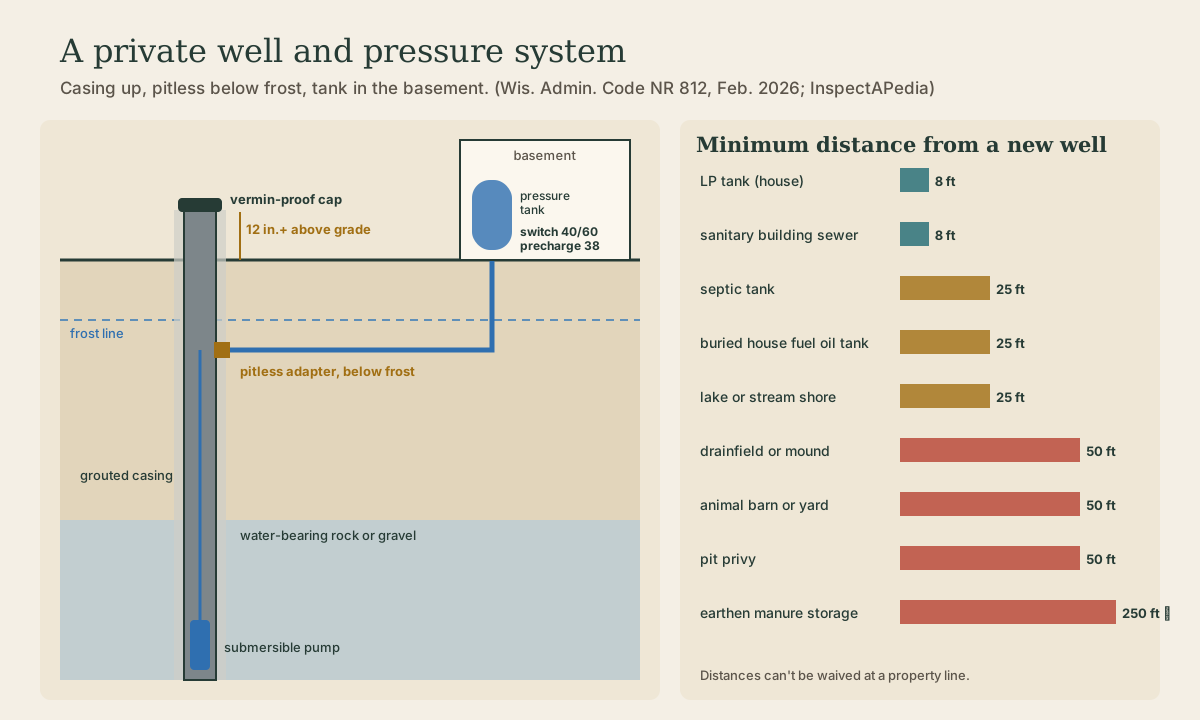
Most rural Wisconsin homes draw water from a drilled well: a borehole, lined with steel casing grouted into place so surface water can’t run down the outside, reaching into water-bearing sand, gravel, or rock. Wisconsin’s well code, NR 812, sets how it’s built 1:
- The casing ends at least 12 inches above the ground surface, building floor, or surrounding concrete.
- It’s topped with a vermin-proof cap, so insects and mice can’t get in.
- A well may not end in a basement or crawl space, or under the floor of a house without a basement.
- Wells in traffic areas are protected with posts or a driveway ramp.
The water leaves the casing underground through a pitless adapter, a fitting on the side of the casing below the frost line, so the line to the house never freezes 1. Down in the water hangs a submersible pump.
Quick check
Wells may not terminate in basements or crawl spaces; a vermin-proof cap tops the casing.
The pressure tank and switch
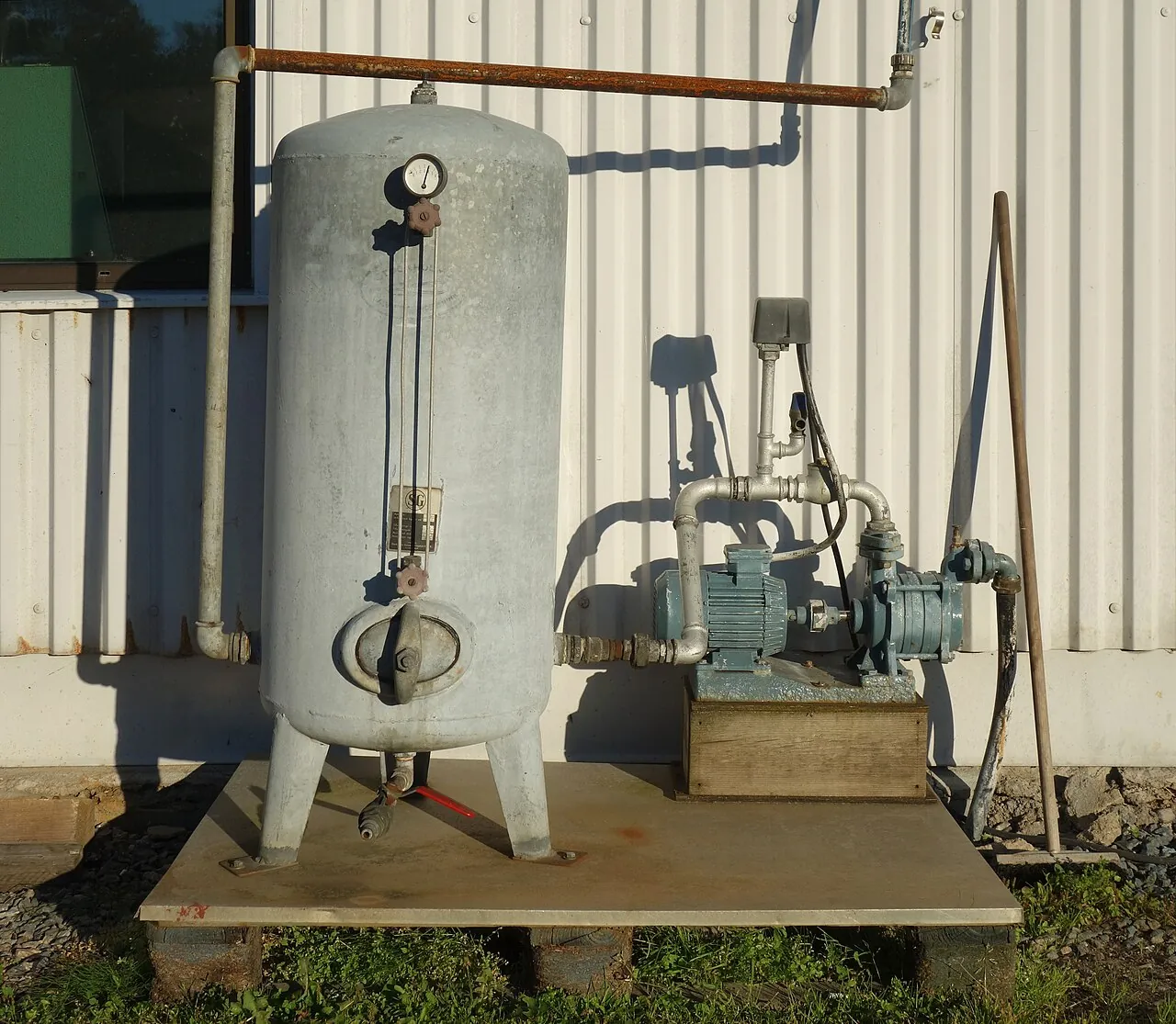
The pump doesn’t run every time you open a tap. It fills a pressure tank in the basement, which stores water against a cushion of compressed air. A pressure switch starts the pump when pressure falls to its cut-in setting and stops it at cut-out: a common setting is 40/60 psi 2.

The tank’s air side has to be charged correctly: about 2 psi below the cut-in pressure, so 38 psi for a 40/60 switch, checked with the pump off and the tank drained 2. If the air charge is low, or the bladder fails and the tank becomes waterlogged, the pump short-cycles, starting and stopping every few seconds; each start heats the motor, and pumps that short-cycle die young 2.
Wisconsin’s plumbing code requires house fixtures to get adequate flow pressure (8 psi minimum at most outlets, 20 at pressure-balancing shower valves), and a well system’s cut-in pressure sets your floor 3.
Quick check
Set the precharge 2 psi below cut-in with the pump off and the tank drained; replace a waterlogged tank.
Keep it away from contamination
Groundwater moves, and anything leaking near a well can reach it. NR 812’s Table A lists minimum distances between a new well and possible contamination sources, and they can’t be waived at a property line 1:
| Source | Minimum distance |
|---|---|
| LP tank serving the house; sanitary building sewer; cistern | 8 ft |
| Septic tank or other treatment tank; holding tank; vault privy | 25 ft |
| House fuel oil tank under 1,500 gallons | 25 ft |
| Lake or stream shoreline | 25 ft |
| Drainfield or mound (household) | 50 ft |
| Animal barn, shelter, or yard; pit privy | 50 ft |
| Fabricated liquid-tight manure storage | 100 ft |
| Earthen manure storage | 250 ft |
| Landfill | 1,200 ft |
On a homestead, those distances shape the whole site plan: the barn, the septic field, and the fuel tank all get placed around the well.
Quick check
Barns, animal yards, and pit privies need 50 feet; earthen manure storage 250.
Old wells
An unused well is a direct pipe into the aquifer. Wisconsin requires unused wells to be properly filled and sealed (the term that replaced “abandoned”) so they can’t carry contamination down 1. If you buy an old farm, find the old dug wells and hand pumps too.
Playback is optional. If the player is unavailable, open the video at its source.
What to take from this
A drilled well is a grouted steel casing ending at least 12 inches above grade with a vermin-proof cap, never in a basement, with a pitless adapter below frost and a submersible pump below. The basement pressure tank stores water on an air cushion; set its precharge 2 psi below the switch’s cut-in (38 for a 40/60 switch) or the pump will short-cycle. Keep new wells 25 feet from septic tanks, 50 from drainfields, barns, and pit privies, and 250 from earthen manure storage, and fill and seal unused wells.
Lesson complete
Nice work.
Sources for this lesson
- 1Wis. Admin. Code ch. NR 812, Well Construction and Pump Installation. Wisconsin Legislature. 2026. verifiedRegister February 2026. Table A minimum separation distances from new wells (not waivable at property lines): LP tank serving a house 8 ft, sanitary building sewer 8 ft, cistern 8 ft, septic tank or other POWTS treatment component 25 ft, holding tank 25 ft, vault privy 25 ft, residential fuel oil tank under 1,500 gal 25 ft, lake or stream shore 25 ft, POWTS dispersal component (drainfield or mound) 50 ft, pit privy 50 ft, animal barn, shelter, or yard 50 ft, fabricated manure storage 100 ft, earthen manure storage 250 ft, landfill 1,200 ft; well casing must terminate at least 12 inches above grade or floor; wells may not terminate in basements or crawl spaces; vermin-proof caps; pitless adapters below frost; drillers must return and correct a new well that tests positive for coliform bacteria; 'filling and sealing' unused wells.
- 2Water Tank Air Charge Questions and Answers. InspectAPedia. verifiedA captive-air pressure tank's air precharge is set about 2 psi below the pressure switch's cut-in pressure (38 psi for a 40/60 switch), measured with the pump off and the tank drained; a wrong precharge causes the pump to short-cycle, which overheats and wears out pump motors.
- 3Wis. Admin. Code ch. SPS 382, Design, Construction, Installation, Supervision, Maintenance and Inspection of Plumbing. Wisconsin Legislature. 2026. verifiedRegister August 2026. SPS 382.10: plumbing protects health and the waters of the state; fixtures need adequate water volume and pressure; drains must carry waste efficiently with cleanouts and enough air circulation that trap seals are never siphoned, aspirated, or forced; every dwelling on a sewer or POWTS needs at least one water closet, wash basin, kitchen sink, and tub or shower. SPS 382.30: horizontal branch drains 2 inches or less slope at least 1/4 inch per foot, larger ones 1/8 inch per foot; drainage fixture units, e.g. residential water closet 4, bathroom group 6, residential kitchen sink 2, lavatory 1, residential shower 2, residential clothes washer 4. SPS 382.31: each gravity building sewer served by at least one 3-inch stack to a vent terminal; vent terminals at least 2 inches for frost; trap-to-vent maximum developed lengths (1/4 inch per foot, sanitary tee: 1-1/4 in. 5 ft, 1-1/2 in. 6 ft, 2 in. 8 ft, 3 in. 12 ft, 4 in. 16 ft); vents not within two diameters of the weir; air admittance valves allowed with limits. SPS 382.32: trap seals 2 to 4 inches; trap primers for evaporation; prohibited traps include bell, drum, non-integral S-traps, partition, and moving-part traps. SPS 382.40: minimum flow pressure 8 psig at fixtures, 15 for washdown and siphonic water closets, 20 for one-piece tank toilets and pressure-balance or thermostatic mixing valves, 25 for blowout fixtures; over 80 psig requires a pressure reducing valve and strainer downstream of the meter and upstream of fixtures; sizing accounts for fixture load, minimum supply pressure, elevation, device losses, minimum fixture pressure, and friction.