Scribe Rule
The oldest layout system - lay each timber over its mate, plumb and level them, and transfer the actual shapes with a plumb bob and dividers - so every joint fits its one partner and carries a marriage mark.
- 4 min
- 6 steps
- 3 questions
- Lesson 101 of 111
In this lesson
- Fitting real timbers to each other
- How it works
- Marriage marks
- Strengths and weaknesses
- Scribing today
- What to take from this
Picking up where you left off.
Fitting real timbers to each other
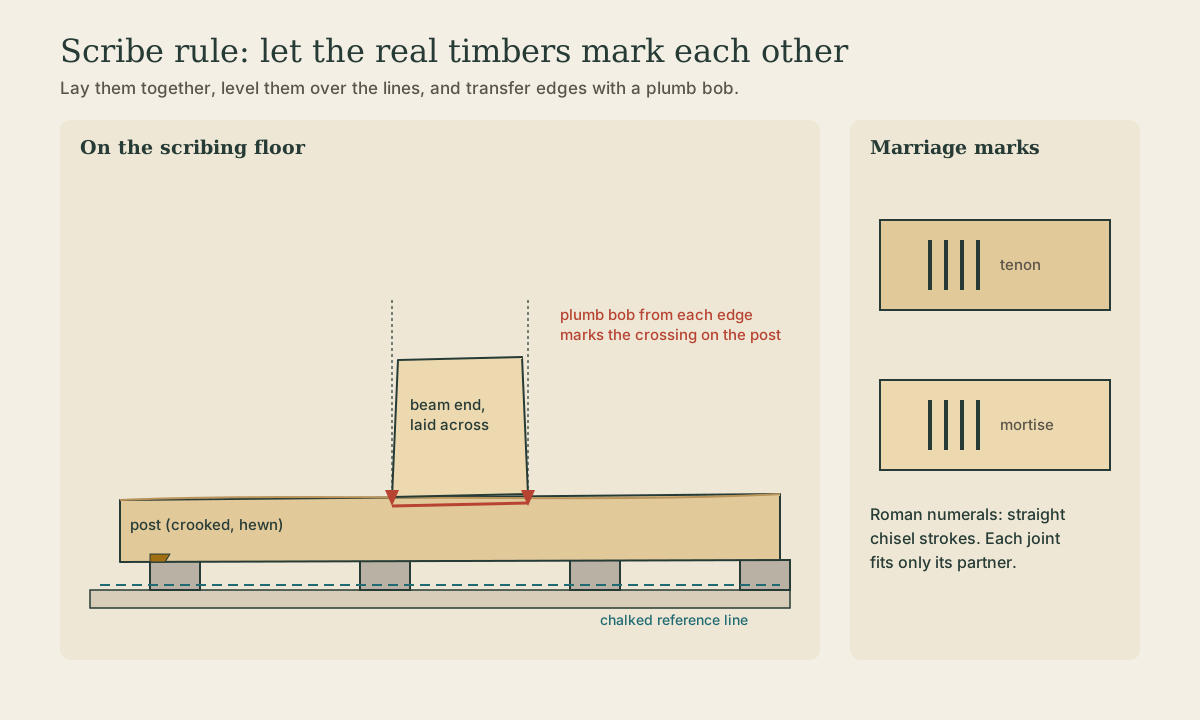
Hewn and hand-sawn timbers are never straight, square, or uniform. The oldest way to make joints fit them anyway is scribe rule: rather than measuring from an ideal, you lay the actual timbers together in their relative positions and transfer one timber’s real shape onto the other 1.
Scribe rule was the norm in Europe and in early American framing through the 1700s and into the 1800s. It produces beautiful fits on irregular wood, and it’s still used for frames of hewn or natural-shaped timbers and in log building, where every log is unique.
How it works
The general method for a bent:
- Build a scribing floor: a level, flat platform of blocks, where a whole wall or bent can be laid out flat.
- Lay out the frame full size on the floor, often with a chalked grid or snapped lines marking the building’s reference planes.
- Place the timbers in position over the lines, one on top of the other where they cross. Posts lie under, beams across them at the joint.
- Level and align each timber on blocks and wedges so its reference faces sit exactly over the layout lines, correcting for crowns and twist.
- Transfer shapes: drop a plumb bob (or use a level and a pair of dividers or a scribe) from the edges of the upper timber down onto the lower one to mark where it crosses, and from the lower timber up onto the upper. The marks capture the actual size and irregularities of each piece.
- Cut the joints, then reassemble on the floor to check the fit and adjust.
Because the shoulders and housings are scribed to the actual neighboring surface, the joint fits even where faces are wavy or out of square.
Quick check
In scribe rule, timbers are laid out together and each joint is scribed to its actual partner, so pieces aren’t interchangeable.
Marriage marks
The catch is that each joint fits only its partner. To keep track, framers chiseled or scribed matching marriage marks on each mortise and tenon, most often Roman numerals, which are easy to cut with straight chisel strokes, sometimes with extra flags or tags to distinguish walls 1. Finding these marks in an old barn tells you it was scribed.
Strengths and weaknesses
Strengths: - Fits irregular, hewn, or crooked timbers precisely. - Needs no assumption that timbers are true; works with natural forms and curved braces. - Visually tight joints in historic and natural-timber work.
Weaknesses: - Slow: every joint involves positioning, leveling, and plumbing heavy timbers. - Requires a large, level scribing floor and lots of handling. - Pieces are not interchangeable; a mistake means re-scribing. - Hard to prefabricate large frames efficiently, which is why square rule replaced it in 19th-century America.
Quick check
That’s why square rule replaced it in 19th-century America.
Scribing today
Modern scribe-rule work uses lasers, chalk lines, levels, and dividers, but the principle is unchanged. It’s the natural choice when you’re building with hewn timbers, round or half-round logs, or natural crooks and knees, and the basis of Scandinavian log building, where each log is scribed to the one below it.
What to take from this
Scribe rule lays real timbers together on a level floor, aligns them to the building’s reference lines, and transfers each timber’s actual shape onto its partner with plumb bobs and dividers. Joints fit perfectly but only their partners, so framers mark them with Roman numeral marriage marks. It suits irregular timbers and natural forms but is slow, which led to square rule.
Practice
Because every joint fits only its partner, framers chiseled matching marriage marks, often Roman numerals, so the frame could be reassembled correctly.
Lesson complete
Nice work.
Sources for this lesson
- 1Jack A. Sobon, Roger Schroeder. Timber Frame Construction: All About Post-and-Beam Building. Storey Publishing. 2012. verifiedClassic reference (first published 1984) on timber selection, tools, joinery, frame types, assembly, and raising. Cited at: Layout.
Further reading
- Will Beemer. Learn to Timber Frame: Craftsmanship, Simplicity, Timeless Beauty. Storey Publishing. 2016. verifiedHeartwood School's step-by-step guide from timber sourcing to a finished 12×16 frame, including layout, joinery, and raising.